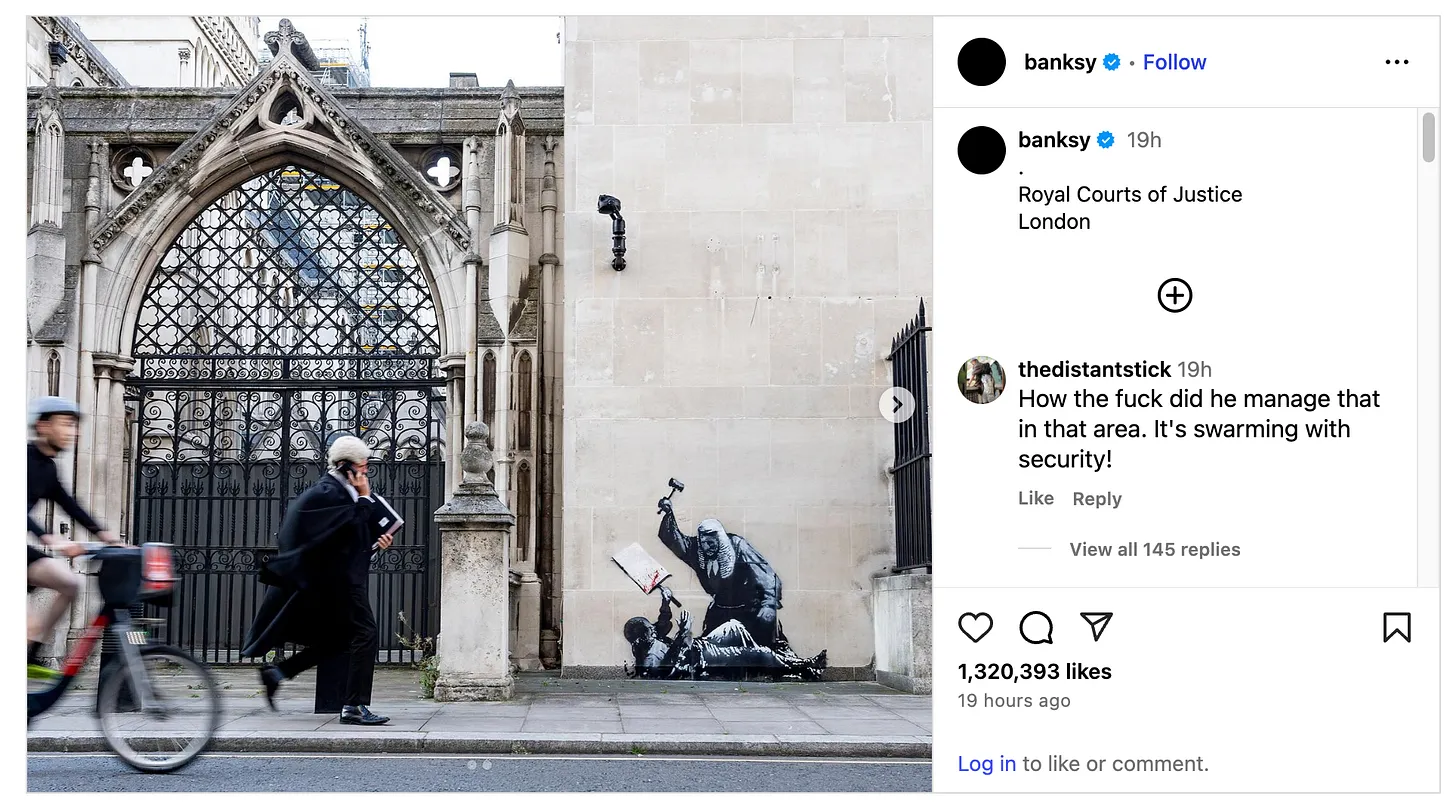
What Banksy’s RCJ mural maybe gets wrong

9th September 2025

Judges are not to blame for the protest laws promoted by the executive and passed by parliament and implemented by the police and prosecuted by the Crown

The Royal Courts of Justice on Strand is a superficially impressive building.

It projects the might and grandeur of the legal system.

*

This elegance continues inside with a bracing great hall with law and justice-related art and statues, and in a gallery above glass cabinets exhibiting judicial costumes.

(Pics above from Wikipedia.)

*

And adjacent to that great hall are several quaint period courtrooms – very pretty but also very uncomfortable and inefficient.

Like a great deal of the British constitution, the RCJ is a Victorian construct made to look and feel a lot older.

And it is quite dreadful building for its practical purpose.

Yet it is there – and perhaps more than the Old Bailey round the corner and certainly more than the Supreme Court on Parliament Square, it is a physical and aesthetic embodiment of our domestic law.

The RCJ is not only where justice is supposed to be done, but it also where justice is seen to be done.

The RCJ is primarily about optics, not functionality.

*

Yesterday another work of art about justice was added to the RCJ, supplementing the various sculptures and paintings inside.

This was, of course, this mural by Banksy:

Aesthetically it is no worse than the depictions of judges and justice inside the RCJ.

But it was unauthorised and so, from a legal perspective, prima facie criminal damage.

And, as Joshua Rozenberg has spotted, the supposed barrister in the Banksy Instagram picture must be a model, given a mistake in their dress.

Furthermore, as 1001 respondents on social media pointed out in merry unison, the judge is using a gavel, and judges in our jurisdiction do not use gavels.

*

Indeed, much of the response to the new art had little or nothing to do with what it depicted.

As such, it maybe failed in its presumed purpose – of getting people to discuss the law of protest and protesting.

And even the depiction was perhaps wrong: judges are not to blame for the laws promoted by the executive and passed by parliament and implemented by the police and prosecuted by the Crown.

Indeed it is often the courts that are the last protection for protesters.

*

One amusing aspect of the incident is that the RCJ – to match its visual rhetoric – provides one of the most elaborate security theatres of any public building.

Security is not only done, but – oh dear gods – it is seen to be done.

And yet yards away from where the zealous performances of security take place, an artist was able to commit what the law would probably regard as criminal damage without interruption.

It was only when it came to public notice that anything was done about it.

The Guardian:

The BBC:

One news report stated that yesterday morning, “guards were trying to stop people from taking pictures. More staff then arrived with supplies to cover it up”.

*

Another amusing aspect to this is that the RCJ itself is where an intellectual property judge once wrestled with questions about the law relating to Banksy murals:

One wonders where any civil dispute or criminal appeal about this week’s mural would be heard, given a possible conflict of interest.

*

Criminal damage is wrong, and as this appears to be criminal damage then this makes this wrong.

Those embarrassed by the failure of the usual RCJ security theatre will no doubt press for an investigation and prosecution.

If there is a prosecution and a conviction then there will be no doubt that this was criminal damage.

But if there is a prosecution there may also be a defence, and an acquittal.

If so, the artist would be saved by the very court process they are depicting in the mural.

Which would be ironic, don’t you think.

***

Comments Policy

This blog enjoys a high standard of comments, many of which are better and more interesting than the posts.

Comments are welcome, but they are pre-moderated and comments will not be published if irksome, or if they risk derailing the discussion.

More on the comments policy is here.

What to know about court orders, injunctions, and super-injunctions

21st July 2025

A general introduction to the coercive powers of the court to order things, and what can be done with those powers

Imagine the polity of the United Kingdom as so many machines.

There is the machine of the Crown, and – from a legal perspective – what comes out are various legal instruments enforceable and/or recognised at law: proclamations, decrees, royal charters, royal warrants, privy council regulations, and so on.

Each instrument following a certain form and even ceremony, with certain ‘abracadabra’ magical wording, and the document exists at law.

And because that document is capable of making things happen, it is called an instrument.

*

There is then the machine of Parliament, and – again from a legal perspective, what comes out are Acts of Parliament.

In a technical way these are a subset of documents from the Crown machine, as an Act of Parliament is not enforceable and/or recognised at law unless it has Royal Assent. It is in this way just another legal instrument signed by the Crown.

But Acts of Parliament can have general, even universal effect, and so are in a category of their own.

Note that other things done by Parliament – such as passing motions and resolutions – do not normally have effect outside of the Palace of Westminster (if at all).

And so when one talks of the sovereignty (or more correctly the supremacy) of Parliament, one usually means the sovereignty (or supremacy) of Parliamentary legislation.

*

And then there is the judiciary machine.

To an onlooker (and indeed many lawyers) the outputs of the judiciary machine are the judgments and sentencing remarks. And indeed the reports of judgments and remarks are central to understanding laws and legal systems around the world.

But.

The main outputs of the judiciary machine are not judgments or sentencing remarks: they are at one or two steps removed.

The main outputs of the judiciary machine are Orders.

(There are other judicial outputs such as writs and summons and warrants.)

It is the Orders that have legal effect, that are enforceable and/or recognised at law.

Judgments and sentencing remarks are all very interesting and informative, but it is the Order that is the thing.

A judgment should explain why the court made one Order instead of another, why a case was disposed of in one way rather than another.

As such, judgments can be integral to understand what has gone with a case, but it is still the resultant Order that is the thing.

Orders are thereby for courts, what Acts are for Parliament, and charters and so on are for the Crown.

They are the things which come out of the judiciary machine, at least from a legal perspective.

*

Orders can take many forms, but the form of Order which comes up most often in the news is the injunction.

An injunction is – very generally – a court Order which tells a person to do a thing or not do a thing, on pain of it being punishable as a contempt of court.

The classic historical-legal theory is that an injunction is there so as to ensure a person acts in accordance with their conscience: to do or not do a thing they ought or ought not to do.

Injunctions usually are either ‘final’ or ‘interim’/’temporary’. The latter are often used by courts to ‘hold the ring’ until a legal matter can be finally disposed of by the court: to keep things in a virtual legal state of suspended animation for the time being.

The normal position is that an injunction can be imposed on a party to litigation.

Here [A] is suing [B] for say breach of contract or an intellectual property infringement, and [A] wants to stop [B] for causing any further damage until the trial.

(Sometimes it may turn out that [B] has been injuncted when [A]’s case does not succeed at trial, and in those situations [A] must make good the damage and costs caused to [B] complying with the injunction. As such injunctions can be double-edged legal weapons. In legal practice, injunctions are the sort of things you ‘don’t try at home’ and should be left to the professionals. Injunctions can cut in unexpected and painful ways.)

Sometimes a party will want a permanent, final injunction – but generally (at least in England) injunctions are a means to an end and the final remedy at court will usually be damages.

A party breaching the injunction faces punishment (and there is a legal debate whether such punishments are criminal as such) which can include imprisonment.

A person guilty of contempt will then be expected – to use a quite lovely legal word – to ‘purge’ their contempt.

*

Injunctions, however, may not only be against a party to legal case.

They can also be granted against third parties.

In England such injunctions are not at all unusual – and the courts have developed all sorts of freezing orders and search orders where third parties caught up in a situation can be obliged to comply with court orders.

Sometimes such injunctions can be made against persons unknown (for example trespassers) or even ‘contra mundum’ (against the world).

Obviously there is practical difficulty in showing a person is aware of such an order, and the normal position is that a person is not bound by an Order unless they have (or should be expected to have) notice of the Order.

That is why injunction notices are tied to fences or emailed to legal departments of newspapers, and so on.

The injunction in the recent Afghan case was applied by the government to be ‘contra mundum’ order:

As a subsequent judgment in the same case described:

If a person has notice of a contra mundum notice then they are as bound by it as any party to the litigation.

An affected third party can have protections built in to the Order – and can also apply to the court to have the Order amended or discharged. But in practical terms the third party has little choice but to comply.

*

There is a further way to super-charge an injunction, by giving it is a special super power (though this is rare for contra mundum injunctions).

A court can turn an injunction into…

…a super-injunction.

In a super-injunction it is a term of the Order that the existence of the Order itself cannot be disclosed.

In the recent Afghan data breach case, there was a super-injunction. A judge in the case described it as follows:

Originally the super-injunction in that case was not published with the raft of documents released last week.

But following a request from this blog, the Order was published.

The “super” element of the Order is at paragraphs 4(b) and (c):

A non “super” version would have 4(a) and no mention of 4(b) in the final sub-paragraph.

If you go to front page of that Order you will see the penal notice, to warn those of the dire consequences of any breach:

Such an Order is thereby not to be taken lightly, and they are not taken lightly by any responsible person.

Super-injunctions were briefly common about 2010 as a means of protecting the claimant when they were suing for the then new tort of misuse of private information, but media and political controversy meant that the courts moved away from granting them.

*

The Afghan data breach case injunction was both a contra mundum injunction *and* a super-injunction.

As such it was an exotic legal creature, the sort which are sometimes speculated about, but rarely spotted in reality.

But even if they are exceptional the components are straightforward:

(1) it was an interim injunction that

(2) was addressed to anyone who had notice of it which

(3) had as one of its terms that the injunction should not be revealed beyond those who had notice of it.

Such injunctions can exist – and some would say that they have their place in exceptional situations.

But one question is whether it was appropriately granted in this situation – and, if so, whether its terms should have been discharged or varied sooner.

And another question is whether in this situation such an injunction stymied legitimate public knowledge and political/media scrutiny of the government by parliament.

For sometimes even the judiciary machine fails to function properly.

**

Comments Policy

This blog enjoys a high standard of comments, many of which are better and more interesting than the posts.

Comments are welcome, but they are pre-moderated and comments will not be published if irksome, or if they risk derailing the discussion.

More on the comments policy is here.

Afghan super-injunction now published

17th July 2025

Court order now in public domain following request from this blog

Yesterday this blog set out that the key super-injunction court Order had not actually been published among the raft of legal materials published a couple of days ago.

It was averred that this was an odd omission.

Following my request to the UK judiciary office, the court Order (with redactions) has now been published.


**

Comments Policy

This blog enjoys a high standard of comments, many of which are better and more interesting than the posts.

Comments are welcome, but they are pre-moderated and comments will not be published if irksome, or if they risk derailing the discussion.

More on the comments policy is here.

Why have the terms of the now-discharged Afghan super-injunction not been published?

17th July 2025

There can be no good reason now for the substantial terms of the court order to be hidden (subject to redactions)

Now, here is a puzzle.

A couple of days ago, a raft of materials was published by the United Kingdom judiciary office in respect of what we can now call the Afghan super-injunction.

(A super-injunction is when the court order forbids even any public disclosure that the injunction exists.)

These materials were published on the judiciary.uk website – and one can tell care and attention was put into their publication.

There is even a prepared, four-page press summary.

But there is something which is not there, which perhaps should be there.

What is missing is the actual super-injunction court order itself.

There is a court order – the one which finally discharged the super-injunction – but not the super-injunction itself.

In the circumstances, this is a striking omission.

Indeed, it is so striking an omission given the other materials published, that the decision not to publish its terms (subject to any necessary redactions) must have been a deliberate decision by somebody.

*

There is a strong public interest in the actual terms of any super-injunction being published after it is discharged.

This is because the terms of such orders are so onerous – and the impact on other rights and freedoms so drastic – that once it is no longer in force then the public should be able to see the terms of such an order.

But in this case, there is an even stronger public interest.

It would appear that it was felt that the existence of this order meant parliamentarians could not even be told of the hidden data breach and subsequent policy-making and implementation.

It is also apparent that the original judge went further than even the government wanted in making this order a “super” injunction.

*

The judiciary press office has now been asked for a copy of the original order.

This request is being considered – and the request has not been rejected outright.

Of course, there may be details which should be redacted – but this was also the case with the published documents. Such redactions caused no practical problem.

But there cannot be any good reason why the substantial terms cannot be published, subject to redactions.

If the courts grant such super-injunctions – especially when the government (or other applicant) does not even ask for the injunction to be made a super-injunction – then it must be beholden on the courts to publish the substance of such orders once they are no longer in force.

**

UPDATE

The original ‘super-injunction’ court order has now been published by a media organisation, though it has not been published by the judiciary office. In these circumstances, I will await the judiciary office decision before linking to it.

**

Comments Policy

This blog enjoys a high standard of comments, many of which are better and more interesting than the posts.

Comments are welcome, but they are pre-moderated and comments will not be published if irksome, or if they risk derailing the discussion.

More on the comments policy is here.

A super-injunction has been revealed

16th July 2025

A curious sequence of court judgments have just been published

Yesterday a raft of court judgments and other legal materials were published in respect of an extra-ordinary super-injunction.

And this was not just a super-injunction, it was also one against the world – contra-mundum.

This is heady stuff.

You can read the materials here.

I do not offer any quick hot-take as these things should be read properly, but at first glance they are fascinating.

More to come soon.

The Sotomayor dissent that is for the ages

2nd July 2025

A re-statement of the rule of law in Trump v Casa – the universal injunctions case

Some dissents are for the ages. In the United Kingdom, one such momentous dissent from a judge in the minority was that of Lord Atkin in the wartime case of Liversidge v Anderson.

*


In the recent – and horrible – case of Trump vs Casa there is another such dissent, this time from Justice Sotomayor.

This blog has already introduced the case (here) and set out why the majority opinion is shoddy even on its own terms (here).

Instead of summarising and paraphrasing her dissent, there are passages which need to be read in the original. Some people are deterred from reading formal(-looking) documents like judgments, and so in this post I am setting out what she said. Please read what is set out below (which I have broken up into smaller paragraphs).

“Children born in the United States and subject to its laws are United States citizens. That has been the legal rule since the founding, and it was the English rule well before then.

“This Court once attempted to repudiate it, holding in Dred Scott v. Sandford, 19 How. 393 (1857), that the children of enslaved black Americans were not citizens.

“To remedy that grievous error, Congress passed in 1866 and the States ratified in 1868 the Fourteenth Amendment’s Citizenship Clause, which enshrined birthright citizenship in the Constitution.

“There it has remained, accepted and respected by Congress, by the Executive, and by this Court.

“Until today.

“It is now the President who attempts, in an Executive Order (Order or Citizenship Order), to repudiate birthright citizenship.

“Every court to evaluate the Order has deemed it patently unconstitutional and, for that reason, has enjoined the Federal Government from enforcing it.

Undeterred, the Government now asks this Court to grant emergency relief, insisting it will suffer irreparable harm unless it can deprive at least some children born in the United States of citizenship. […]

“The Government does not ask for complete stays of the injunctions, as it ordinarily does before this Court.

“Why?

The answer is obvious: To get such relief, the Government would have to show that the Order is likely constitutional, an impossible task in light of the Constitution’s text, history, this Court’s precedents, federal law, and Executive Branch practice.

“So the Government instead tries its hand at a different game. It asks this Court to hold that, no matter how illegal a law or policy, courts can never simply tell the Executive to stop enforcing it against anyone.

“Instead, the Government says, it should be able to apply the Citizenship Order (whose legality it does not defend) to everyone except the plaintiffs who filed this lawsuit.

“The gamesmanship in this request is apparent and the Government makes no attempt to hide it.

“Yet, shamefully, this Court plays along. A majority of this Court decides that these applications, of all cases, provide the appropriate occasion to resolve the question of universal injunctions and end the centuries-old practice once and for all. In its rush to do so the Court disregards basic principles of equity as well as the long history of injunctive relief granted to nonparties.

“No right is safe in the new legal regime the Court creates. Today, the threat is to birthright citizenship. Tomorrow, a different administration may try to seize firearms from lawabiding citizens or prevent people of certain faiths from gathering to worship.

“The majority holds that, absent cumbersome class-action litigation, courts cannot completely enjoin even such plainly unlawful policies unless doing so is necessary to afford the formal parties complete relief. That holding renders constitutional guarantees meaningful in name only for any individuals who are not parties to a lawsuit.

“Because I will not be complicit in so grave an attack on our system of law, I dissent.

[…]

“The rule of law is not a given in this Nation, nor any other. It is a precept of our democracy that will endure only if those brave enough in every branch fight for its survival.

Today, the Court abdicates its vital role in that effort. With the stroke of a pen, the President has made a “solemn mockery” of our Constitution. Peters, 5 Cranch, at 136.

“Rather than stand firm, the Court gives way.

“Because such complicity should know no place in our system of law, I dissent.”

*

Justice Jackson concurs (again broken into shorter paragraphs, and emphasis added):

“I agree with every word of Justice Sotomayor’s s dissent. I write separately to emphasize a key conceptual point: The Court’s decision to permit the Executive to violate the Constitution with respect to anyone who has not yet sued is an existential threat to the rule of law.

“It is important to recognize that the Executive’s bid to vanquish so-called “universal injunctions” is, at bottom, a request for this Court’s permission to engage in unlawful behavior.

“When the Government says “do not allow the lower courts to enjoin executive action universally as a remedy for unconstitutional conduct,” what it is actually saying is that the Executive wants to continue doing something that a court has determined violates the Constitution— please allow this. That is some solicitation.

“With its ruling today, the majority largely grants the Government’s wish.

**

Like Atkin’s famous war-time speech, these dissents should endure.

These dissents have got the fundamental issue right, and they have said the right things about that fundamental issue.

What is currently happening in the United States is nothing other than a polity voluntarily sabotaging itself.

Congress and the courts could stop it. Yes, there is Trump – but there are always Trumps. But instead of checking and balancing Trump, Congress and the courts are nodding and clapping instead.

*

The next post in this series will be an overall assessment of this unfortunate case.

**

Comments Policy

This blog enjoys a high standard of comments, many of which are better and more interesting than the posts.

Comments are welcome, but they are pre-moderated and comments will not be published if irksome, or if they risk derailing the discussion.

More on the comments policy is here.

The US Supreme Court judgment on injunctions – what Justice Barrett said

1st July 2025

On a curiously unconvincing exercise in judicial reasoning

*

This week this blog is looking at the United States Supreme Court case of Trump vs Casa. You can read the judgment here.

This is the judgment where the court held by a majority that federal courts could not grant “universal” injunctions against the federal government, but instead could only grant injunctions as between the parties to that particular law suit.

The main reason for this case warranting a good hard look is that, on the face of it, the judgment is highly significant.

As this blog averred yesterday, it seems that while onlookers were (mis-)directed into worrying about what would happen if the Trump administration ignored court orders, the conservative majority on the US Supreme Court, with more subtlety and artistry, has now robbed federal judges from making many of the most unwelcome court orders in first place.

This sequence of blogposts is an exercise in testing whether this adverse impression is correct.

*

United States Supreme Court judgments are structured in a particular way. This one has first a syllabus, effectively a summary of the decision of the court and a record of the court’s decision.

Next, on pages 7 to 32 of the pdf, is the Opinion of the (majority of the) court as given by Justice Barrett. It is with this Opinion that this blogpost is concerned.

Barrett is one of more junior members of the court and is the most junior on the conservative side of the court. From time to time she shows flashes of independent thinking, though that independent thinking often still leads to conservative conclusions. That said, it is often worth while reading her opinions, as opposed to those of some of her colleagues.

But this is not one of her more impressive judgments.

*

Here we can quickly go from the United States of the 2020s to the English courts of the 1960s, and in particular to the hallowed and seminal 1963 case of Ridge v Baldwin.

In that judgment, which is one of the founding cases of modern English administrative law (that is the special area of law dealing with public administration), Lord Reid said:

“We do not have a developed system of administrative law – perhaps because until fairly recently we did not need it.”

In other words: there had been changes in the role and configuration of the state – and the courts now had to keep up, and so develop both the substantive law and the remedies available to the court.

(To adapt Philip Larkin: English administrative law began in 1963, between the end of the Chatterley ban and the Beatles’ first LP.)

*

Now if we go back the the Barrett opinion, we read her setting out the increase in universal injunctions granted by federal courts against the federal administration (references and citations removed):

“[…] universal injunctions were not a feature of federal court litigation until sometime in the 20th century. […] The D. C. Circuit issued what some regard as the first universal injunction in 1963. […] Yet such injunctions remained rare until the turn of the 21st century, when their use gradually accelerated. […] One study identified approximately 127 universal injunctions issued between 1963 and 2023. […] Ninety-six of them—over three quarters—were issued during the administrations of President George W. Bush, President Obama, President Trump, and President Biden. […] The bottom line? The universal injunction was conspicuously nonexistent for most of our Nation’s history.”

*

Now, why would this be the case?

Why would the growth of such injunctions have accelerated in recent years?

Why, as Barrett states in another part of her Opinion, would it be that “[d]uring the first 100 days of the second Trump administration, [federal] district courts issued approximately 25 universal injunctions”?

If you read only Barrett’s Opinion, you would think that this increase of the use of such remedies against public bodies was solely because of the courts.

But courts do not exist in a vacuum.

Following Lord Reid in Ridge v Baldwin, one explanation is that perhaps until recently the federal courts did not need to use such injunctions.

The increasing use of executive orders under Trump to do thing for which he has no legal basis – including in respect of matters which are really for Congress or other agencies – is left unremarked.

To adapt an economics phrase, Barrett looks at the use of such injunctions entirely as a “supply side” issue.

For her, the courts have gone off on a frolic of their own and developed this jurisdiction to grant such injunctions.

By ignoring this context of the changing nature of the state, Barrett shows that whatever she is as a judge, she is no Lord Reid.

*

Of course, this context by itself would not give the courts a jurisdiction that they would not otherwise have.

But by ignoring this context Barrett provides a one-sided and misleading view of why these injunctions have been applied for and why they have been granted.

And the reason context here is especially important is because we are dealing with what lawyers call “equity”. Equity is, in general terms, about the courts ensuring things are done which should be done.

There are a number of equitable remedies, but the most famous of which is the injunction: an order of a court to stop someone doing something until further order of the court. Injunctions can be permanent, but they also can be on an interim basis – to “hold the ring” so to speak.

And courts develop equitable remedies over time. In England for example, the courts have developed all sorts of orders so as to ensure things are done which should be done – for example herehere, and recently by the United Kingdom Supreme Court with “contra mundum” injunctions against persons unknown.

As the United Kingdom Supreme Court set out in that last decision:

“the court will be guided by principles of justice and equity and, in particular:

(a) that equity provides a remedy where the others available under the law are inadequate to vindicate or protect the rights in issue;

(b) That equity looks to the substance rather than to the form;

(c) That equity takes an essentially flexible approach to the formulation of a remedy; and

(d) That equity has not been constrained by hard rules or procedure in fashioning a remedy to suit new circumstances.

These principles may be discerned in action in the remarkable development of the injunction as a remedy during the last 50 years.”

*

But instead of setting out the development of universal injunctions in the United States, Barrett insists that there should have been no development at all.

Although she mentions the need for equity to be flexible, Barrett says that flexibility has to be exercised within inflexible limits:

“Though flexible, this equitable authority is not freewheeling. We have held that the statutory grant encompasses only those sorts of equitable remedies “traditionally accorded by courts of equity” at our country’s inception.”

And:

“The issue before us is one of remedy: whether, under the Judiciary Act of 1789, federal courts have equitable authority to issue universal injunctions.”

*

This reads both strangely and unconvincingly. Even without reading the dissent, the Opinion of Barrett is not compelling.

Sometimes you can read one judge and then only after reading another judge can you work out who has the stronger position. Even conservative judges can make out a convincing position: that is the nature of judicial rhetoric.

But here you have a weak judgment on its own terms, which ignores both context and the nature of equity.

And given the United Supreme Court has not previously ruled against such injunctions even though the remedies have been around since about 1963, such a ruling needed not a weak judgment but a strong one – both for looking back and looking forward.

Looking back: there have been, according to Barrett quoting a study, 127 universal injunctions since 1963 – and the import of this judgment is that each and every one of those would seem to have been outwith the jurisdiction of the federal court. That is a big step.

(Universal injunctions seemingly also began in 1963, between the end of the Chatterley ban and the Beatles’ first LP.)

Looking forward: federal courts now have been robbed it seems of the most effective remedy in dealing with presidential Executive Orders that are outwith any legal or constitutional basis. That also is a big step.

And so this required a similarly big judgment, not this little one.

*

These, however, are initial views on an important judgment. It may be that a more considered view will reveal nuances and meanings that were not obvious on first readings.

But even a more developed view will not generate within the majority Opinion context which is not there, and nor will it remove the inflexibility of insisting equity cannot have significantly developed since 1789.

*

The last word should perhaps go to Barrett, and here you can form your own views:

“No one disputes that the Executive has a duty to follow the law. But the Judiciary does not have unbridled authority to enforce this obligation—in fact, sometimes the law prohibits the Judiciary from doing so.”

*

The last word there being the “But”.

*

Next in this series of posts I will look at the dissents in this case.

***

Comments Policy

This blog enjoys a high standard of comments, many of which are better and more interesting than the posts.

Comments are welcome, but they are pre-moderated and comments will not be published if irksome, or if they risk derailing the discussion.

More on the comments policy is here.

The significant Supreme Court judgment on universal injunctions

30th June 2025

Now the federal government does not have to comply with certain irksome court orders because the federal courts can no longer make them

This week I will be looking closely at what seems at a highly significant judgment of the United States Supreme Court. It is 119 pages and you can read it here.

At first glance it seems that while onlookers were (mis)directed into worrying about what happens if the Trump administration ignores court orders, the conservative majority on the US Supreme Court, with more subtlety and artistry, has now robbed federal judges from making many of the most unwelcome court orders in first place.

If so, the problem of the federal government disobeying many irksome court orders in large part goes away, because federal judges cannot now even make the most effective court orders!

Such a judgment does not require just a hot-take, but a considered view. I will post more shortly.

**

Comments Policy

This blog enjoys a high standard of comments, many of which are better and more interesting than the posts.

Comments are welcome, but they are pre-moderated and comments will not be published if irksome, or if they risk derailing the discussion.

More on the comments policy is here.

Explaining a 31-month sentence for a tweet

27th May 2025

How a mixture of court process, law and sentencing policy led to the lengthy imprisonment of Lucy Connolly

For some a prison sentence – or indeed any criminal sanction – for a speech act needs an explanation.

An offence for a speech act can seem different to, say, where there is tangible damage to the person or to property.

You say [x] aloud, or you type and publish [y], and you go from not having criminal liability to having criminal liability, because of the words that you used.

But there are many offences which come down to speech acts: many forms of fraud, breaches of the Official Secrets Act, planning or inciting crimes, obscene publications, terrorism offences, and various forms of threatening behaviour.

All are about just words, and all are offences.

In fact there are more criminal offences about speech acts than many realise.

There are all sorts of crimes that one commit by saying the wrong thing at the wrong time in the wrong way.

*

There was media disquiet about the 31-month sentence for Lucy Connolly in respect of a tweet which was online for about three and a half hours. Some have criticised the judges for the sentence.

I have written about this case at Prospect – please click and read here.

Here I just want to add some further comments, as I have a longstanding interest in social media and criminal liability (and I was once the successful appeal solicitor in a leading case in this area).

There were three key decisions which led to this sentence – none of which were taken by any judge in this case. Indeed, these three decisions taken together left the court with little choice as to the range of sentences.

*

The first decision was that of Parliament.

In 2001 the maximum sentence for relevant offence under the Public Order Act was increased from two years to seven years:

This meant that anyone convicted under the offence at the Crown Court would necessarily have a starting point for their sentence higher than before. This is a form of sentencing inflation which governments of all parties do again and again, for their regular ritual of being “tough on crime”.

And the seven year range is reflected in the sentencing guidelines:

Sentencing guidelines, to adapt Parkinson’s law, tend to expand to fill the maximum sentence available.

*

The second decision was that of the Crown Prosecution Service in electing to charge Connolly under section 19 of the Public Order Act 1986:

This is quite a serious offence. The CPS could have elected to charge her under a lesser offence, such as under section 127 of the Communications Act 2003, which has a maximum sentence of six months.

But the CPS chose not do this, no doubt because of the violent disorder that happened following the tweet.

You will see that the offence charged has two elements.

First, person has to publish or distribute “written material which is threatening, abusive or insulting”. This is a question of fact.

Second, if a person has published or distributed such written material, that the person “intends thereby to stir up racial hatred, or […] having regard to all the circumstances racial hatred is likely to be stirred up thereby.”

Here we come to the intention of the person – or to the circumstances of the publication.

In this case, the CPS adopted the position that Connolly (a) published or distributed “written material which is threatening, abusive or insulting” and (b) she intended to stir up racial hatred. The CPS did not rely on “all the circumstances”. They insisted she had intent.

*

The third decision was that of Lucy Connolly herself.

She decided to plead guilty.

At her appeal against sentence, her barrister said the tweet was hyperbole:

However, if this was actually the case and Connolly had intended only to vent and that she had not published anything that was “threatening, abusive or insulting” to be taken seriously, then she should have considered pleading not guilty.

But once she pleaded guilty without disputing the CPS position on intent, she necessarily admitted that (a) the words were “threatening, abusive or insulting” and that (b) she intended to stir up racial hatred.

She could have pleaded guilty but disputed intent, but if the CPS did not accept this she would have faced a “Newton Hearing” mini-trial, and if the judge went against her, she could lose any discount on sentence.

*

All these decisions were made by others and not the judge at first instance or the judges on appeal.

Connolly decided to plead guilty, to a serious charge decided by the CPS, under an offence which parliament decided had a maximum sentence of seven years.

If any of these decisions had been different then there could have been a different sentence – or, if Connolly had been found not guilty, no sentence at all.

Connolly was advised that the wording of her tweet made it likely that a court would convict:

She was advised that it was likely that a jury would decide that (a) the words were “threatening, abusive or insulting” and that (b) she intended to stir up racial hatred.

Faced with that advice, she had to decide whether to plead guilty and get a discount on sentence or plead not guilty and risk a longer sentence.

As it was the Crown Court judge imposed a 42-month sentence discounted to 31 months – that is two years and seven months discounted from three and a half years.

Given that she accepted she had intent, and given the sentencing guidelines, there was little the court could have done otherwise.

*

Personally I think the court could have put more weight on the practical mitigation that she took the post down herself within hours. That is something to be encouraged when otherwise offending things are published, however vile. (I don’t think the personal mitigation was relevant, for the reasons given by the court of appeal.)

But even taken this practical mitigation at its highest, it would not have much reduced the sentence.

If you think the seven year maximum sentence is too high (thereby meaning that the starting points for sentences are also high) then your complaint is with parliament.

If you think the CPS over-charged and should have gone with a lesser offence then your complaint is with the CPS.

And if you think that Connolly’s tweet was not “threatening, abusive or insulting”, and that she did not intend to stir up racial hatred, then this means you think Connolly should not have pleaded guilty to the charge brought.

For it was these three decisions, and not any decision of the court of any judge, that explain the sentence imposed on Connolly.

***

Comments Policy

This blog enjoys a high standard of comments, many of which are better and more interesting than the posts.

Comments are welcome, but they are pre-moderated and comments will not be published if irksome, or if they risk derailing the discussion.

More on the comments policy is here.

A close reading of the “AI” fake cases judgment