
9th September 2025
Judges are not to blame for the protest laws promoted by the executive and passed by parliament and implemented by the police and prosecuted by the Crown
The Royal Courts of Justice on Strand is a superficially impressive building.
It projects the might and grandeur of the legal system.


*
This elegance continues inside with a bracing great hall with law and justice-related art and statues, and in a gallery above glass cabinets exhibiting judicial costumes.

(Pics above from Wikipedia.)
*
And adjacent to that great hall are several quaint period courtrooms – very pretty but also very uncomfortable and inefficient.
Like a great deal of the British constitution, the RCJ is a Victorian construct made to look and feel a lot older.
And it is quite dreadful building for its practical purpose.
Yet it is there – and perhaps more than the Old Bailey round the corner and certainly more than the Supreme Court on Parliament Square, it is a physical and aesthetic embodiment of our domestic law.
The RCJ is not only where justice is supposed to be done, but it also where justice is seen to be done.
The RCJ is primarily about optics, not functionality.
*
Yesterday another work of art about justice was added to the RCJ, supplementing the various sculptures and paintings inside.
This was, of course, this mural by Banksy:
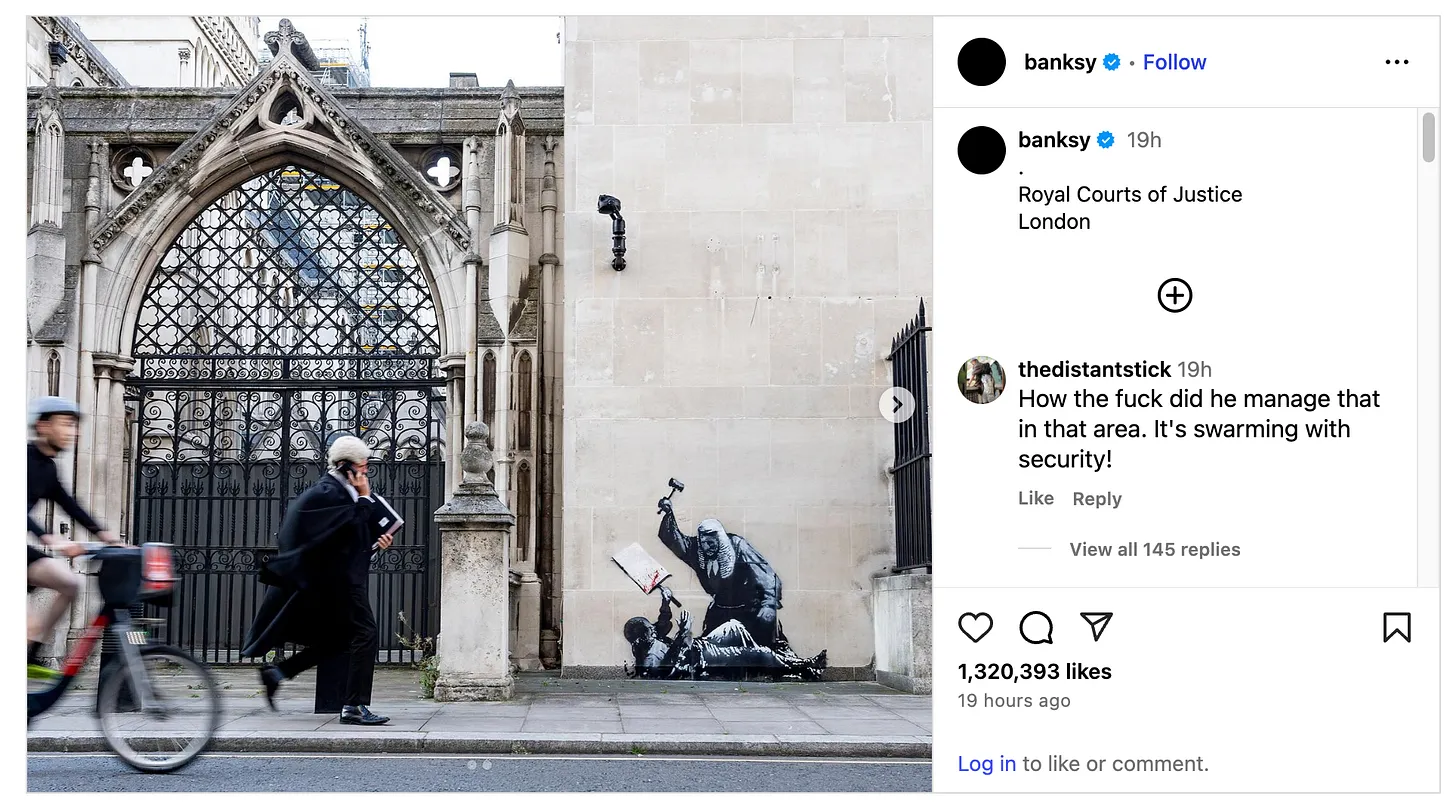
Aesthetically it is no worse than the depictions of judges and justice inside the RCJ.
But it was unauthorised and so, from a legal perspective, prima facie criminal damage.
And, as Joshua Rozenberg has spotted, the supposed barrister in the Banksy Instagram picture must be a model, given a mistake in their dress.
Furthermore, as 1001 respondents on social media pointed out in merry unison, the judge is using a gavel, and judges in our jurisdiction do not use gavels.
*
Indeed, much of the response to the new art had little or nothing to do with what it depicted.
As such, it maybe failed in its presumed purpose – of getting people to discuss the law of protest and protesting.
And even the depiction was perhaps wrong: judges are not to blame for the laws promoted by the executive and passed by parliament and implemented by the police and prosecuted by the Crown.
Indeed it is often the courts that are the last protection for protesters.
*
One amusing aspect of the incident is that the RCJ – to match its visual rhetoric – provides one of the most elaborate security theatres of any public building.
Security is not only done, but – oh dear gods – it is seen to be done.
And yet yards away from where the zealous performances of security take place, an artist was able to commit what the law would probably regard as criminal damage without interruption.
It was only when it came to public notice that anything was done about it.
The Guardian:

The BBC:

One news report stated that yesterday morning, “guards were trying to stop people from taking pictures. More staff then arrived with supplies to cover it up”.
*
Another amusing aspect to this is that the RCJ itself is where an intellectual property judge once wrestled with questions about the law relating to Banksy murals:


One wonders where any civil dispute or criminal appeal about this week’s mural would be heard, given a possible conflict of interest.
*
Criminal damage is wrong, and as this appears to be criminal damage then this makes this wrong.
Those embarrassed by the failure of the usual RCJ security theatre will no doubt press for an investigation and prosecution.
If there is a prosecution and a conviction then there will be no doubt that this was criminal damage.
But if there is a prosecution there may also be a defence, and an acquittal.
If so, the artist would be saved by the very court process they are depicting in the mural.
Which would be ironic, don’t you think.
***
Comments Policy
This blog enjoys a high standard of comments, many of which are better and more interesting than the posts.
Comments are welcome, but they are pre-moderated and comments will not be published if irksome, or if they risk derailing the discussion.
More on the comments policy is here.
I don’t think anyone imagines that Banksy is accusing judges of attacking protestors with gavels. Clearly the judge in the picture is a synecdoche for the justice system as a whole, which criminalises peaceful protest as terrorism.
Synecdoche (as a rhetorical trope) is ubiquitous in political discourse (“No. 10 is waiting for Washington make its move”, etc.) and especially in political cartoons, so I’m not sure why this would cause confusion.
Yes, and attacking the judicial system for what is done by the legislature and the executive is more-or-less the populist approach. There is a reason why the right wing press love the “enemies of the people” caricatures of the courts.
I take your point, and it’s true that judges can become whipping boys (even without having to pay for the privilege), but they are far from being automata. The fact that a judge is depicted in this picture does not mean that Banksy (or anyone else) is letting the executive and legislature off the hook – both are included in what I mean when I write ‘the justice system’. How could they not be, when (as you say) they are the ones that make the laws and mandate the punishments?
Entirely agree.
Whilst it is true judges do not, as a matter of constitutional principle, make law, the practice is I think worth examining more.
From the extreme deference to vague ‘national security’ in the Begum case, to nodding through the extraordinary abuse of Terrorism Act powers in the Palestine Action case, judges are very much siding with the government in clobbering civil liberties.
And the recent For Women Scotland case which basically reversed the intent and letter of two Acts of Parliament will I suspect be in many future textbooks as an example of judicial overreach and law making.
Very much agree.
Absolutely.
That judges do not, as a matter of constitutional principle, make law, is – as I understand ‘constitution principle’ – wrong: sorry ‘tall person’. The common law, which has been developed by judges over the centuries, is as much law – but ‘made’ by judges in the higher courts – as is statute law developed by Parliament; and as I tried to explain in the first couple of paras of
https://substack.com/home/post/p-146962442?utm_campaign=post&utm_medium=web
> to nodding through the extraordinary abuse of Terrorism Act powers in the Palestine Action case, judges are very much siding with the government in clobbering civil liberties.
In what sense have judges nodded through ‘the extraordinary abuse of Terrorism Act powers in the Palestine Action case’? And which case(s), specifically?
I’m not sure it’s so wide of the mark. Judges have shown a remarkable appetite, in recent times, for handing down stiff jail sentences for environmental and other activists whose “offences” (zoom calls and so forth) have not, in themselves, comprised damage to property or harm to individuals.
P.S. While the judge itself is an example of synecdoche (using the whole for the part or the part for the whole), the gavel is an example of metonymy (using something associated with an entity to represent it – e.g. referring to London as “the Smoke”). It’s irrelevant that judges don’t use gavels in our jurisdiction – the gavel is associated with (and so metonymically represents) the exercise of judicial power. That’s what’s going on in Banksy’s picture.
Banksy usually hits nails on heads but this is multiply ignorant.
Tempted to ask why a C17th auctioneer would have needed such violence. A troublesome lot, maybe?
There are a number of ironies operating here and the possibility that Banksy may be saved from conviction by the institution he is lampooning is but one.
The artwork singles out judges (not the police or government) in the suppression of protest, which represents for protestors and their supporters, an attack on free speech via the legal proscription of support for Palestine Action.
But perhaps, the image of the judge is best understood as a metaphor for the “establishment”.
Judges apply the law of Parliament without fear or favour and to represent them as arbitrary executive actors will bring them into disrepute if such a representation gains traction.
If the artwork is (as seems likely) removed, then the removal will be represented as a further layer of suppression. Not only may Palestine Action not be supported, but what is essentially a protest about the suppression of protest may not be seen. If the artist is then prosecuted, yet another layer of suppression is added.
Banksy, the national treasure, who has never been prosecuted for criminal damage before has done nothing new or different in daubing the walls of the Royal Courts of Justice.
In other contexts, his daubings add monetary and promotional value (the social commentary aesthetics are really of secondary importance in those contexts and everybody dreams of getting one and enriching themselves), in this context, they attack the establishment, add no monetary and only negative promotional value and cannot be tolerated.
If Banksy has committed criminal damage here, then he has committed criminal damage on multiple occasions elsewhere. No one cared about that before.
I suspect the whole point of this project was to anticipate the reaction of eradicating a protest piece about the suppression of protest. And so, the art is only a part of a larger performance and Banksy (or the Banksy collective) is playing puppet master here.
And the perception may well be, as false as it no doubt is, that it is the judges who ordered the removal of the artwork and even ( if it happens) were responsible for Banksy’s prosecution.
This has been well thought out.
Perception is everything, we might conclude.
Spot on!
Why was the mural temporarily covered up as shown here? Was it an embarrassment? Then why not paint over it straightaway – in minutes – and two security men could have continued the work they are paid to do. Or was it bring treated as a valuable work of art ? Highly unlikely. That consideration surely crossed no one’s mind. It’s laughable. Why would it ever be considered ‘valuable’ ? A photo of it might possibly adorn the RCJ’s 2026 calendar as light relief.
Did Banksy capture the zeitgeist? (despite the gown, wig and gavel).
This is exactly the same as the Daily Mail’s “enemies of the people” attack on the judiciary and the courts. It mistakes the arbiters of the law for the makers of the law.
Many excellent and intelligent comments.
I suppose quite reasonable and non violent people might think banning protest re Palestine Action is unreasonable and oppressive. Smacks of a frightened government doing what is bought and paid for. Banksie hits the nail, that the judges are ‘only following orders mate’ is part of the point. They are quite capable of giving the HS a hard time.
Will Banksie be hauled before the beaks and made an example of? Unlikely, too embarrassing, too much dirt under the rug.
Good choice of venue, nice white wall and the guards did not rush forth and bind the boy, more tricky to pull this off at the HoC, lost their sense of humour or justice down there.
Any destruction of the work will be deemed “downright criminal” in some quarters. A future parliament may agree.
Is it confirmed that it is a genuine Banksey or some facsimile?
With all that is going on in the UK – which, let’s be honest, isn’t possibly the best of times for our nation – I actually think the Banksey ( behind the new hording) actually improves the environment within which it has been painted.
It’s not apparent that the ‘picture painted is to be seen as the gospel truth – rather, in view of how many of the public hold the law, it’s participants and politicians in such low esteem, maybe it could act as a catalyst to try and make people think better of the law.
Half perhaps more than half of the people see ” the law” as being too remote from the people or, in recent years, 2- tier in its interpretation and enforcement for certain elements of the populace.
Using graffiti ( artfully done) is perhaps one way of defusing some tricky cultural and social mores of our time – I’m sure if the cross of St George had been painted – the graffiti would have been removed forthwith.
The post above includes a screengrab of Banksy’s own Instagram account authenticating it.
As a matter of interest I would like to know whether the barrister on that photo with his phone is real. I seem to recall on old rule about fully robed briefs having to only be seen within the precincts of the Court.
Technology exists these days for photos to include QR codes . From these QR codes it can be determined when exactly the photo was taken and whether it has been altered or not. try getting an international travel visa these days and see what I mean.
There is also a security camera above the mural so perhaps there is video footage of what was done when and by whom. If the incident has been missed by the camera questions need to be asked and solutions found and addressed as security firms are not behind the door when it comes to billing for taxpayer funded services.
I know you lead on the criminal damage point . Looking at the sentencing guidelines I puzzle how this would be categorized upon a conviction. The damage to the wall might be minimal but the perpetrator ( or perpetrators) would have had premeditated intent with one eye perhaps on financial enrichment . This argument could be developed by some to justify quite a long prison sentence.
I know some people will think the mural is good for a laugh and at one level it is. However the more I look at it the more I wonder where this seemingly trivial incident is going to lead us.
That nice man draws a lovely picture.
A judge merely applies the law, authorizing any subsequent state violence and often legitimizing any prior state violence. The word “merely” does way too much work here. The judge’s role is at least as questionable as the violence authorized or legitimated.
I refer the reader to Robert Cover’s brilliant “Justice Accused”, discussing the quandary of abolitionist judges when faced with the Fugitive Slave Act in 1850’s America. The British anti-protest laws are not as bad as the Fugitive Slave Act, and British judges do not have the relief-valve of judicial review. But that is faint praise indeed.
Would the value of the work at market being many multiples of any conceivable costs of restoration form a possible basis for a defence against the charge of criminal damage, given that it has become the property of the alleged victim?
It seems someone is not happy with the attention that the ghost of Banksy’s work has continued to attract, so more effectual measures are being taken to ensure the wall regains a crisp, clean and unadorned appearance.
https://www.lawgazette.co.uk/obiter/rcjs-banksy-is-screened-off-again/5125066.article
Perhaps similar attention, time and money could be spent on fixing some of the egregiously dysfunctional aspects of other court buildings.