How the BBC censored the line that Trump is “the most openly corrupt president in American history”

30th November 2025


The British Broadcasting Corporation’s Reith Lectures are prestigious things, a highlight of the broadcasting year.

The 2025 lecturer is Rutger Bregman.

The first of this year’s lectures is available to listen here and there is a BBC transcript of that lecture here.

But there is something missing from the broadcast lecture and the transcript.

The broadcast lecture and the published transcript are not a complete and accurate record of what was actually said.

What is missing – edited out by the BBC – is a single line.

The line is that Donald Trump is “the most openly corrupt president in American history”.

As a special treat for those who are kind enough to pay for subscriptions for this blog, I have done a close look at those “legal reasons” from an English media law perspective.

You can read it on Substack here and on Patreon here.

If you financially support this blog by other means (eg PayPal), leave a comment below (which will not be published) and I can either add you as a complementary subscriber or send the post to your email address.

Why the BBC is right not to pay damages to Trump

14th November 2025

By apologising, the broadcaster has taken the sting out of Trump’s excessive attack

I have done a piece at the New Statesman where I used to be legal correspondent, you can read it here.

You can comment below.

The letter the BBC could send to Trump in reply to his $1bn claim

12th November 2025

Yesterday this blog offered a close reading of the letter Trump’s lawyers had sent to the British Broadcasting Corporation. As a follow-up, this is a letter that the BBC could send in reply.

*

Dear Sirs

We refer to your letter.

As a preliminary point, it is accepted that the edited video in the Panorama programme was an error which should not have been made by the production company or approved by us for broadcast. We apologise for that error both to our viewers generally and to your client in particular. It was a failure of commissioning, journalistic and editorial standards. The programme has been removed from our iPlayer online platform and it will not be broadcast again with the error.

But failures of commissioning, journalistic and editorial standards do not by themselves give rise to a legal claim. We have looked carefully at your client’s claim as set out in your letter, and for the reasons below that claim is denied.

Your letter provides no evidence that your client was aware of the programme when it was broadcast or for at least a year afterwards. If your client maintains this claim please disclose evidence for our pre-action inspection that your client was aware of the broadcast before the press coverage of the last two weeks. Please also inform us when you were first instructed in respect of this complaint. In your letter you are anxious that we retain relevant documents, and so we presume you also have relevant documents about your client’s awareness of the programme. If you do have such evidence, please confirm that is the case.

The programme was not broadcast in the United States generally or Florida in particular. Our programmes on iPlayer are not available in the United States. Please provide any evidence for our pre-action inspection that the programme was watched by any person in your jurisdiction. Again, given the document retention requirements you set out in your letter, you presumably have retained such documents. And again, if you do have such evidence, please confirm this is the case.

You state in your letter three times that your client has suffered “overwhelming financial and reputational harm”. This is presumably on the Beetlejuice principle that if you say something three times it somehow appears. But your letter contains no evidence of either financial or reputational harm, let alone both. And your letter certainly fails to provide evidence of any harm being “overwhelming”. Given that your client was actually re-elected to the presidency within days of this programme being shown (in the United Kingdom but not the United States) there is no obvious harm that was suffered by your client.

If you do have any evidence of the alleged harm, either “overwhelming” or at all , and if your client continues with this claim, please provide that for our pre-action inspection. Please also provide evidence that the programme was “widely disseminated throughout various digital mediums, which have reached tens of millions of people worldwide”.

Talking of “tens of millions” you provided no basis whatsoever for the figure of one billion dollars. Please confirm whether this is a billion in an English or an American sense. As the figure seems arbitrary, please provide your workings out of the quantum. As it stands, the figure has no more meaning than a demand for one trillion dollars, or for one dollar.

Both your client and the BBC believe in the value of freedom of expression. Your client benefits from the constitutional and other legal protections for free speech in the United States. The BBC also should have the benefit of the same protections. We made a mistake for which we have apologised and undertaken not to broadcast again. But this should not be a matter for the courts.

Thank you for your attention to this matter.

Yours faithfully

[ ]

***

Comments Policy

This blog enjoys a high standard of comments, many of which are better and more interesting than the posts.

Comments are welcome, but they are pre-moderated and comments will not be published if irksome, or if they risk derailing the discussion.

More on the comments policy is here.

A close look at Trump’s $1 billion claim against the BBC

11th November 2025

The litigation letter is weak, but his underlying practical position is not weak

*

The headlines are eye-catching.

Other, similar front pages are here.

What is going on?

And what can be usefully said from a United Kingdom perspective about this threat by the President of the United States of America to sue our state broadcaster, the British Broadcasting Corporation?

This post is divided into three parts: (1) what is being complained about, (2) what can be said about the threat from a legal perspective, and (3) how this threat fits into he context of how President Trump uses civil litigation and threats of civil litigation.

In essence: what are the facts, what is the legal analysis, and what is the practical position.

*

Posts like these take time and opportunity cost – and this blog (currently) is free-to-view and does not have advertising. So if you do genuinely value independent and informed law and policy commentary (rather than AI slop, client journalism, or litigation PR) please become a paying subscriber.

The Empty City – a law and polity blog is a reader-supported publication. To receive new posts and support my work, please become a paid subscriber.

*

Let us begin.

The complaint is in respect of a Panorama programme broadcast by the BBC on 28 October 2024, which is well over a year ago.

The BBC page for the programmes is here:

You will see on that page that “this episode is not currently available”.

You will also see that dates of the broadcast:

Note that the broadcast dates are before Trump’s successful election on 5 November 2024.

And if you look carefully at that page you will also see that the programme was not made by the BBC, but by a third-party production company. This was thereby not made directly by the BBC news teams, though they would have presumably reviewed and approved the content before broadcast.

This distinction between production and broadcast is not unusual for such programmes.

There is also no evidence that the programme broadcasts were readily available in the United States:

*

As regards the content complained of, the Guardian have provided this handy comparison, which you should now click on and watch:

It is a speech by President Trump on 6 January 2021.

In the Panorama edit two parts of the speech are put together so to give the impression that a single statement was made – effectively a succinct incitement to violence:

“We’re going to walk down to the Capitol and I’ll be there with you, and we fight. We fight like hell.”

In fact the first part – “We’re going to walk down to the Capitol…” – and the last part – “…and we fight. We fight like hell” – were at different parts of the same speech. Indeed, the two passages are about 54 minutes apart.

*

From a journalistic and editorial perspective, the Panorama edit is misleading. It conveys the false impression that the two statements were said in one go. There is nothing in the Panorama edit to suggest any passage of time between the two utterances.

As such, from a journalistic and editorial perspective, the Panorama edit is indefensible and it should not have been broadcast.

*

However, not all journalistic and editorial errors are breaches of the law.

For such an error to be unlawful as well as unfortunate something else is needed. A complainant needs to bring the error into the scope of the applicable law, which in England and Wales, for example, would the laws of libel and of malicious falsehood.

A journalistic or editorial error is not, in and of itself, actionable at law.

*

So what is the legal complaint of President Trump and his legal representatives?

According to Sky the legal letter is as follows:

Re: Demand to Retract False And Defamatory Statements About The President of the United States of America

Dear All:

This law firm serves as litigation counsel for President Donald J Trump (hereinafter referred to as “President Trump”). Please direct all future correspondence relating to this matter to my attention. This correspondence serves as a demand under Florida Statute § 770.011 that you immediately retract the false, defamatory, disparaging, and inflammatory statements made about President Trump, which were published in a Panorama documentary that was fabricated and aired by the BBC.

Failure to comply will leave President Trump with no choice but to pursue any and all legal rights and remedies available to recover damages for the overwhelming financial and reputational harm that the BBC has caused him to suffer, with all rights and remedies being expressly reserved by President Trump.

In the Panorama documentary, titled “Trump: A Second Chance”, which was first broadcast on October 28, 2024 – a week before the 2024 United States presidential election – the BBC intentionally sought to completely mislead its viewers by splicing together three separate parts of President Trump’s speech to supporters on January 6, 2021.

The documentary showed President Trump telling supporters: “We’re gonna walk down to the Capitol and I’ll be there with you and we fight. We fight like hell and if you don’t fight like hell, you’re not going to have a country anymore.”

This fabricated depiction of President Trump was false and defamatory given that President Trump’s actual and full remarks were: “We’re going to walk down, and I’ll be there with you, we’re going to walk down, we’re going to walk down any one of you but I think right here, we’re going to walk down to the Capitol and we’re going to cheer on our brave senators and congressman and women.”

Moreover, the BBC edited out President Trump saying, “I know that everyone here will soon be marching over to the Capitol building to peacefully and patriotically make your voices heard.” Thus, as set forth in an internal whistleblower memorandum, the BBC’s segment maliciously made it appear that President Trump “[said] things [he] never actually said,” by editing together footage from the start of the speech with a separate quote early an hour later.

Due to their salacious nature, the fabricated statements that were aired by the BBC have been widely disseminated throughout various digital mediums, which have reached tens of millions of people worldwide. Consequently, the BBC has caused President Trump to suffer overwhelming financial and reputational harm.


A. Applicable law

Words are defamatory under Florida law when “they tend to subject one to hatred, distrust, ridicule, contempt or disgrace or tend to injure one in one’s business or profession.” Johnston v. Borders, 36 F.4th 1254, 1275 (11th Cir. 2022) (quoting Am. Airlines, Inc. v. Geddes, 960 So. 2d 830, 833 (Fla. 3d DCA 2007) (citation and quotation marks omitted)). Statements are defamatory if “the defendant juxtaposes a series of facts so as to imply a defamatory connection between them, or creates a defamatory implication by omitting facts.” Johnston v. Borders, 36 F.4th 1254, 1275 (11th Cir. 2022) (quoting Jews for Jesus, 997 So. 2d at 1108).

Further, “where the speaker or writer neglects to provide the audience with an adequate factual foundation prior to engaging in the offending discourse, liability may arise.” See Zambrano v. Devanesan, 484 So. 2d 603, 607 (Fla. 4th DCA 1986).

Even if the BBC attempts to whitewash its conduct as simply an expression of its opinions, Florida law makes clear that such a defense will not absolve its liability. See Dershowitz v. Cable News Network, Inc., 541 F. Supp. 3d 1354, 1362 (S.D. Fla. 2021); see also Milkovich v. Lorain Journal Co., 497 U.S. 1, 18-19 (1990) (”Even if the speaker states the facts upon which he bases his opinion, if those facts are either incorrect or incomplete, or if his assessment of them is erroneous, the statement may still imply a false assertion of fact. Simply couching such statements in terms of opinion does not dispel these implications.”) (emphasis added); see also Eastern Air Lines, Inc. v. Gellert, 438 So. 2d 923, 927 (Fla. 3d DCA 1983) (“[A] statement that although ostensibly in the form of an opinion ‘implies the allegation of undisclosed defamatory facts as the basis for the opinion’ is actionable.”) (emphasis added).

Consequently, the BBC lacks any viable defense to the overwhelming reputational and financial harm it has caused President Trump to suffer.


B. Demand

The above-referenced false, defamatory, malicious, disparaging, and inflammatory statements were published to deliberately denigrate President Trump. The timing of the fabricated documentary is evident.

The BBC’s reckless disregard for the truth underscores the actual malice behind the decision to publish the wrongful content, given the plain falsity of the statements.

Accordingly, President Trump hereby demands that you:

1) immediately issue a full and fair retraction of the documentary and any and all other false, defamatory, disparaging, misleading, and inflammatory statements about President Trump in as conspicuous a manner as they were originally published;

2) immediately issue an apology for the false, defamatory, disparaging, misleading, and inflammatory statements about President Trump; and

3) appropriately compensate President Trump for the harm caused.

Moreover, please allow this letter to serve as notice to you, to your affiliated entities, subsidiaries, to all of their employees, and any other person acting on behalf of or in concert with the BBC, to preserve any and all evidence related in any way to the above-mentioned malicious, false, and defamatory statements the BBC published, and any other statements that the BBC has published regarding President Trump.

By way of this letter, the BBC is hereby directed not to destroy, conceal, or alter any paper or electronic files, physical evidence, and/or other data relating in any way, no matter how remote, to your false claims regarding President Trump, and/or the circumstances leading to their dissemination, including, but not limited to:

1) all communications between you and any third party in any way related to your wrongful claims regarding President Trump;

2) all sources for your false claims regarding President Trump;

3) any and all documents and data referring to, reflecting, or relating to communications between you and any such third parties or sources regarding your false claims regarding President Trump; and

4) any and all documents in any way related to your false claims regarding President Trump. This includes any information alleged to be protected by Florida Statute § 90.5015. Monarch Air Group, LLC v. Journalism Dev. Network, Inc., No. 23-CV-61256, 2025 WL 445491, at *1 (S.D. Fla. Feb. 10, 2025) (interpreting Fla. Stat. § 90.5015 and explaining that the Eleventh Circuit “recognizes a qualified privilege for journalists, allowing them to resist compelled disclosure of their professional news gathering efforts. This privilege shields reporters in both criminal and civil proceedings.”) (quoting United States v. Capers, 708 F.3d 1286, 1303 (11th Cir. 2013)).

I understand that many records and files are maintained electronically. However, this letter specifically requests that all paper and hard copy originals be maintained and preserved in their original format.

By the same token, electronic documents and the storage media on which they reside may contain relevant, discoverable information beyond that which may be found in printed documents. Therefore, even where a paper copy exists and has been preserved, please preserve and maintain all electronically stored documents in their original native format, including all metadata.

This preservation demand specifically encompasses any and all electronic documents, including but not limited to, all word-processed files, emails, spreadsheets, all databases, log files, and any other electronically stored and/or generated documents or files.

If the BBC does not comply with the above by November 14, 2025, at 5:00 p.m. EST, President Trump will be left with no alternative but to enforce his legal and equitable rights, all of which are expressly reserved and are not waived, including by filing legal action for no less than $1,000,000,000 (One Billion Dollars) in damages.

The BBC is on notice.

PLEASE GOVERN YOURSELF ACCORDINGLY.

[ ]

(That last term in block capitals is a feature of US litigation letters.)

*

There some rather odd things about this legal threat.

*

First, the letter states in three places about the the reputational harm caused to Trump:

“…the BBC lacks any viable defense to the overwhelming reputational and financial harm it has caused President Trump to suffer”

“…the overwhelming financial and reputational harm that the BBC has caused him to suffer”

…the BBC has caused President Trump to suffer overwhelming financial and reputational harm.”

The Panorama programme was broadcast in the United Kingdom days before Trump was re-elected in the United States.

It is impossible to see how Trump being re-elected is consistent with him suffering any harm by the broadcast, let alone “overwhelming financial and reputational harm”.

And if you look closely at the letter, no harm is even shown – let alone “overwhelming financial and reputational harm”.

Instead harm is merely asserted – rather than demonstrated.

As such this seems a weak litigation letter.

*

The failure by this letter to show harm then feeds into the threat that Trump may sue for “no less than $1,000,000,000 (One Billion Dollars) in damages.”

Because no harm is shown, this figure is arbitrary.

The letter may have said one dollar or a trillion dollars and would have made as much rational sense.

It is a preposterous demand.

*

The letter is also alert to the inconvenient truth that the programme was not actually broadcast in the United States. This is is why the following passage is included:

“…the fabricated statements that were aired by the BBC have been widely disseminated throughout various digital mediums, which have reached tens of millions of people worldwide.”

There is no evidence in the letter that anyone in the United States, let alone Florida, either saw the programme or even know of its existence.

Interestingly, in the demands for document retention, the letter fails to even ask the BBC for evidence of the extent of downloads and broadcasts of the programme. This is a strange omission, if this was a serious legal threat.

*

I am not an American lawyer, and so I can offer no view on the merits of this legal threat under the laws of Florida. Even what can seem weak litigation letters may have traction in other jurisdictions.

But if this threat was made under the laws of England and Wales (Scotland and Northern Ireland have their own legal systems) one would say that this claim also had its weaknesses over here.

First, it is would be out of time: there is a one year limitation period.

Second: the claimant would have to show – and not merely assert – serious damage to their reputation. The letter does not do so.

And third: the ceiling for damages claims for libel in England and Wales is about £300,000 – and any award over £100,000 is rare.

This rules out one million pound claims, let alone one billion pound claims.

*

Would the BBC have any defence in a hypothetical case brought in England, regardless of the above defences?

A straight defence of truth would not be available – Trump did not say what the Panorama edit had him saying, at least not in one go.

However, the truth defence also covers things which are “substantially” true. This is a riskier defence to mount, but if the BBC did mount it would be along the lines of Trump did effectively promote an insurrection, even if he did not say in one go what was said in the Panorama edit.

Here the BBC could point to findings of Congressional committees and the terms of the impeachment of Trump passed by the House of Representatives (even though he was not convicted by the Senate). The BBC could also say that the 54 minute gap between the statements did not necessarily mean that the latter statement – “fight like hell” – was not an incitement.

An English court would also have regard to the programme as a whole, and also to Trump’s speech as a whole.

Whether Trump was an insurrectionist would presumably not be something Trump would want to have decided by an English court on the basis of the civil standard of proof – the balance of probabilities.

On the other hand, it was a bad journalistic and editorial fail, and so the BBC would not relish this being decided by the London high court either.

On the face of it, if this was litigated at the high court in London (and assuming limitation was not a problem, and the claimant was able to show serious damage) one could see it going either way, though one would expect a successful claim to be worth only about £30,000.

*

Stepping back, what we have here is an overstated claim on a somewhat artificial basis. Until recent news reports, one suspects neither Trump nor anyone else in the US even knew about the Panorama programme.

And given he was re-elected president (in the USA) days after broadcast (in the UK), any claim for damages would seem to fall flat.

But.

The facts of the Panorama edit are ugly for the BBC. It was a bad mistake, and so it would not be one where a confident defence could be mounted.

And this, in turn, means Trump has leverage.

Trump loves leverage.

For Trump, civil litigation is a form of deal-making – the promotion of his political and business interests by other means.

One should not approach his legal manoeuvres as if they are cases that will go all the way. They are skirmishes intended to force a deal, a compromise, a back-down by the other side.

A confident BBC would admit a mistake and move on without admitting legal liability.

But we do not have a confident BBC.

We have a media corporation lacking confidence.

Trump loves media corporations -and other institutions – that lack confidence.

And although one would hope the BBC would mount a complete defence to any claim being brought in a jurisdiction where a programme was not even broadcast and where no damage has been shown, one can also imagine the BBC seeking to make amends including by means of compensation (of licence fee payers money) so as to avoid litigation.

The litigation letter may be weak, but Trump’s underlying practical position is strong: the BBC made a mistake, and he knows how to take full advantage of it.

So putting aside the theatrics of a bombastic letter with its senseless $1 billion claim, there is a power play here which Trump has done many times before.

And the real mistake of the BBC (and the production company) was opening itself up to such a play of power.

***

Comments Policy

This blog enjoys a high standard of comments, many of which are better and more interesting than the posts.

Comments are welcome, but they are pre-moderated and comments will not be published if irksome, or if they risk derailing the discussion.

More on the comments policy is here.

What Banksy’s RCJ mural maybe gets wrong

9th September 2025

Judges are not to blame for the protest laws promoted by the executive and passed by parliament and implemented by the police and prosecuted by the Crown

The Royal Courts of Justice on Strand is a superficially impressive building.

It projects the might and grandeur of the legal system.

*

This elegance continues inside with a bracing great hall with law and justice-related art and statues, and in a gallery above glass cabinets exhibiting judicial costumes.

(Pics above from Wikipedia.)

*

And adjacent to that great hall are several quaint period courtrooms – very pretty but also very uncomfortable and inefficient.

Like a great deal of the British constitution, the RCJ is a Victorian construct made to look and feel a lot older.

And it is quite dreadful building for its practical purpose.

Yet it is there – and perhaps more than the Old Bailey round the corner and certainly more than the Supreme Court on Parliament Square, it is a physical and aesthetic embodiment of our domestic law.

The RCJ is not only where justice is supposed to be done, but it also where justice is seen to be done.

The RCJ is primarily about optics, not functionality.

*

Yesterday another work of art about justice was added to the RCJ, supplementing the various sculptures and paintings inside.

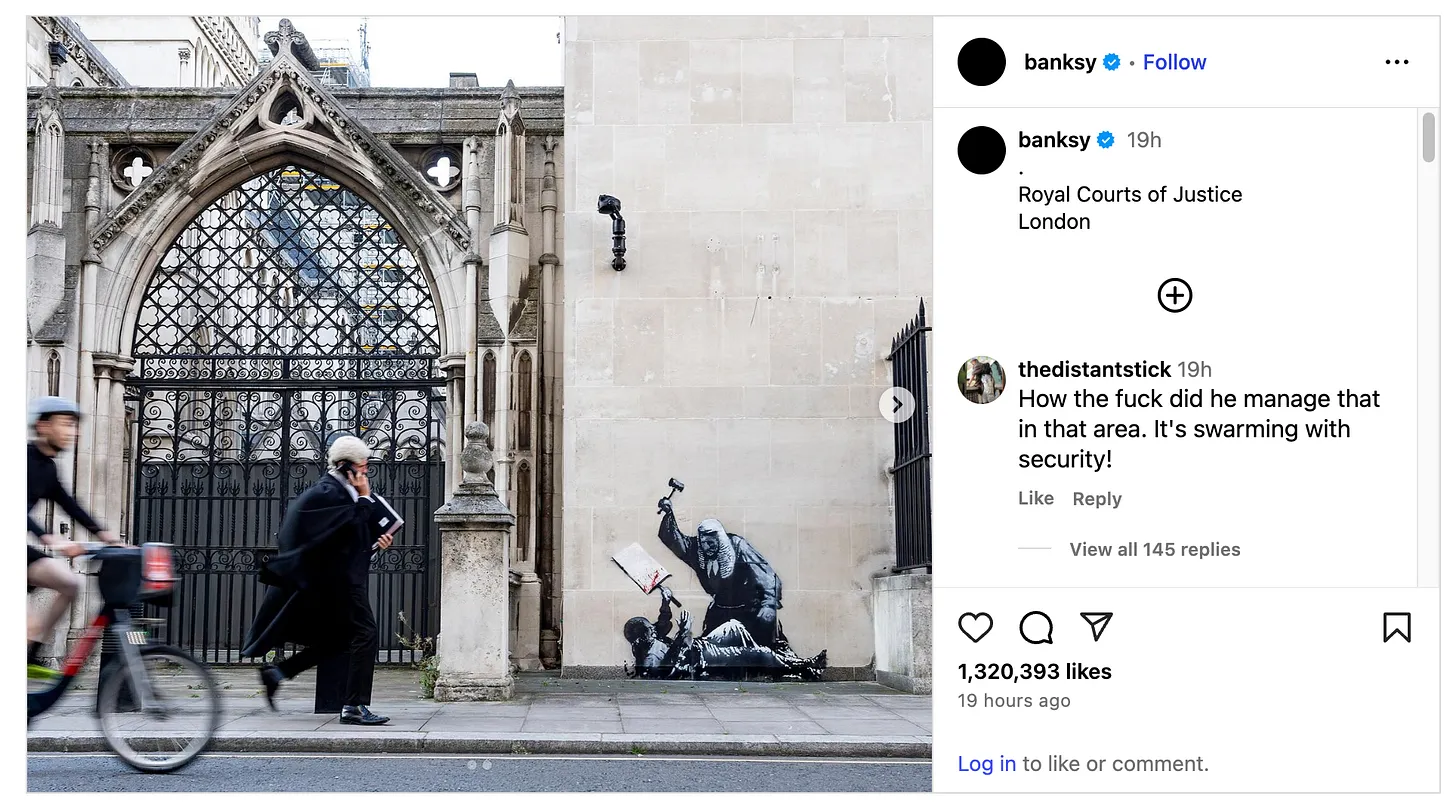
This was, of course, this mural by Banksy:

Aesthetically it is no worse than the depictions of judges and justice inside the RCJ.

But it was unauthorised and so, from a legal perspective, prima facie criminal damage.

And, as Joshua Rozenberg has spotted, the supposed barrister in the Banksy Instagram picture must be a model, given a mistake in their dress.

Furthermore, as 1001 respondents on social media pointed out in merry unison, the judge is using a gavel, and judges in our jurisdiction do not use gavels.

*

Indeed, much of the response to the new art had little or nothing to do with what it depicted.

As such, it maybe failed in its presumed purpose – of getting people to discuss the law of protest and protesting.

And even the depiction was perhaps wrong: judges are not to blame for the laws promoted by the executive and passed by parliament and implemented by the police and prosecuted by the Crown.

Indeed it is often the courts that are the last protection for protesters.

*

One amusing aspect of the incident is that the RCJ – to match its visual rhetoric – provides one of the most elaborate security theatres of any public building.

Security is not only done, but – oh dear gods – it is seen to be done.

And yet yards away from where the zealous performances of security take place, an artist was able to commit what the law would probably regard as criminal damage without interruption.

It was only when it came to public notice that anything was done about it.

The Guardian:

The BBC:

One news report stated that yesterday morning, “guards were trying to stop people from taking pictures. More staff then arrived with supplies to cover it up”.

*

Another amusing aspect to this is that the RCJ itself is where an intellectual property judge once wrestled with questions about the law relating to Banksy murals:

One wonders where any civil dispute or criminal appeal about this week’s mural would be heard, given a possible conflict of interest.

*

Criminal damage is wrong, and as this appears to be criminal damage then this makes this wrong.

Those embarrassed by the failure of the usual RCJ security theatre will no doubt press for an investigation and prosecution.

If there is a prosecution and a conviction then there will be no doubt that this was criminal damage.

But if there is a prosecution there may also be a defence, and an acquittal.

If so, the artist would be saved by the very court process they are depicting in the mural.

Which would be ironic, don’t you think.

***

Comments Policy

This blog enjoys a high standard of comments, many of which are better and more interesting than the posts.

Comments are welcome, but they are pre-moderated and comments will not be published if irksome, or if they risk derailing the discussion.

More on the comments policy is here.

Commissioner Breton writes a letter: a post in praise of the one-page formal document

Two set-backs for animal welfare law – and a consolation

25th May 2023

While I prepare a detailed post on Boris Johnson and the Cabinet Office lawyers thingie, this is just a quick post to note a couple of setbacks to another interest of this blog: animal welfare law.

*

First, you may recall this blog covering the “Frankenchicken” claim, which I thought was a well-made application for judicial review.

Unfortunately the High Court did not, though the judgment is rather difficult to follow – and I may unpack the judgment at a later date.

But plaudits must go to the Humane League (and, yes, we all know the puns for the 80s pop band) for putting together such an impressively crafted case.

*

Second, late today on a quiet parliamentary sitting, the government announced it was reneging on the Animal Welfare (Kept Animals) Bill – even though it was at an advanced parliamentary stage.

There are news reports on this here and here.

You may recall that the Conservative manifesto for 2019 devoted an entire page to animal welfare, making (specific) commitments:

And you may also recall two senior cabinet ministers recently insisting that the House of Lords had to accept that the (generalised) content of the Conservative manifesto as the “will of the people”:

But it would seem the government picks-and-chooses which of its manifesto commitments are serious enough to threaten the House of Lords with, and which the government cannot even be bothered with so that it can progress its own bill.

The reason for this pulling of a bill appears to be that the government does not feel confident that it can resist amendments that would further protect animal welfare beyond the protections promised in the manifesto.

It is a depressing moment for animal welfare law.

*

On the bright side, however, there is consolation: the great Chris Packham – who does sterling work not only on animal welfare but also neurodiversity – won his libel case, and the judgment is well worth reading.

(The pic above shows him supporting the “Frankenchicken” claim which was coincidently heard at the High Court at same time as his libel claim.)

***

Comments Policy

This blog enjoys a high standard of comments, many of which are better and more interesting than the posts.

Comments are welcome, but they are pre-moderated and comments will not be published if irksome, or if they risk derailing the discussion.

More on the comments policy is here.

NDAs and the Public Interest – a beginner’s guide for Matt Hancock and others

2nd March 2023

The publication this week by the Daily Telegraph of the WhatsApp messages of Matthew Hancock with several third parties was unusual and striking.

It was so unusual and striking that the first response of many was: surely there must be a law against this sort of thing.

And no doubt Hancock himself thought he was legally protected, having entered into (we are told) a Non Disclosure Agreement (NDA) with Isabel Oakeshott, the ghost writer of his recent book about his experiences as health secretary in dealing with the pandemic.

On available information, it appears the ghost writer has in turn disclosed the messages to the Daily Telegraphand the newspaper then published a selection of these messages (we are told) without prior notice to Hancock or to any of the third parties with whom Hancock messaged.

The messages are certainly of interest to the public and, given the insights they provide into how government (and the media) dealt with the pandemic – especially in respect of what happened with care homes and testing – the publication of the messages can plausibly be said to be in the public interest.

*

This post now sets out the general law of England and Wales in respect of NDAs and the public interest, and it then will apply that general law to what appears to be the facts of this incident.

In doing so, I have not had sight of the actual NDA which was signed between Hancock and his ghost writer – and, as will become apparent, a great deal can turn on the terms of a NDA.

For although NDA sounds as if it should be an acronym for a generic thing, there are many ways of framing a NDA.

NDA is not, in and of itself, a legal term of art, but instead a label of convenience.

*

To understand NDAs you must first understand what it means not to have a NDA.

If there is not a NDA between two parties there will still be the law of confidentiality.

(Technically, confidentiality is not law but what is called “equity”, which is a set of doctrines and rules which complement law, but I hope I may be permitted to call it law for the purposes of this post.)

Confidentiality usually works as follows: person (A) imparts information to person (B) and when that information has (i) the quality of confidentiality and (ii) been imparted so that it is plain that it is considered confidential, the courts will protect that confidential information when they can.

If tests (i) and (ii) are met then person (B) will be bound to keep the information confidential.

This means that if person (B) wrongly discloses that information to another, or misuses the information, then (A) can obtain an injunction against (B).

(A) can also, depending on circumstances, obtain another remedy against (B) such as an “account of profits” of the monies made by (B) in wrongly disclosing or misusing that information.

Generally, the law of confidentiality is about the remedy of injunctions.

This is because injunctions are the supposed means that confidential information can remain confidential: the cork is put back into the bottle.

*

So given there is already a general law of confidentiality, why do parties have NDAs?

There are many reasons.

First, NDAs can serve to identify and list the information which is confidential, so that there is no need to rely on the general test of whether the information has the quality of confidential information.

Second, the NDA will show beyond serious doubt that the parties were aware that the information was imparted on a confidential basis.

These two reasons supercharge the basic law of confidentiality so that the wronged party can show a court the two tests are met at law.

But there are other reasons why parties may want a NDA.

NDAs can provide the financial terms of the parties: in essence how much is being paid to the parties in respect of the exchange of information.

A strong NDA will also provide the financial consequences of what will happen if a party breaches the NDA, such as an indemnity or damages.

A NDA can also provide for the intellectual property position of the imparted information – for example, whether the receiving party also has a licence to use the information and for what purposes.

But.

Generally NDAs are signed as a ceremonial act of trust between the parties, a rite of passage.

Often people will ask for and sign NDAs without much consideration of their contents, so that they can progress with a commercial or media relationship.

NDAs also often suit both parties as a convenient shield, and a NDA can be used as the complete reason not to disclose something.

*

NDAs, however, are not magical devices.

They do not, in and of themselves as signed pieces of paper, stop an unwanted disclosure – especially if trust breaks down.

*

If party (B) wants to breach a NDA then there will often be little that (A) can do to stop them.

This is especially the case if (A) is not given notice of the breach.

For, as set out above, the law of confidentiality is generally about the remedy of an injunction.

And as injunctions are discretionary remedies of the court, they will not usually be granted if the court order would be futile or academic.

It would be too late to put the cork back in the bottle.

*

So if (A) cannot obtain an injunction to restrain publication or some other wrongful disclosure by B, what is there for (A) to do?

Well.

This will come down to the other terms of the NDA – and often with NDAs there will not be other terms.

Sometimes, especially when it is foreseeable that party (B) will breach the NDA, there can be financial terms that would deter (B) from doing so.

For example, there could be structured payments that would not be payable in the event of any breach.

Or there can be an indemnity against the costs of dealing with the consequences of a breach.

But often the NDA will be silent, for – as set out above – the NDA is usually a convenient shield or a ceremonial ornament.

*

And now we come to the public interest.

Even if (A) has been given notice of an imminent breach, if (B) pleads the public interest, then the court may not give (A) an injunction.

All (A) would then have, if they have been careful, would be other terms of the NDA.

The legal position was recently summarised by a judge:

The modern (i.e. post-[Human Rights Act 1998]) approach as to the public interest defence is set out in the Court of Appeal’s judgment in Associated Newspapers Limited v HRH Prince of Wales […].

“The four main tenets can be summarised as follows:

“(1)  There is an important public interest in the observance of duties of confidence since those who engage employees, or who enter into other relationships that carry with them a duty of confidence, ought to be able to be confident that they can disclose, without risk of wider publication, information that it is legitimate for them to wish to keep confidential (ibid at [67]).

“(2)  The modern approach as to the circumstances in which the public interest in publication can be said to override a duty of confidence is whether a fetter of the right of freedom of expression is, in the particular circumstances, “necessary in a democratic society”.  The test is one of proportionality: the court will need to consider whether, having regard to the nature of the information and all the relevant circumstances, it is legitimate for the owner of the information to seek to keep it confidential or whether it is in the public interest that the information should be made public (ibid at [67]).

“(3)  It is arguable that a duty of confidentiality that has been expressly assumed under contract carries more weight, when balanced against the restriction of the right of freedom of expression, than a duty of confidentiality that is not buttressed by express agreement; but the extent to which a contract adds to the weight of duty of confidence arising out of a confidential relationship will depend upon the facts of the individual case (ibid at [69] citing Campbell v Frisbee [2003] ICR 141).

“(4)  Thus, in essence, the Court must consider whether, having regard to the nature of the information and all the relevant circumstances, it is legitimate for the owner of the information to seek to keep it confidential or whether it is in the public interest that the information should be made public.”

*

Applying these four tests in the instant case, Hancock would say that as the messages had been disclosed to the ghost writer under a contract, this “carries more weight, when balanced against the restriction of the right of freedom of expression, than a duty of confidentiality that is not buttressed by express agreement”.

Hancock would also say there was an “important public interest in the observance of duties of confidence since those […] who enter into other relationships that carry with them a duty of confidence, ought to be able to be confident that they can disclose, without risk of wider publication, information that it is legitimate for them to wish to keep confidential”.

But.

The ghost writer would say “having regard to the nature of the information and all the relevant circumstances […] it is in the public interest that the information should be made public”.

Here the ghost writer would also be able to point to the material being supplied for a book on the pandemic, as well as to the contents of the messages.

*

The Daily Telegraph did not sign the NDA and so would not be bound by its terms.

Hancock’s remedies, if any, against the Daily Telegraph would be under the general law of confidentiality, or perhaps under the law of misuse of private information, data protection law, or even copyright.

But whichever way he framed the claim, he would face (in some form) a public interest defence.

The position of third parties with whom Hancock messaged, however, may be stronger.

And one expects the Daily Telegraph legal team has been very careful in respect of third party information it is disclosing from the messages.

The Daily Telegraph must have had very bullish and robust legal advice on the public interest.

They also felt confident enough in their public interest defence not to give Hancock notice of publication.

*

Hancock is today quoted as saying:

“There is absolutely no public interest case for this huge breach.  All the materials for the book have already been made available to the inquiry, which is the right, and only, place for everything to be considered properly and the right lessons to be learned.  As we have seen, releasing them in this way gives a partial, biased account to suit an anti-lockdown agenda.”

If Hancock sincerely believes that there is absolutely no public interest defence then presumably there is no bar to him seeking some form of legal remedy against either the ghost writer or the newspaper – for example to restrain publication of messages so far unpublished.

He could even seek to obtain an account of profits from the ghost writer or the newspaper if he believes they are acting uncocionably.

So far it appears that he may not take legal action, he also has said today (emphasis added):

“I will respond to the substance in the appropriate place, at the inquiry, so that we can properly learn all the lessons based on a full and objective understanding of what happened in the pandemic, and why.”

If he believes that, one may wonder why he published a book seeking to give his side of what happened before the inquiry.

*

NDAs are usually ornaments or shields.

Unless they are tightly drafted and prudently structured, they offer little protection in practice to an imparting party if the other party deliberately breaches the NDA without notice.

As such NDAs are often articles of trust.

And here is the paradox: given NDAs often depend on trust, they usually are not needed, and if there is lack of trust, then the NDA can make little difference.

On the available information, Hancock was naive to believe a NDA would give firm, still less absolute, protection against onward disclosure of the messages.

And on the available information, there does appear to be a public interest in disclosure to the public of the messages – at least to the extent that they show public policy making and implementation in action.

As Hancock himself has published a book which has been described as misleading based on the same material, then he may struggle to get redress in respect disclosures which expose his own misleading account.

*

We do not know what were the terms of the NDA – and so we cannot pass comment on whether the NDA was well drafted for its purpose or not.

But we can evaluate the wisdom of Hancock in thinking any NDA, on any terms, would protect him against onward disclosure of the messages by a counter-party willing to breach the NDA on the basis of the public interest.

It was a daft thing for him to do.

***

Comments Policy

This blog enjoys a high standard of comments, many of which are better and more interesting than the posts.

Comments are welcome, but they are pre-moderated and comments will not be published if irksome, or if they risk derailing the discussion.

More on the comments policy is here.

A latter-day tale of the unexpected: Roald Dahl and the “censors”

24th February 2023

With one sterling exception, I never much cared for Roald Dahl’s stuff growing up.

The children’s books were, for me, twee and their supposed gruesomeness tame.

I much preferred reading a certain kind of second world war novel which you found in certain cardboard boxes at certain stalls in Birmingham’s rag market.

(And these were a lot worse than anything written by Dahl.)

The one sterling exception was not any of Dahl’s children’s books, but a television programme – the theme tune of which still mildly disconcerts even today.

Tales of the Unexpected was a wonder.

Not all the tales were Dahl’s – but every short episode was tightly scripted, wonderfully acted by star actors, and nicely plotted.

They were the televisual truth of Pascal’s old adage that he was was writing something long, because he did not have enough time to write it short.

Along with Rod Serling’s Twilight Zone, they were examples of what you could repeatedly achieve with short-form drama on television, if you put your mind to it.

And, of course, as the title of the programme averred, there were twists.

Sometimes you could see the twist coming, and you could feel smug when other viewers fell for stereotypes and knee-jerk reactions.

But the twists were usually satisfying, all the same.

*

Now we come to this week’s news, about the “censorship” of Dahl’s children’s books.

Like the early scenes of an episode of Tales of Unexpected, we have been led to believe a thing has happened.

We have then been encouraged to let our fears race, and to worry about outcomes and possible implications.

And in this excitement we have been helped along by glamorous celebrities playing their roles, whom you instinctively trust.

Earnest authors and pundits have appeared on our television screens to tell us of the “woke” menace.

Commentators pitched for and filed their 800 or 1,100 word articles about the terror of the censors – articles which pretty much all wrote themselves.

You can understand why so many of us hid behind our metaphorical sofas.

*

And then the twist.

There was never any censorship, all along.

All that happened is that a capitalistic publisher, presumably with the consent of the Dahl estate, issued alternate versions of certain texts so as to generate purchases which otherwise may not have been made.

None of the original texts are out of print.

None of the original texts were going to go out of print.

This was just an attempt by a publisher to appeal to an additional audience, who may not care for the original texts.

There was no censor, no censure, no clamour.

The alarmed audience for this short drama have been misled.

So the moral for this tale is that never get carried away with a panic, even – perhaps especially – when it is an author you once enjoyed (or think you enjoyed) reading yourself.

And now…

…the closing credits for this blogpost:

***

Comments Policy

This blog enjoys a high standard of comments, many of which are better and more interesting than the posts.

Comments are welcome, but they are pre-moderated and comments will not be published if irksome, or if they risk derailing the discussion.

Musk and the three ways his acquisition of Twitter shows a remarkable approach to legal risk

11th November 2022

The acquisition of Twitter by Elon Musk is fascinating – at least to watch from the outside.

*

I am not an American lawyer, and I have not seen any of the legal or other documents related to the acquisition.

Like many of you, I only know what I have read in the media and watched play out on Twitter.

But from the information available to me, and based on twenty years’ experience as an English commercial lawyer, there are three elements of this acquisition which may show us things about Musk’s approach to the issue of legal risk.

*

The first element is the agreement to purchase, which Musk reportedly sought to get out of.

It would appear that he was unable (or unwilling) to do so, and so had to complete the purchase.

There were two things here which seemed odd.

The first odd thing was that an experienced business person like Musk, who presumably had access to legal advice, could even get seemingly trapped by such an agreement.

The second odd thing was his use of issues such as the number of bot accounts as a basis to get out of the transaction.

It seemed to me that such issues would normally go to warranties than to anything more substantial.

(In this context, a warranty would be a promise that a certain state of affairs existed which would allow a cash adjustment to the purchase price if the warranty was breached – and so the ultimate price of the purchase would be adjusted to what it would have been had the correct state of affairs been known.)

The issues he raised did not appear to me to be convincing, and many better placed observers were not convinced either.

It looked like Musk had put himself into a commercial situation he could not get out.

Few business people, following advice, would have allowed this to happen.

It was a curious situation.

*

The second element of this acquisition is the reported disdain for regulatory and other legal risks by Musk and his new managers once Twitter was purchased.

On this, the New York Times has reported:

Musk “was used to going to court and paying penalties, and was not worried about the risks”.

This is an extraordinary position for any experienced business person – but it does accord to his approach to risk as described in the first element above.

Some of the regulatory and other legal risks now facing Twitter are not trivial, from data privacy to employment rights.

The approach described by the New York Times is not even cavalier – it is outright denial and disdain.

What a curiouser and curiouser situation.

*

The third element is the very structure of the acquisition.

Musk may be conducting himself online as if he were a buffoon, but those lenders and investors also financing the transaction are serious people.

And if for some reason those lenders and investors were easily impressed by a charismatic figure, their legal advisers certainly would not be.

The position of these lenders and investors here is the greatest puzzle of all.

What were they thinking?

Reuters tells us these are the lenders and investors:

Even if Musk was in denial or disdainful about legal or other risk, these lenders and investors would not be.

Again, according to Reuters:

“Twitter faces interest payments totaling close to $1.2 billion in the next 12 months on the debt that Musk piled on it, following a string of interest rate hikes by the Federal Reserve, an analysis of the financing terms disclosed in regulatory filings shows.

“The payments exceed Twitter’s most recently disclosed cash flow, which amounted to $1.1 billion as of the end of June, according to financial disclosures Twitter made before Musk took it private on Oct. 27.”

Even if Musk’s antics were not foreseeable, the state of Twitter would have been obvious when lenders and investors did their due diligence.

Lenders and investors proceeded even though they were aware of the precarious financial state of Twitter.

Why would they do this?

Perhaps they were confident that Musk would suddenly turn the platform around and generate revenues in excess of costs.

Perhaps they took a view on the risks and thought they could just write it off if the investment went bad.

Or perhaps they were less interested in any return on investment than in the security they could enforce if the transaction went bad.

Some lenders plan on the basis that an investment will go well – and some lenders plan on the basis that it will not.

If Twitter defaults on the payments, it will be interesting – fascinating – to see what security is in place, if any, and what is enforced, if anything is enforced.

Even if Musk somehow though this transaction was free of risk, those who co-financed the transaction would not have done.

What will happen next?

The situation gets curiouser.

*

Musk’s acquisition of Twitter is almost as if it were taking place in a magical business world where legal and other risks do not really exist.

A fabulous world devised by, say, Italo Calvino rather than our mundane real world of contracts and regulations.

Perhaps the fantasy will hold, and Musk will pull off a great commercial success.

Perhaps.

But us trudging legal sorts are used to seeing the downsides.

And the utter lack in this transaction of any visible risk-based approach by Musk is remarkable.

If this transaction escapes the world of fantasy, then Musk and Twitter will need to brace, brace.

***

Thank you for reading – and this blog needs your support to carry on doing these posts., even though I cannot offer you a BLUE TICK.

Posts like this take time and opportunity cost, and so for more posts like this – both for the benefit of you and for the benefit of others – please support through the Paypal box above), or become a Patreon subscriber.

***

Comments Policy

This blog enjoys a high standard of comments, many of which are better and more interesting than the posts.

Comments are welcome, but they are pre-moderated and comments will not be published if irksome.

The comments policy is here.