How the Government both won and lost the Priti Patel High Court bullying case

6th December 2021

Today judgment was handed down in the case brought by the civil service union the FDA in respect of the Prime Minister’s determination that the bullying of the Home Secretary had not broken the Ministerial Code.

On the face of it, the government won the case.

And so this is what the press reported (and that is what time-poor news desks have published on their news sites):

But.

There are different ways that a government can win a case like this – and a closer look at the judgment shows that in substance this is not a welcome decision for the government at all.

*

First, we need to know what the case was – and was not – about.

The case was not about deciding whether the Home Secretary is a bully or not – that was not what the court was being asked to determine, and the detailed evidence about bullying was not put before the court:
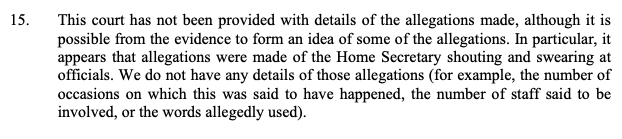
And, as that was not the question before the court, then the hot takes that the court has ‘cleared the Home Secretary of bullying’ are not and cannot be true.

The primary question before the court was whether it was open to the Prime Minister, given the information before him, to determine that there had not been a breach of the Ministerial Code.

The court found that, on this occasion, the determination that there had not been a breach of the Ministerial Code was one of the determinations open to the Prime Minister on the information before him.

But in reaching that conclusion the court made a number of points that were against the government – and these points may be significant in future cases.

*

First, the court held that the Prime Minister’s determinations of the ministerial code were, in principle, amenable to judicial review by the courts.

The government made a spirited attempt to argue that the Prime Minister’s determinations of the ministerial code were not ‘justiciable’ – that the very subject matter was a no-go area for the High Court.

The court deal with justiciability in paragraphs 25 to 43 of a 61 paragraph judgment – about a third of the decision.

The court accepted that not every determination of the Code may be judicially reviewed.

And, of course, those judicial reviews which are heard by the court may not succeed (as with this case).

But there is nothing stopping a similar case on different facts succeeding just because of the subject matter.

That the court held that, in principle, prime ministerial determinations of the Ministerial Code are amenable to judicial review is a boon for transparency and accountability.

*

Once the court had dismissed the government’s attack on justiciability, it turned to whether the Prime Minister had misdirected himself in applying the Code.

Here the key paragraph of the Code is:

“1.2 Ministers should be professional in all their dealings and treat all those with whom they come into contact with consideration and respect. Working relationships, including with civil servants, ministerial and parliamentary colleagues and parliamentary staff should be proper and appropriate. Harassing, bullying or other inappropriate or discriminating behaviour wherever it takes place is not consistent with the Ministerial Code and will not be tolerated.”

The information before the Prime Minister was an advice from Sir Alex Allan, the independent adviser on the Code.

His advice included the following:

“My advice is that the Home Secretary has not consistently met the high standards required by the Ministerial Code of treating her civil servants with consideration and respect.

“Her approach on occasions has amounted to behaviour that can be described as bullying in terms of the impact felt by individuals.

“To that extent her behaviour has been in breach of the Ministerial Code, even if unintentionally. This conclusion needs to be seen in context. There is no evidence that she was aware of the impact of her behaviour, and no feedback was given to her at the time.”

Having considered this advice, the Prime Minister’s conclusion was:

“Sir Alex’s advice found that the Home Secretary had become – justifiably in many instances – frustrated by the Home Office leadership’s lack of responsiveness and the lack of support she felt in DfID three years ago.

“He also found, however, that the Home Secretary had not always treated her civil servants with the consideration and respect that would be expected, and her approach on occasion has amounted to behaviour that can be described as bullying in terms of the impact felt by individuals.

“He went on to advise, therefore, that the Home Secretary had not consistently met the high standards expected of her under the Ministerial Code. 

“The Prime Minister notes Sir Alex’s advice that many of the concerns now raised were not raised at the time and that the Home Secretary was unaware of the impact that she had.

“He is reassured that the Home Secretary is sorry for inadvertently upsetting those with whom she was working. He is also reassured that relationships, practices and culture in the Home Office are much improved.

“As the arbiter of the code, having considered Sir Alex’s advice and weighing up all the factors, the Prime Minister’s judgement is that the Ministerial code was not breached.”

*

The FDA’s claim was that, given Allan’s advice, this was not a conclusion that the Prime Minister could have legally made.

Here paragraph 58 of the judgment is important about the Prime Minister’s conclusions:

In other words: because the Prime Minister did not say Patel was not a bully, it must be that he either accepted Allan’s advice or did not form his own view.

Had the Prime Minister explicitly rejected Allan’s advice that it was bullying then it would have been a different legal situation.

The judgment then goes on in paragraph 59 to the other factors considered by the Prime Minister – it is not a paragraph easy to follow in one go, and may require re-reading:
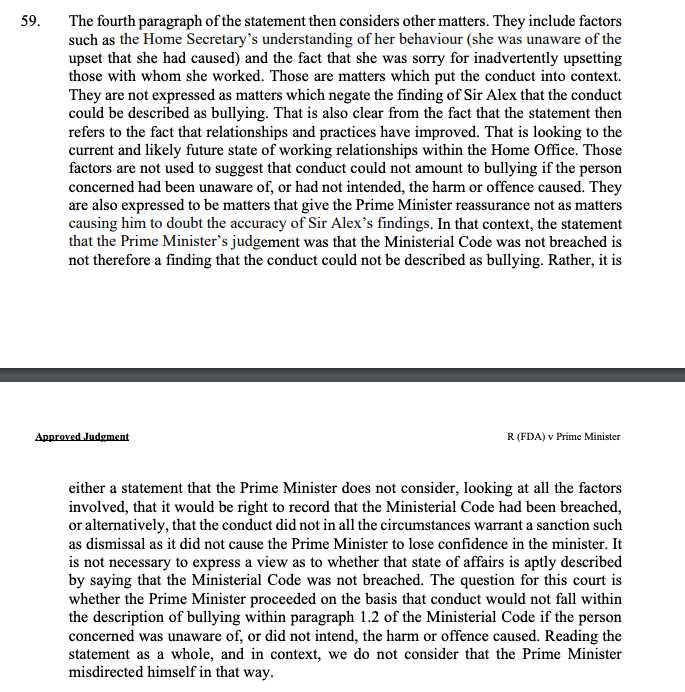
The essence of the paragraph is in the sentences:

“In that context, the statement that the Prime Minister’s judgement was that the Ministerial Code was not breached is not therefore a finding that the conduct could not be described as bullying.

“Rather, it is either a statement that the Prime Minister does not consider, looking at all the factors involved, that it would be right to record that the Ministerial Code had been breached, or alternatively, that the conduct did not in all the circumstances warrant a sanction such as dismissal as it did not cause the Prime Minister to lose confidence in the minister.”

*

The Prime Minister can consider himself very lucky to have won this case.

Once can quite imagine a differently constituted court (or the Court of Appeal) taking a harder view against the Prime Minister

The FDA, in turn, are right to aver the following:

“The High Court has decided:

 – That the prohibition on bullying, discrimination and harassment in the Ministerial Code is justiciable in the Courts.

– That the Prime Minister must correctly apply those concepts when determining complaints against ministers.

– That it is not an excuse for bullying under the Code that a minister does not intend or is not aware of the upset and distress caused by their actions.

“These findings vindicate the claim brought by the FDA and represent a clear rejection of the idea that there are different standards for ministers than for civil servants. The FDA is applying for its full costs of the claim to be paid by the government.

“In an unexpected development, the Court also found that the Prime Minister had not acquitted the Home Secretary of bullying in his decision in November 2020. The Court has held that the Prime Minister must have accepted the advice of Sir Alex Allan that the Home Secretary had engaged in bullying (or at least that he did not reach any concluded view on the matter).”

*

Whichever government lawyer drafted the conclusions of the Prime Minister ultimately won this case for the government.

A more clumsily worded statement would have meant that even this court would have decided in favour of the FDA.

The government won – just about.

But now there is a High Court decision holding that determinations of the Ministerial Code are justiciable and that the Prime Minister must act properly in applying the Code to particular cases.

The case was also decided on the bases that the Home Secretary was not exonerated of the allegations and that the lack of intention did not mean it was not bullying.

The FDA must be tempted to have one more heave – and to take this to the Court of Appeal (though there would be a risk that it could lose the gains it has made).

The government is in the harder appeal position – for it can hardly appeal a case which it has ‘won’ and so it is stuck (for now, unless the FDA appeals) with the finding of justiciability and other points made by the court.

So this is a good example of a case which both sides can be seen to have lost – but one in which both sides can also be seen as having won.

And the more significant victory, for transparency and accountability, is that of the FDA.

******

This daily law and policy blog needs your help to continue – for the benefit of you and other readers.

Each free-to-read post takes time and opportunity cost.

This law and policy blog provides a daily post commenting on and contextualising topical law and policy matters.

If you value this free-to-read and independent legal and policy commentary – both for the you and for the benefit of others – please do support through the Paypal box above, or become a Patreon subscriber.

*****

You can also have each post sent by email by filling in the subscription box above (on an internet browser) or on a pulldown list (on mobile).

******

Comments Policy

This blog enjoys a high standard of comments, many of which are better and more interesting than the posts.

Comments are welcome, but they are pre-moderated.

Comments will not be published if irksome.

“We do not recognise…” – on the increasingly popular evasive phrase used by government press offices

3rd December 2021

One of the joys of dealing with press officers is their insincerity.

They know they are being insincere and evasive, and you know they are being insincere and evasive.

But they are in their role, and you are in yours.

One of the increasing common formulations adopted by press officers is “We do not recognise [x]”.

The phrase is not a denial: it is not being stated that [x] is false.

Nor is it, of course, an admission.

It is something in between.

In this way the phrase is like “We do not admit” used by civil litigators – though in litigation you should only use that phase if the fact is actually outside of your knowledge, even if you do not accept it to be true.

*

“We do not recognise [x]”.

So an alleged thing may be true and unwelcome – but a spokesperson has managed to find something about the thing alleged which means they can avoid admitting it without denying it.

https://twitter.com/davidallengreen/status/1466708215983398913

As a lawyer, I would just then want to ask “well, what do you recognise to be the case?”

Though so deft are press officers at their insincerity and evasion that this clever follow-up will also no doubt be dodged.

And so we have this phrase – joining the likes of “we do not want to get into speculation” and “we do not give a running commentary” – as a means by which government press officers pretend to you (and perhaps to themselves) that there a good reason for not providing the information or confirmation requested.

The shame of it is that government press officers are (or should be) public servants.

The provision of information to the press and the public, in the public interest, is what they are actually being paid to do (and for which many will get civil service pensions and even gongs).

Yet they seem to to take pride in not serving the public interest but the political interests of current ministers.

This uncomfortable truth should be stark and glaring to those who work in government press offices.

But they do not see it.

Perhaps they do not recognise it.

******

This daily law and policy blog needs your help to continue – for the benefit of you and other readers.

Each free-to-read post takes time and opportunity cost.

This law and policy blog provides a daily post commenting on and contextualising topical law and policy matters.

If you value this free-to-read and independent legal and policy commentary – both for the you and for the benefit of others – please do support through the Paypal box above, or become a Patreon subscriber.

*****

You can also have each post sent by email by filling in the subscription box above (on an internet browser) or on a pulldown list (on mobile).

******

Comments Policy

This blog enjoys a high standard of comments, many of which are better and more interesting than the posts.

Comments are welcome, but they are pre-moderated.

Comments will not be published if irksome.

How if a business issued the government’s “40 new hospitals” guidance it would be acting unlawfully

1st December 2021

The current government makes much of its manifesto promise that it will build ‘forty new hospitals’.

But at prime minister’s questions today, the opposition leader referred to the following guidance for public officials (or ‘playbook’ as it is formally described):

So a ‘new hospital’ includes an additional new clinical building where there is an existing hospital.

And even the refurbishment (or upgrade) of an existing hospital, as long as it looks different from the outside.

Both of these are jolly good things to be welcomed, but no sensible person would call them ‘new hospitals’.

Yet the government is requiring public officials to say this untruth.

*

What if a business did this to consumers?

The Consumer Rights Act says things have to be as described.

Regulation 5 of the consumer regulations provides that an unfair commercial practice includes when a practice ‘in its overall presentation in any way deceives or is likely to deceive the average consumer in relation to…the quantity of the product’.

That reference to ‘overall presentation’ means that something hiding in the small print is not good enough as a legal escape.

If a business made such claims to a consumer then the law would regard this as ‘a misleading commercial practice’ and in breach of consumer protection rights.

Even without consumer law, claims that a major thing would be ‘new’ when it would either be merely an addition or a refurbishment would be likely – under general contract principles – to be either a misrepresentation that would mean the contract would be put aside or a material breach of a contract.

Indeed, some would go further and say such knowingly misleading statements in would even constitute fraud.

*

The reason why these false claims are to be made so that it will appear that the governing party has met its own political manifesto commitment – and note how the manifesto itself distinguishes between upgrades and new hospitals:

‘Everyone in the UK should have the peace of mind and confidence that come from world-class health care – and so this new One Nation Conservative Government is giving the NHS its biggest ever cash boost, with 20 hospital upgrades and 40 new hospitals […]’

‘[…] have begun work on building 40 new hospitals across the country , as well as investing in hospital upgrades […]’

‘We will build and fund 40 new hospitals over the next 10 years. This is on top of the 20 hospital upgrades announced in the summer […]’.

Three times the promise is explicitly made in the manifesto.

*

Of course, law is not politics, and political language is not to be held to legal(istic) standards.

But.

It is rare to have official guidance – even if called a ‘playbook’ – which sets out how public officials are to describe something falsely as a new hospital when it is not a new hospital.

Not only are ministers lying to us, but ministers are now requiring public officials to lie too.

******

This daily law and policy blog needs your help to continue – for the benefit of you and other readers.

Each free-to-read post takes time and opportunity cost.

This law and policy blog provides a daily post commenting on and contextualising topical law and policy matters.

If you value this free-to-read and independent legal and policy commentary – both for the you and for the benefit of others – please do support through the Paypal box above, or become a Patreon subscriber.

*****

You can also have each post sent by email by filling in the subscription box above (on an internet browser) or on a pulldown list (on mobile).

******

Comments Policy

This blog enjoys a high standard of comments, many of which are better and more interesting than the posts.

Comments are welcome, but they are pre-moderated.

Comments will not be published if irksome.

“Law and Order” vs law and order, “Free Trade” v free trade, and so on – but can the dislocation between political language and policy substance be healed?

27th November 2021

Consider the following areas of policy: law and order, taking control of our borders, free trade, and so on.

All of them sensible, everyday areas of policy.

Now take each of those phrases, and do a little magic: capitalise them, and add speech marks and an exclamation mark.

You now have: ‘Law and Order!‘, ‘Taking Control of our Borders!’, ‘Free Trade!’,  and so on.

This blog has previously averred at the distinction – indeed discrepancy – between law and order and ‘Law and Order!’: that those promoting the slogan do so at the expense of law and order in practice.

And this week this blog also set out why a strident and unilateral approach of ‘Taking Back Control’ is the opposite of a practical and effective border policy.

As for ‘Free Trade!’ the reality of Brexit is that it is perhaps the biggest single protectionist measure in modern British history, even though Breixters profess that they believe in free trade.

There is a fundamental dislocation of political language and policy substance.

But it is one thing to observe and note these tensions – contradictions – but it is another to know what to do about them.

And it is important that this dislocation is fixed, for it is difficult to see how we can have any sensible politics and policies when there is a basic dysfunction in our political discourse.

Maybe there is no solution.

Perhaps this fracture can never heal, and all the opponents of the current government can do is adopt a similarly cynical approach to language and policy.

If there is a solution then it no doubt has to be one which addresses the demand for (or at least tolerance of) meaningless politics by voters and the supply of meaningless politics by those in politics and the media.

One can hope that the next great reforming politician will be the one who reconnects political language and policy substance.

But there is no particular reason or evidence to think that we will get such a politician.

And so in the meantime, all we can do with this dislocation is (if you forgive the pun) brace ourselves.

******

This daily law and policy blog needs your help to continue – for the benefit of you and other readers.

Each free-to-read post takes time and opportunity cost.

This law and policy blog provides a daily post commenting on and contextualising topical law and policy matters.

If you value this free-to-read and independent legal and policy commentary – both for the you and for the benefit of others – please do support through the Paypal box above, or become a Patreon subscriber.

*****

You can also have each post sent by email by filling in the subscription box above (on an internet browser) or on a pulldown list (on mobile).

******

Comments Policy

This blog enjoys a high standard of comments, many of which are better and more interesting than the posts.

Comments are welcome, but they are pre-moderated.

Comments will not be published if irksome.

Three ways in which this government is devaluing the currency of political language

20th November 2021

Over at his substack the fine political journalist Adam Bienkov has a good and detailed post on how Downing Street lies:

Of course, some will say, all politicians lie.

But what is distinctive about these lies is how easy they are now to document and expose.

For example, Downing Street had falsely insisted Johnson had complied with the rules on a recent hospital visit.

So yes, all politicians lie – but rarely are the lies in such plain sight.

We can all watch this dishonesty in real time, and there is no other word for what we can all see but lying.

Yet this is just one of (at least) three ways in which the current prime minister and his government are devaluing the language of politics.

*

Take promises.

 A recent post on this blog set out three express promises in the 2021 general manifesto that the government has disregarded:

‘We will proudly maintain our commitment to spend 0.7 per cent of GNI on development, and do more to help countries receiving aid become self-sufficient.’

‘On entering Government in 2010, the Conservatives acted decisively to protect the UK’s pensioners. The ‘triple lock’ we introduced has meant that those who have worked hard and put in for decades can be confident that the state will be there to support them when they need it. We will keep the triple lock…’

‘We promise not to raise the rates of […] National Insurance […].’

We can now add to these reneged commitments, a fourth:

‘We will build Northern Powerhouse Rail between Leeds and Manchester and then focus on Liverpool, Tees Valley, Hull, Sheffield and Newcastle.’

Of course, all elected governments depart from their manifestos.

But there is something so blatant about how the current government repudiates on its explicit commitments.

These are detailed explicit promises – and the government does not care about disregarding them.

*

And take threats.

How many more times are we going to hear Lord Frost threaten to trigger Article 16?

Even jaded Brexit commentators cannot easily keep up.

And now, with the prospect of Christmas supply lines being affected by any European Union response to the United Kingdom triggering the provision, the United Kingdom this weekend seem to be downplaying the prospect.

But threats, like promises, need to be credible to be effective.

And the United Kingdom government generally, and David Frost in particular, seem to be doing everything they can to discredit and undermine their own position.

*

Words matter.

For although the United Kingdom state has (rightly) a monopoly on the use of coercive power, most politics – and policy and law – in practice rests on words and the meanings that people understand those words to have.

And so if there are fundamental dislocations between words and meanings then this subverts the polity itself.

Our current government states things which can be effortlessly disproved, reneges on detailed manifesto promises, and does not carry out threats.

Political discourse thereby becomes just noise.

Yes – the government can perhaps claim some tactical advantages from this conduct, but this is at the cost of strategic strength.

And as Bienkov avers in his post, one recent cost is that nobody believes Downing Street when it denies a story.

For this Boris Johnson and those around him have only themselves to blame.

They are squandering something of absolute political value.

And they do not seem to care.

******

This daily law and policy blog needs your help to continue – for the benefit of you and other readers.

Each free-to-read post takes time and opportunity cost.

This law and policy blog provides a daily post commenting on and contextualising topical law and policy matters.

If you value this free-to-read and independent legal and policy commentary – both for the you and for the benefit of others – please do support through the Paypal box above, or become a Patreon subscriber.

*****

You can also have each post sent by email by filling in the subscription box above (on an internet browser) or on a pulldown list (on mobile).

******

Comments Policy

This blog enjoys a high standard of comments, many of which are better and more interesting than the posts.

Comments are welcome, but they are pre-moderated.

Comments will not be published if irksome.

“Let me be absolutely clear” – the two rules of clarity

19th November 2021

Here is a government minister:

*

“For clarity…

“I would like to make our position… 100% clear….

“I want to be clear…”

And so on.

This minister is not even the worst politician in this respect – the former prime minister Theresa May often seemed incapable of saying anything without prefacing with how she was making something clear.

But David Frost’s latest verbiage means it is perhaps time for me to state on this blog a couple of rules about clarity that I have often tweeted.

*

The First Rule of Clarity

If you have to describe a thing as “clear” then it usually is not.

The Second Rule of Clarity

The stronger the intensifier for “clear” (for example, “very clear”, “absolutely clear”, “crystal clear”) the less clear that thing will tend to be.

*

The rules also apply to “clearly” – and this is always a tell in a litigation letter or legal argument that the author has no confidence in what they are saying.

Compare and contrast:

“This passage clearly shows that…”

“This passage shows that…”

The very fact you are having to gloss what the passage means indicates that the passage is not clear.

If the passage were clear, the gloss would be redundant.

*

Going back to the example above, Frost says three times – in a tweet and his quoted speech – about things being clear.

If the position were clear he would, of course, not need to tweet or make a speech in the house of lords saying things were clear.

As it happens, there is no clarity about what the government’s position on Article 16 is – and it seems to change every weekend with the Sunday papers.

And the reason why the position is unclear is that the thinking (or lack of thinking) is unclear.

Fog everywhere, as Charles Dickens would put it.

*

These are rules – and not laws.

They are not laws in the scientific sense – like Godwin’s law – which are perhaps affirmed rather than broken.

Nor in the jurisprudential sense, the usual fare of this blog.

Of course, there will be exceptions to these general rules.

But: clear is a good strong word describing a good strong concept.

And if you do take clarity seriously, you will never have to say so aloud.

Is that clear?

******

This daily law and policy blog needs your help to continue – for the benefit of you and other readers.

Each free-to-read post takes time and opportunity cost.

This law and policy blog provides a daily post commenting on and contextualising topical law and policy matters.

If you value this free-to-read and independent legal and policy commentary – both for the you and for the benefit of others – please do support through the Paypal box above, or become a Patreon subscriber.

*****

You can also have each post sent by email by filling in the subscription box above (on an internet browser) or on a pulldown list (on mobile).

******

Comments Policy

This blog enjoys a high standard of comments, many of which are better and more interesting than the posts.

Comments are welcome, but they are pre-moderated.

Comments will not be published if irksome.


Why ‘legally ringfenced’ is a phrase used by political knaves to take you for a fool

7th September 2021

Another late-night revelation about our current government-by-essay-crisis:

The phrase ‘legally ringfenced’ is a legal and political nonsense.

It is a legal nonsense because nothing in the United Kingdom can, in any meaningful way, be ‘legally ringfenced’ .

This is because of the doctrine of parliamentary supremacy, which means a parliament can make or unmake any act of parliament.

Nothing – to use a similar dishonest phrase – can be ‘enshrined in law’.

Even if there were a provision put in a statute – with super-duper protections intended to prevent its repeal or amendment – the provision and all those super-duper protections could be repealed or amended with a simple parliamentary majority.

And it is a political nonsense for it is a trick that that has been played before and which has been exposed as trick before.

The international aid budget was, supposedly, legally ringfenced.

The fixed-term parliaments act was, supposedly, enshrined in law.

The current triple-lock on pensions likewise, and so on.

And so on.

But still politicians use this trickery – and still too many nod-along by these impressive sounding phrases.

The claims ‘legally ringfenced’ and ‘enshrined in law’ do have a rhetorical purpose, of course.

They invoke the majesty of law to charge up what would otherwise be a banal political utterance.

An utterance intended to reassure waverers or even win over somebody who would otherwise be opposed.

And in that way, it is perhaps slightly significant that politicians still feel law has sufficient respect so that political statements can be framed as grand legal announcements.

But it is trickery all the same.

Any politician who uses the phrases ‘legally ringfenced’ and ‘enshrined in law’ is a knave – and a knave taking you to be a fool.

**

Hello there –  if you value this daily, free-to-read and independent commentary for you and others please do support through the Paypal box above, or become a Patreon subscriber.

Please do support this sceptical liberal constitutionalist blog – and do not assume it can keep going without your support.

***

You can subscribe for each post to be sent by email at the subscription box above (on an internet browser) or on a pulldown list (on mobile).

****

Comments Policy

This blog enjoys a high standard of comments, many of which are better and more interesting than the posts.

Comments are welcome, but they are pre-moderated.

Comments will not be published if irksome.

“I am sorry but I make no apology” – words and meanings and politics

12 August 2021

The eminent jurist Elizabeth Doolittle once averred:

‘Words Words Words
I’m so sick of words
I get words all day through’.

Of course, the problem of too many words and not enough meaning is an old problem.

Once can point at a current example and deplore it, and soon someone in reply will point out it is nothing new.

*

*

Perhaps it is not new, and perhaps the only difference now is that, because of the internet, there are just far more words to be seen.

An ever-growing tower of babble.

But.

The use (misuse, abuse) of words by the authoritarian populist nationalists in today’s politics – in both the United Kingdom and the United States – does seem to have something novel to it.

Maybe it is the shamelessness of the knowing disconnect between words and their meanings – as if our ‘post-truth’ and ‘fake news’ predicament meant that politicians do not even need to try to have words that correspond with reality.

If so, and if this is indeed a novel situation, then there is no inherent reason to believe that politics will be happily cyclical, and that we will return to the good days of there being a match between what politicians say and what they do.

That said, it may not actually be that happy and good, if those politicians – like Orban in Hungary (see here) – next say illiberal things and very much do mean them, because they no longer care about liberal pieties.

For the illiberal politicians of our age, it seems the first step is to rob words of meanings, and then to be unafraid of saying what they really do mean.

This in turn makes the political challenge difficult for those (of us) who are liberal and progressive.

Not only do we have to combat the assault upon truth, but we then have to combat the follow-on candid and unapologetic assault upon human dignity and autonomy.

It is a grim prospect – and it is one for which illiberals ‘make absolutely no apologies’.

Brace, brace.

**

Thank you for reading.

Please support this liberal and constitutionalist blog – and please do not assume it can keep going without your support.

If you value this daily, free-to-read and independent legal and policy commentary for you and others please do support through the Paypal box above, or become a Patreon subscriber.

***

You can subscribe for each post to be sent by email at the subscription box above (on an internet browser) or on a pulldown list (on mobile).

****

Comments Policy

This blog enjoys a high standard of comments, many of which are better and more interesting than the posts.

Comments are welcome, but they are pre-moderated.

Comments will not be published if irksome.