The magical thinking of Donald Trump

22nd September 2022

A theme of this blog is that law is akin to magic, and that law and lore have a good deal in common.

For example:

But the comparison is only made as a-kind-of-analogy.

I never thought that when writing about law in modern times I would come across actual magical thinking.

I was wrong.

Consider this:

Here the proposition is not that Trump could unilaterally, by some form of words, either in writing or said aloud, change the classification of documents.

The proposition is that by thinking a thing, with that thought having no other trace or manifestation, then a classification of a document can change.

This would mean that the legal consequences for other people with reference to that document would be different, even though there was no record of Trump’s thoughts, because Trump had thought one thing or another.

And, presumably, Trump can classify the document by thoughts alone, as well as de-classify it.

Perhaps he could even in turns classify and de-classify a document every few moments, and nobody would ever know.

It would be an extraordinary thing – even supernatural and paranormal.

*

Of course, what is (probably) going on is that Trump is resorting to the only defence he thinks he has left, which accords with the evidence.

There is no actual evidence of de-classification, then his explanation needs to deal with that absence.

There is also the implicit point that if he accepts these are documents which he “de-classified” then they were not “planted” – as that defence would seem to contradict his purported “de-classification”.

It is all very odd.

*

Stepping back, it would seem Trump has realised that he is in serious legal jeopardy.

If anyone else had been found with such classified documents without authority or lawful excuse then that person would no doubt have been arrested and charged, convicted and imprisoned.

The only difference here is whether the law applies to Trump as it applies to others.

Or is there a legal privilege for Trump?

This is a hard question for the rule of law: is there one law (or lack of law) for him and one for others?

Perhaps following his exercise in magical thinking, Trump would accept criminal liability if enough people think that he is guilty?

Or perhaps not: one suspects he would want to rely on real-world law and procedure, where things are properly written down and recorded.

For that is the thing about those who want to be above the law: they wish to dispense with legal formalities when it suits them, but they certainly want the protection of legal formalities when it protects them.


***

Comments Policy

This blog enjoys a high standard of comments, many of which are better and more interesting than the posts.

Comments are welcome, but they are pre-moderated and comments will not be published if irksome.

The comments policy is here.


Why the broadcast of the Accession Council was informative and significant

12th September 2022

The Accession Council was broadcast live on Saturday morning.

That broadcast was a boon for the public understanding of the constitution of the United Kingdom, showing the sort of things that are usually hidden from public view.

It was fascinating watching for anyone interested in the nature of our constitutional arrangements.

You can watch it here – and I will explain below why various aspects of it were important and/or interesting:

https://www.youtube.com/watch?v=aKci6iKET2Q

*

The Accession Council is a configuration of the Privy Council.

David Torrance, who has written an outstanding briefing for the House of Commons library on what happens when a monarch dies, explains the background of the Accession Council:

That there is now no longer a strict statutory requirement for an Accession Council should not mislead you into thinking that the council meeting was mere ceremony and its content mumbo-jumbo.

There was actually a point to a good part of it, even if that point was constitutional rather than strictly legal(istic).

*

For example, take the oath in respect of the Church of Scotland.

(Here note I am neither Scottish nor a Scots lawyer, and so please nudge me in the comments below if I put my foot wrong.)

The taking of the oath is a legal requirement, under the Protestant Religion and Presbyterian Church Act of 1707.

Under this Act, it is provided among other things:

“And Lastly That after the decease of her present Majesty (whom God long preserve) [Anne] the Sovereign succeeding to her in the Royal Government of the Kingdom of Great Britain shall in all time comeing at his or her accession to the Crown Swear and Subscribe that they shall inviolably maintain and preserve the foresaid Settlement of the true Protestant Religion with the Government Worship Discipline Right and Priviledges of this Church as above established by the Laws of this Kingdom in prosecution of the Claim of Right”.

This is an Act not of the Parliament at Westminster but of the Parliament of Scotland.

Indeed, it appears to be the legislation passed just before that parliament voted for union with England:

The Act was passed by the Scottish Parliament at a time when the then Queen looked as if she was to be succeeded by distant relatives – and the Scottish Parliament was presumably anxious to ensure that its position would be protected by the new monarch.

The 1707 Act has (as far as I can tell) a unique legal and constitutional status.

The Westminster Parliament cannot repeal this Act if there is a regency in place.

Under the Regency Act of 1707:

“The Regent shall not have power to assent to any Bill for changing the order of succession to the Crown or for repealing or altering an Act of the fifth year of the reign of Queen Anne made in Scotland entitled “An Act for Securing the Protestant Religion and Presbyterian Church Government.””

I am not aware of any other statutory provision which prevents the Royal Assent of an otherwise passed Bill – and it is a deft device to achieve a measure of entrenchment.

*

Now let us turn to seals.

It is a mark of our age that it is difficult not to think of aquatic animals when the word “seal” is used:

Unhelpful.

But if we can put out pinniped friends aside for a moment, seals were – and are – important.

Part of the business of the Accession Council was for the new king to approve the various seals still used in government business.

These seals convert documents that have no legal standing and effect into instruments that can have just as much legal standing and effect as any Act of Parliament.

Seals are an important part of the business of government.

The current seals have the name, image and chosen inscription of the late Queen:

(From Wikipedia.)

There was no legal requirement for Charles to confirm that the current seals could continue to be used, for the Succession to the Crown Act 1707 provides:

“And be it further enacted by the Authority aforesaid That the Great Seal of Great Britain the Privy Seal Privy Signet and all other Publick Seals in being at the Time of the Demise of Her Majesty Her Heirs or Successors shall continue and be made use of as the respective Seals of the Successor until such Successor shall give Order to the contrary”.

*

There was also a confirmation that Charles will surrender the (considerable) revenues of the Crown Estate in return for the Sovereign Grant.

And today (the Monday after the Saturday) there has already been a statutory instrument amending this provision of 2011:

With this one:

Given the amounts involved – the annual revenue of the Royal Estate is about half a billion pounds – one can appreciate why the government would want to act quickly to ensure the legal framework was up-to-date.

It should be noted that Charles referred to the “tradition” of surrendering the revenue of the Royal Estate, as if it were a voluntary act which he just happens to wishes to continue with, rather than being a firm legal obligation.

This “tradition” dates back to George III and it is unthinkable that the surrender would ever be rescinded, but it is an element of our uncodified constitution which owes more perhaps to a “good King’s theory of the constitution” rather than the more well known “good chap’s”.

*

Charles also approved legislation for a bank holiday for the State Funeral.

This approval was legally required under the Banking and Financial Dealings Act 1971:

The usual statutory bank holidays are listed in schedule 1 to that Act – and so for England and Wales they are:

The eagle-eyed among you will see that neither Christmas Day nor Good Friday are statutory bank holidays.

This is because they are bank holidays at common law, a point which is recognised by this wonderful sub-section that follows the one just quoted:

This means the King and his Privy Council has the legal power, by proclamation, to make it like Christmas everyday.


*

The broadcast of a meeting of the Privy Council itself – even if this special one – is illuminating.

The business is done directly between the monarch and the ministers attending, seeking approval for various measures.

A famous such meeting took place three years ago:

Note the “Note” at the bottom.

The business of the council is conducted standing up:

Orders in Council can cover many things, ranging from important constitutional acts to trivial-seeming amendments of existing royal charters.

They are, however, a system of making law parallel to the legislative process at Westminster.

Many would be surprised at what can be given legal effect outwith the Westminster Parliament.

The meetings take place wherever the monarch happens to be – and, as Torrence explains in another outstanding briefing, the Queen would engage with ministers on the measures to be approved:

*

The public broadcast of the Accession Council was a decision that must have been made some time ago.

It is difficult to believe that the filming was arranged at speed after the death of the Queen.

There seems to be no inherent reason why they cannot be filmed and broadcast – and so it is presumably in the gift of the King as and when other Privy Council meetings are filmed and broadcast.

Perhaps future meetings will also now be filmed and broadcast – showing Charles engaging face-to-face with government ministers on a range of issues.

This may be good – or bad – for Charles and/or the ministers involved.

If so, they would be an interesting complement to the filming and broadcast of parliamentary proceedings.

*

The business of the Accession Council included matters that went back to the Stuarts.

The content included the monarch’s promise to protect of the Church of Scotland; the monarch’s tradition of surrendering the revenues of the Crown; the practical need to carry on the Monarch’s government; and the proclamation of a public holiday.

As the historian Judy Stephenson noted, the Accession Meeting was in the round a reminder of various agreements and compromises over centuries that have shaped our current constitutional arrangements:

*

The decision to film and broadcast the Accession Council was a wise and informative one.

A whole sector of the usually hidden constitution was opened to the public gaze – and it was informative, and not just for constitution geeks.

It was also a reminder of the key distinction between the Crown and those who have served the Crown.

The King on one side, and – roped-off – some familiar faces on the other:

The Accession Council meeting should now be required viewing for history and law students, among others.

And let us hope that further Privy Council meeting are now televised.

There are few events in which varied elements of our constitution, from different times, are brought together in one place and at one time.

I wish it could be possible to have such insights every day.

***

Thank you for reading – and now please help this blog continue providing free-to-read and independent commentary on constitutional matters and other law and policy topics.

Posts like this take time and opportunity cost, and so for more posts like this – both for the benefit of you and for the benefit of others – please support through the Paypal box above, or become a Patreon subscriber.

***

Comments Policy

This blog enjoys a high standard of comments, many of which are better and more interesting than the posts.

Comments are welcome, but they are pre-moderated and comments will not be published if irksome.

Lawyers as brands, and “legal opinions” as franchised products – on the nature of legal opinions

5th September 2022

Friday’s blogpost on that “devastating” legal opinion has been very popular – with over 30,000 views.

But there were some things missing.

And one omission in particular was deliberate.

The post did not mention either of the authors of the opinion.

This is because, for the purposes of the blogpost, it did not matter who the authors were of the opinion.

The authors could have been two unknown newly qualified barristers at some obscure chambers.

Or the authors could have been the ghosts of Thomas More and Edward Coke.

It did not matter.

And this is one of the great things about law – for it is the content of a given legal document that usually matters, and not the identity of the lawyer.

In this way, a pupil barrister or trainee solicitor can sometimes trump a QC or a partner, just as a cat can look at a king.

(And this is one reason why it is so important that all lawyers should have access to a fully resourced law library, rather than such facilities being only for top chambers and big law firms.)

*

The omission was also deliberate in that so many other pundits were placing huge reliance on the reputation of one of the opinion’s authors, David Pannick.

(Pannick, for example, acted in the two Miller cases against the government and he is regarded as the leading barrister in England on constitutional and public law matters.)

It was almost as if he had been instructed just so it could be said: “look, this is what even Pannick says”.

As such, it was almost as if he was being used as a brand, rather than as an advisor.

A similar thing recently happened, you may recall, with the attempted use of the Treasury Devil, James Eadie, to say that the Northern Irish Protocol Bill was lawful under international law – see my posts from June here and here.

As I then described: what appears to have happened was that the government got its convenient advice from the current Attorney General; somebody insisted that this still had to be referred to First Treasury Counsel – the Treasury Devil; a clever compromise was reached where it would be referred to him on the basis of certain assumptions, so as not to undermine the convenient legal advice; and the Devil, while accepting those assumptions, provided an unhelpful view on the merits of those assumptions.

*

In both cases, there seems to be a cynical exercise to get a convenient-seeming opinion from [Pannick/Eadie] so that it could be said that this distinguished lawyer had supported it.

Here, the barrister involved is not to blame.

Seriously.

The so-called “cab rank” rule means, among other things, that a barrister cannot refuse an instruction just because of the identity of the person instructing them.

Once the Prime Minister and his chosen criminal defence firm instructed the authors of last week’s opinion, those authors had little choice but to accept the instruction.

And Pannick – himself a parliamentarian – has a record in dealing with matters concerning parliamentary procedure, such as his support for Anthony Lester.

Who knows what the authors of the opinion thought about their work being used in the way that it was?

*

If a legal position is being urged by politicians or pundits just on the reputation of the lawyer who has (supposedly) endorsed it – be it Pannick or the Treasury Devil or anyone else – then it is suspect.

For if the legal point is sound, the reputation of the lawyer is irrelevant.

And if the legal point is unsound, the reputation of the lawyer will not save it.

This is especially the case when – with both the Pannick and Eadie advices – we do not have the crucial, prior “instructions to counsel”.

As techies would say, without sight of the instructions, such opinions can be instances of “garbage in, garbage out”.

*

As it happens, the thrust of my post on Friday is also the view of the former Conservative justice minister David Wolfson:

(And Wolfson is about as un-woke a lawyer as I am a woke legal commentator.)

And it also the view of the professor of public law at the University of Cambridge:

*

Such concurrence is always a reassurance.

But.

Even if the cards had fallen differently, and I was saying something in support of (say) Pannick and against (say) Wolfson and Elliott, it would not ultimately matter.

Because it is the content of a legal opinion that matters the most.

Just as if a “distinguished” computer programmer churns out code that does not add up, it is the same for lawyers and legal opinions.

Being distinguished – or experienced or well-regarded – is a factor, as such lawyers and commentators may be accorded more respect.

But respect is not necessarily deference, and it is certainly not subjugation.

And a wise lawyer or commentator knows this, and will take ready account of better and stronger views.

*

Without knowing the instructions and other privileged material, little weight can be placed on any formal legal opinion; and even if there is full disclosure of such things, any opinion has little weight in a court or tribunal.

For such opinions are not pleadings or statements of case to be presented to a court, and nor are they statements of evidence or summaries of the arguments before a court.

They are documents addressed solely to the client, on the client’s terms, and can be disclosed to third parties only if it suits the client.

And, as an opinion, it is always open to those to whom it is disclosed to take their own view.

*

So, in conclusion: this harsh (now deleted) put-down on Twitter is correct:

(Though the “highly arguably” is adverbly painful to read.)

But.

There is nothing wrong with being a blogger.

For even bloggers can look at kings.

***

Thank you for reading – and now please help this blog continue providing free-to-read and independent commentary on constitutional matters and other law and policy topics.

Posts like this take time and opportunity cost, and so for more posts like this – both for the benefit of you and for the benefit of others – please support through the Paypal box above, or become a Patreon subscriber.

***

Comments Policy

This blog enjoys a high standard of comments, many of which are better and more interesting than the posts.

Comments are welcome, but they are pre-moderated and comments will not be published if irksome.

The comments policy is here.

The not-at-all-devastating “devastating” Johnson opinion on contempt of parliament

2nd September 2022

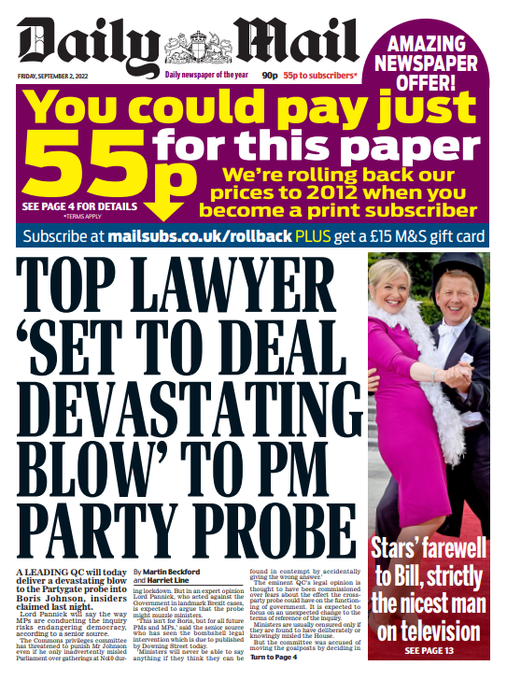
The “opinion”, we were told, would be “devastating”.

To quote the Daily Mail:

“An insider said of the QC’s legal advice: ‘It is absolutely devastating.'”

Not just devastating – but devastating absolutely.

Gosh.

Huge, if true.

*

*

The opinion has now been published on the government’s website.

The government website calls it a “legal opinion”:And the document itself is formatted and signed as an opinion, and it even records the instructing solicitor, who happens to be a criminal defence specialist.

But the opinion does not set out any views on the criminal law, and nor is it in respect of criminal proceedings, and the authors of the opinion are not criminal lawyers.

Indeed, the opinion does not set out any views on a matter before any court or tribunal, or in respect of any criminal or civil liability.

One could even perhaps doubt – but for (ahem) what the government website says – whether this document constitutes a legal opinion at all.

That it has been placed happily into the public domain would make one wonder if any legal privilege would attach itself to this document.

But.

The question for this post is not whether it is a legal opinion or not, but is it devastating?

*

An opinion – which is the name for a document setting out the views of a lawyer on a particular legal matter – is a curious form of legal document.

It is not a pleading or statement of case, which would set out a client’s legal position before a court or tribunal.

Nor is it a statement containing evidence that would set out the facts which a party wishes to put before a court or tribunal.

And nor is it a skeleton argument, which provides a summary of the legal arguments on which a party wishes to rely.

All three of these documents – pleading or statement of case, statement of evidence, skeleton arguments – are court- or tribunal-facing.

They are to assist the court or tribunal in determining the questions before it.

And an opinion is not itself a letter before action, which a party will send to another party so as to set out its case before a claim is issued.

No.

An opinion (or an “advice” depending on the matter) is usually a thing between a client and their lawyer.

The lawyer tells the client their view of the law – and it is to the client that the lawyer has the duty.

Sometimes, such opinions are shared or published by the client – so as to inform or influence third parties.

For example, before he went on to other things, the tax barrister Jolyon Maugham wrote an informative post on how certain tax barristers were well-known for giving convenient advices to be shared:

(Maugham and I are not close, and I am not an uncritical fan of the Good Law Project, but that was – and is – a remarkable piece of legal blogging.)

The point is that such “opinions” are that – they are the views of a lawyer who has an obligation only to their client, even if the client choses to share that document with third parties.

*

As such, an opinion is rarely “devastating” – at least, not to any one else other than the client.

It is merely an expression of a view.

No court or tribunal will adopt such an opinion uncritically as its own view – and, indeed, lawyers are required to set their cases in different documents, mentioned above.

There is a fashion for campaigners and pressure groups to commission opinions from lawyers to use as aids for their goals.

And many lawyers are happy to provide such opinions, knowing they are going to be used for such non-judicial purposes.

But such opinions have, by themselves, almost no weight as a legal document.

They are PR, not probative.

*

And now we come to this, capital-O Opinion.

This Opinion is, in effect, a PR exercise.

If this Opinion was, in fact, devastating then – in my view – it could have been quietly disclosed to the House of Commons committee of privileges in respect of its inquiry.

The inquiry would then have been devastated.

The content of the Opinion would have been so formidable that the committee would have known the game was up, and they would have terminated the inquiry with immediate effect.

That is what the effect of a “devastating” opinion would have been: devastation.

But this Opinion was not quietly disclosed to the committee.

It was instead placed into the public domain.

On a Friday afternoon.

After it was leaked to a newspaper.

(And although those reading this blog may not be readers of the Daily Mail, the newspaper was right to give this Opinion prominence and to quote the insider – for the Opinion and what the insider said are newsworthy.)

*

The publication of this Opinion is an example of litigation by other means.

It is an appeal for media and public support.

It is an attempt to place pressure on the committee to drop the inquiry.

For if the Opinion were truly devastating there would be no need for publicising it on the government website or for leaking it to the press.

That is the difference between something being devastating and something being described as “devastating”.

*

The Opinion is not strong.

Indeed, it relies entirely on the “but for” device, which can be one of the deftest rhetorical tactics for any advocate.

The colour of a thing would be black, but for it being white.

The object would be cheese, but for it being chalk.

And here:

“But for Parliamentary privilege, a court hearing a judicial review application brought by Mr Johnson would declare the Committee’s Report to be unlawful.”

*

There are a few points to make about this Opinion.

To begin with, the inquiry into whether Boris Johnson misled the House of Commons is a matter for Parliament and not the courts.

And Parliament is in charge of its own procedures which, as a matter of basic constitutional principle (and the Bill of Rights), cannot be gainsaid by the courts.

So to say “but for” this being a parliamentary matter it would have this judicial consequence is to disregard perhaps the most fundamental part of our constitutional arrangements.

But.

It gets worse.

*

The Opinion does not even deal with the alleged wrong of Johnson not promptly correcting the record when he realised Parliament had been misled than him misleading parliament in the first place.

This has been spotted by the Labour MP Chris Bryant:

The motion referring Johnson to the privileges committees was as follows:

The question for the committee is whether the misleading of the House of Common amounted to a contempt.

If Johnson did in good faith give an incorrect statement then at some point he would have realised the error.

That would not be a contempt.

But.

Under the rules of Parliament (and the Ministerial Code) Johnson was also under a duty to correct the record as soon as he realised, at the “earliest opportunity” and he has chosen not to do so.

Here is Erskine May, the authority on parliamentary procedure (highlighting added):

On this, see this thread by Alexander Horne from back in April:

And my post on the same:

There is no good reason why this “earliest opportunity” point is not fully addressed by the Opinion.

The Opinion mentions the relevant duty in paragraph 26 (and the corresponding Ministerial Code duty in paragraph 28) but uses it only to somehow say that it indicates only deliberate lying can be contempt.

But if this a point set out in Erskine May, and obvious to Horne (and me) in April 2022, then it is a point that should have been addressed in an Opinion dated 1 September 2022.

As it is, the Opinion offers no defence whatsoever to the “earliest opportunity” charge.

*

The Opinion is also odd in how it seeks to judicial-ise parliament.

This has already been spotted by the estimable Hannah White:

This contempt inquiry is a parliamentary (and political) exercise into assessing whether Johnson was dishonest.

This process is required because of the notion (or fiction) that MPs do not lie to the House.

This is because it is assumed MPs are honourable – and it is out of order for one MP to accuse another of lying in the Commons.

Ministers, for example, do not sign “statements of truth” when giving their answers at the dispatch box.

(And you will remember that Johnson lost the prorogation case at the Supreme Court because he refused to sign a statement of truth, under pain of perjury, as to his true reasons for the prorogation.)

As such the privileges committee inquiry is part of what some commentators call the “political constitution”.

It is how certain issues and disputes are dealt with within parliament, rather than outside of parliament by courts or other agencies.

The Opinion, by seeking to judicial-ise part of the process is taking a misconceived pick-and-mix approach.

The committee has set out its process and has called for evidence:

A motion was passed by the Commons; a process was adopted in accordance with the relevant rules agreed by Parliament; documents have been sought and evidence has been called for.

This is entirely appropriate for the parliamentary issue which needs to be addressed and resolved.

If the committee were to be amenable to judicial review, then the entire process would cease to be an entirely parliamentary matter.

The whole process would have to be recast, with judicial protections built in at each stage.

And, in any case, there is no good reason – and certainly no reason set out in the Opinion – why Johnson cannot simply explain why he gave a misleading statement and did not correct it at the earliest opportunity.

He can answer, parliamentarian to parliamentarians.

The motion of the House gives precise particulars of the statements, and he was the one that made the statements.

The sanction, if he is found in contempt, is not civil or criminal liability – no criminal record or county court judgment – but a sanction to him as a parliamentarian – he could be suspended, or perhaps face a recall petition.

This is a parliamentary process to deal with a parliamentary question with a possible parliamentary sanction.

To assert that “[b]ut for Parliamentary privilege, a court hearing a judicial review brought by Mr Johnson would in our view declare the approach taken by the Committee to be unlawful” is therefore not just deft, it is also daft.

*

As a further observation: why has this matter not seemingly gone through the government legal system and treasury counsel?

It appears a top white-collar criminal firm and the barristers have been instructed directly by the Prime Minister, presumably with public money.

For all Johnson’s derision about “lefty lawyers” and his supporters’ attacks on legal aid “fat cats”, Johnson is very ready to use taxpayer money to find technicalities so as to frustrate processes.

Those caught in the criminal justice system do not have access to this sort of legal advice.

*

To conclude: the Opinion is not only not strong, it is a disappointment.

One would hope and expect that its esteemed authors would have provided a more compelling critique of the process; that they would have engaged with the “earliest opportunity” charge; and that they would have explained, in parliamentary terms why it was unfair, rather than relying entirely on a “but for” rhetorical device and a false analogue.

This could have been a far more interesting opinion.

But instead, we got this weak, misconceived, incoherent document.

Frankly, it is devastating.


**

POSTSCRIPT


***

Thank you for reading – and now please help this blog continue providing free-to-read and independent commentary on constitutional matters and other law and policy topics.

Posts like this take time and opportunity cost, and so for more posts like this – both for the benefit of you and for the benefit of others – please support through the Paypal box above, or become a Patreon subscriber.

***

Comments Policy

This blog enjoys a high standard of comments, many of which are better and more interesting than the posts.

Comments are welcome, but they are pre-moderated and comments will not be published if irksome.

The comments policy is here.

Never underestimate archivists and librarians – as Donald Trump is discovering

31st August 2022

Here is a lovely story about libraries and public policy.

The year is 1983.

The library is the British Library, formerly hosted in the reading room at the British Museum and other sites.

Nicolas Barker, then the library’s head of conservation, and Lord Dainton, then the chair of the British Library Board, had a problem.

Public finances were under pressure, and spending cuts were everywhere.

But.

They needed to work out a way to convince the then Prime Minister Margaret Thatcher about the urgent need for the move of the library to a new purpose-built building.

They decided to keep the issue simple: no lengthy paragraphs in a wordy report, still less charts or tables.

And certainly no waffly arguments.

They instead took her half a dozen books, as well as a novel by one of her favourite authors, which were falling apart, regardless of the care being taken to conserve them.

They placed the books on the table in front of Thatcher.

Silence.

She looked with horror at the state of the books.

Silence.

And then they then said:

‘Mrs Thatcher, we need a new building because all our books will fall to pieces if they stay where they are.’

So horrified was the Prime Minister at the potential fate of the national collection that they got the go-ahead for the new building.

*

There are perhaps two morals to this tale (which I have told before here and is recorded in this obituary).

One is that sometimes exhibits are more persuasive than words.

The other is never to underestimate archivists and librarians.

*

That there seems a real prospect of legal jeopardy for former President Donald Trump because of a breach of American archival law.

For many watching this is evocative of Al Capone being nailed on tax evasion charges.

Archival offences seem to Trump’s supporters a convenient pretext for legal action, rather than a substantive wrong.

But.

It is a substantive wrong.

For keeping documents and other information safe both for now and for posterity is a central function of the state.

It is how the government (and legislature and judiciary) of one day speaks to those charged with power in the future.

It is how those with power can be confident that certain information does not go to those who would use that information to cause damage and injury.

Like the integrity of the currency and protecting the realm, preservation of certain information is a core duty of those entrusted with power.

And like the damaged books put in Thatcher, visual evidence can be telling:

(Source.)

Of course, few of us know the facts.

It may well be that this legal exercise comes to nothing, and Trump escapes personal legal liability again.

And Trump is entitled to due process, like you and me.

But the wrongful removal of information from a government is not a trivial thing.

For without properly documented information, modern governments could not function.

That is why laws and policies about document management and retention are so important.

And there would be a wonderful irony if laws and policies about ensuring the integrity of written information were used to check the arch-abuser of political language and post-truth politics.

POSTSCRIPT

The historian Dr Adam Chapman has provided us with this similar story – click through to read more:


***

Comments Policy

This blog enjoys a high standard of comments, many of which are better and more interesting than the posts.

Comments are welcome, but they are pre-moderated and comments will not be published if irksome.

The comments policy is here.

“[X] is [not X]!” – commentary in the age of populism, polarisation, and post-truth

23rd August 2022

One problem with books like Nineteen Eighty-four is that their sheer familiarity means they lose their impact.

Indeed, phrases like Big Brother and Room 101 have become so detached from their literary mooring that they now have their own existence in popular culture.

George Orwell, if he were still alive and writing, would probably say that we should not use such now-hackneyed images and create fresh ones – and he may well have a point.

He would no doubt urge that we throw away Nineteen Eighty-four and come up with new and vivid turns of phrase.

But it is a pity for there is one passage in particular in his great novel which seems very relevant in these days of populism, polarisation, and post-truth, the 3Ps.

You will know the passage:

“From where Winston stood it was just possible to read, picked out on its white face in elegant lettering, the three slogans of the Party:

WAR IS PEACE

FREEDOM IS SLAVERY

IGNORANCE IS STRENGTH”

 In formal terms:

“[X] is [the opposite of X]

[Y] is [the opposite of Y]

[Z] is [the opposite of Z]”

*

These slogans are extreme.

But they are perfect, in their ways, for they cover and anticipate what may otherwise disprove them.

These are the slogans of politicians who are utterly unafraid of it being pointed out that the opposite is the case to what they are claiming.

*

The slogans of today are similar in effect, if not form, in that they are not capable of being defeated by the opposite being the case in reality.

Yesterday on this blog it was contended (again) that there is not only a discrepancy but a contradiction between the slogan “Law and Order!” and actual law and order.

But there are many more.

For example, think about “Free Trade!” vs free trade.

In the name of “Free Trade!”, we have in Great Britain – with this government’s Brexit policy – cut ourselves off from an immense single market just a few miles away.

Similarly, in the name of “Free Speech!” all supposedly “woke” positions are to be cancelled, especially if taxpayers’ money is involved.

And so on.

There are many more.

*

But none of these contradictions matter, for the slogans can brook no opposition:

“Law and Order!”

“Free Trade!”

“Free Speech!”

Against any practical objection – or empirical disproof – the shouted slogans just get louder, and the nods and cheers – and clicks – continue.

Against this, commentary is often pointless.

It does not matter that anyone is pointing out the differences between what is said and what is done, because these politico-linguistic constructs have lives of their own.

You may as well try to catch ghosts and wisps with a butterfly net.

*

As this blog has averred before, there is still some purpose in commentating, as at least there can be a register at the time that some people saw the mismatches.

And there may be – perhaps – one or two readers who come to a blog like this other than to have their prejudices confirmed.

But generally blogs like this are merely part of the noise that 3P politicians actually want to provoke – the sound of “libs” being “owned”.

Perhaps after the general election there may be politicians in power (even from the current governing party) who want again to connect what they say with what they do.

Perhaps there may even be enough voters who begin to care that they are being lied to.

Perhaps.

But as it stands, a great deal of commentary – including on this blog – is not making things any better, because many politicians know it does not matter if what they say is not true.

If politicians and voters do not mind such contradictions, then pointing out these contradictions has no real purchase.

And until there comes about politicians that want power who can provide leadership – and make voters care about they are being lied to – then there is little point to law and policy commentary.

But we should do it anyway.

***

Comments Policy

This blog enjoys a high standard of comments, many of which are better and more interesting than the posts.

Comments are welcome, but they are pre-moderated and comments will not be published if irksome.

The comments policy is here.

How to read a formal document

27th July 2022

This post follows yesterday’s very popular post which provided a close reading of the letter from Prime Minister Boris Johnson to the House of Commons liaison committee.

Indeed, the most popular posts on this blog are often close readings of some formal document or another.

It therefore seems a good idea to do a stand-alone post on how to read formal documents.

*

In doing this, please note I am not trained in forensic linguistics – nor am I clever enough to understand deconstructionism or post-modern philosophy.

My perspective is that of a practical lawyer and legal commentator.

This means that with one hat (or wig) I create legal and other formal documents, and with the other I take them apart and seek to explain them to the public.

So treat this post like a poacher’s guide to gamekeeping, or as a gamekeeper’s guide to poaching.

It is also perhaps relevant that I have a history degree and that I am a former central government lawyer.

In other words: I am a documents geek.

*

Let us begin with what we are looking at.

What is a formal document?

Literally, a formal document would be a document that has a certain, well, form.

And documents that have to be set out in a certain form are usually formal documents.

But the term has a wider meaning, and I take it to cover serious and considered documents generally.

In this way formal documents are distinct from, say, casual writing.

In essence: a formal document is a document which has been created with care to serve a function.

*

So the first step is to understand the function of a formal document.

Why has this document been created?

An Act of Parliament or a deed is created so as to create or affect legal relationships.

A resignation letter is created so as to effect a resignation.

A letter in response to a request needs to be understood in the context of the request.

And so on.

Once you have ascertained the function of a document, that will inform you as to what one can expect to be in the document.

For example, here is the resignation letter of President Richard Nixon:

This letter fulfils its function.

Nothing more needed to be said, and so nothing more was said.

In contrast, this is the Article 50 notification letter of then Prime Minister Theresa May.

All that letter needed to say was that the United Kingdom is providing notification of its intention to depart the European Union.

But the letter went on (and on) for six pages.

There was no need for anything more than one substantive paragraph.

And so by understanding the function of a formal document you can understand which part of its content serves the function of that document – and what part needs other explanations.

*

The next question to ask is whether the document is an instrument.

Some documents record things, and some documents do things in-and-of-themselves.

For example, an Act of Parliament does not (normally) record the law but is a source of the law.

Or a deed does not (usually) evidence a contract but can create legal relationships and obligations.

This is why lawyers can be prone to pompous language such as “hereby” and “hereinafter” as the idea is that the words on the page that are themselves (magically) creating things.

If a document is an instrument then for it to have the intended (magical) effect then certain words and phrases (spells) have to set out (incanted) in a certain way.

And if those words and phrases are not set (incanted) in a certain way then the instrument fails.

One error that can be made by those who are inexperienced with dealing with certain instruments is to take such formalities as saying something in particular.

For example, take the preamble for an Act of Parliament:

If you had never seen an Act of Parliament before you may wonder why all these lords (spiritual and temporal), and commoners, happened to be assembled in one place for enacting this bill.

But when you realise the document is an instrument – a document which, in-and-of-itself does a thing, you see which parts make it instrumental – and thereby which parts do not need another explanation

*

The next question to ask is about what audiences the document will have.

For example, take a lawyer’s letter threatening legal action.

If the letter is “open” it is intended to be placed before the court to show that the suing party put its case to the defendant(s) before issuing a claim.

The letter thereby is written for the judge.

But the letter is also written for the other side to see – and to have a certain effect on the other side.

Another audience for the letter is the suing lawyer’s own client, who may have wanted a robust lawyer’s letter as a form of satisfaction – or perhaps therapy.

A wise lawyer in a high-profile case will also realise that a potential audience for such a letter can be the public and/or the media.

Another example are contracts.

A contract is there to tell the court what the parties have agreed, including as to what would happen in certain circumstances.

But a contract also needs to be comprehensible to the parties without going to court.

And the contract may need to be disclosed to regulators and tax authorities, or investors and business purchasers.

Parts of the contract may be written with one or more of these audiences in mind.

And in this internet age, resignation letters – of which there have recently been a large number in British politics – can be written not just for the respondent but also for the public to read on social media.

*

And now we get to the author(s).

Many formal documents are not created by a single author.

Indeed, many formal documents can be regarded as negotiated documents – whether the negotiation is between different parties (like a contract) or between the nominal author and their advisors and employees.

A ministerial letter can be as much the product of civil servants and perhaps special advisers than of the mind of the minister themselves.

Some formal documents, such as Acts of Parliament, are the work of dozens – perhaps hundreds – of people.

Sometimes one can discern the subjective intention of an author – and how the creation of a document serves that author’s personal or partisan interests.

This is especially true if a particular person approves the final version of the document.

But sometimes that personal or partisan interest is not obvious and is difficult to disentangle from the function of the document and the purposes of its content.

Authorial intention is important – sometimes crucial – but it is not the only thing.

The best starting points with a formal document are function and purpose – and it is then, by relief, that you can sometimes see how an author’s personal or partisan interests are being promoted or protected.

*

Now we come to the important bit.

The first of two ingredients of close reading.

Read what the document (actually) says.

Read every word and every phrase and think about those words and phrases.

You should presume every word and every phrase of a formal document is there for a purpose.

Your job is to work out that purpose.

Some lawyers call this “the rule against surplusage”.

The document itself should have a function – but in serving that function every word and every phrase in that function can be presumed to have a purpose.

Of course, you can have redundant words and phrases – just as you can have redundant code in a computer program.

But until you are satisfied that the words and phrases are redundant, the safe presumption is that they are purposeful.

For what is written with care should be read with care.

So you should ask: what is that word or phrase doing?

*

And now we come to the difficult bit.

The second ingredient of close reading.

This is working out what is not said – or what could have been said differently, but was not.

For it is one thing to read carefully what is written, but it is another to work out what is not there.

Here we are not only concerned with complete, glaring omissions.

It is more about the words and phrases that could have been used – but were not.

It is about the text in the context of its function and of the relationship between the author(s) and its audiences.

Here context is important.

Some judges like to say “context is everything”.

This is true – but this does not mean context is anything.

The context of a text needs to relate to that text – and, in particular, the function of the text, the purpose(s) of its content, the audiences of the text, and the position (and subjective personal and partisan interests) of its author(s).

*

Now let’s look again at Johnson’s letter to the liaison committee.

That letter, in response to a direct and plain query, could have said (and ideally should have said):

1. Alexander Lebedev’s name and his position as a former KGB spy;

2. That the then Foreign Secretary meeting Alexander Lebedev at the party was unexpected;

3. But in any case, that no official business was discussed between Alexander Lebedev and the then Foreign Secretary; and

4. That the meeting was, of course, reported to officials.

Had the Prime Minister been able to give this (ideal) response then he would have done so.

But he did not.

And he did not because he could not.

(And, although Johnson is a habitual and fluent liar, he could not say something in this exchange and in this formal document which may emerge as untrue.)

He did not want to say plainly: “As Foreign Secretary, I was not surprised to meet Alexander Lebedev, a former KGB spy, at a party where government business may have been discussed, and I did not subsequently report this meeting to officials”.

One can understand why.

So, applying the above approach, we can work out the following.

The function of his letter was to reply to the committee’s query.

The purpose of the content of the letter was to give the impression that he was answering the question posed.

Care and effort went into the words and phrases used.

As a ministerial letter, it would have been authored by Johnson in negotiation with his advisers, but he would have had final approval.

The audience for the letter is the committee and the public – and, crucially, individuals who may have evidence that government business was discussed.

We know what he could (and should) have said in an ideal world in response to the query – that he had not met a former KGB spy and he had not discussed government business without officials present.

We also know what he could have said, if he were writing plainly – that he had met a former KGB spy and may have discussed government business without officials present, and he did not report this meeting.

By comparing what he could (and should) have been able to say with what he did say we can see a gap.

Johnson went out of his way not to mention Alexander Lebedev by name, let alone his position as a former KGB spy.

Johnson went out of his way not to say that the meeting was unexpected – saying only that it was not “pre-arranged”.

Johnson went out of his way not to say plainly that official business was not discussed, but instead used a formulation “[a]s far as I am aware” that makes no sense as he would presumably have complete knowledge of any conversation to which he was a party.

And Johnson goes out of his way to give the impression that things were properly reported when he did not report the conversation to officials subsequently.

All this can be worked out not by just reading what the letter says but by comparing what the letter said with what it should have said in response to the query.

*

A close reading of any formal document is a combination of reading carefully what is said and considering carefully what could have been said but was not.

The danger of this approach, of course, is that one can speculate or project things.

This is why understanding the function of the document and the purpose(s) of its content are important.

Regard to function and purpose provides the guide to measure what is said against what is not said – and it also provides the discipline against speculation and projection.

Nixon’s resignation letter requires little or no gloss.

May’s Article 50 notification letter indicates that five pages of verbiage requires some explanation by something other than the notification itself.

Johnson’s letter to the liaison committee contained twelve paragraphs in response to a simple query, seeking to mask and misdirect from the true situation – that he had, as Foreign Secretary, met a former KGB spy and was not able to say definitively no official business was discussed, and that this meeting was not subsequently reported to officials.

*

In essence: a formal document is one where the document has been created with thought and care to serve a function, and with words and phrases chosen (and not chosen) by its author(s) so as to serve particular purposes before certain audiences.

And a close reading of that formal document is where you have regard to the thought and care that went into that document, and its context, working out why certain words and phrases were chosen and what things were not said instead.

Welcome to being a documents geek.

***

Thank you for reading (closely or otherwise).

Please help this blog continue providing free-to-read close readings of documents, as well as independent commentary on constitutional matters and other law and policy topics.

Posts like this take a lot of time and opportunity cost, and so for more posts like this – both for the benefit of you and for the benefit of others – please support through the Paypal box above, or become a Patreon subscriber.

***

Comments Policy

This blog enjoys a high standard of comments, many of which are better and more interesting than the posts.

Comments are welcome, but they are pre-moderated and comments will not be published if irksome.

“As far as I am aware, no Government business was discussed” – A close reading of Boris Johnson’s letter about the Lebedev meeting

26th July 2022

There are perhaps two stages to a close reading of a legal, formal or otherwise considered or negotiated document.

The first stage – sometimes overlooked – is to read what the document actually says (and not what you think or hope it says).

The questions to ask here are: What is the content? How is that content framed and conveyed? What propositions are put forward? How are paragraphs and sentences structured? What words are used?

And so on.

In essence: if thought has gone into compiling a text, thought should also go into reading that text.

The second stage is more difficult.

Here the reader needs to work out not what is said, but what is not said.

Why did the writer not say certain things which they otherwise would have said?

What were the words and phrases and sentences which could have been used, but were not?

Of course: this second stage can be prone to speculation or projection or other forms of (over-)elaborate analysis.

But it can be a useful exercise when one has a document where the wording seems, well, strained or odd.

In short: why does the text say this – and not something else?

*

Now we come to a letter that was placed today into the public domain.

The letter is from the current (and departing) Prime Minister Boris Johnson and it is on his official headed paper.

You can read the letter here.

The portion of the letter with which this blogpost is concerned is that under Question 41.

The background to this is as follows: on or about 28 April 2018, Boris Johnson, then Foreign Secretary, attended a social event in Italy where one of the other guests was Alexander Lebedev, a former KGB agent.

He was asked about this when he appeared at the recent liaison committee of the House of Commons on 6 July 2022:

There was a follow-up question:

This was not a comfortable moment for the Prime Minister – and it was at the time he was being forced to announce his upcoming departure as Prime Minister.

You will see from the exchanges above that Johnson said he would write to the committee – but in any case the chair of the committee wrote to the Prime Minister on 8 July 2022 expressly asking for – among other things – the Prime Minister to write on the matter of:

“Whether you met with Alexander Lebedev on 28 April 2018 without officials, and whether officials were subsequently informed of the meeting”

The question being asked was plain – and precise.

*

In his letter dated 21 July 2022 (and published by the committee today) devotes over a page of a four-page letter to responding to this question:


*

You will see the response to the question asked comprises twelve paragraphs.

And you will see that from the fifth paragraph onwards, the information provided is not the information requested.

Indeed, if you look at the final paragraph, the Prime Minister is providing information about who Labour politicians have met.

Only the first four paragraphs of the response relate to the request and should be read again:

You can read these paragraphs as well as anyone, and it is worth taking time to read what they say.

And what they do not say.

*

For some reason, there is no mention of Alexander Lebedev by name – he is instead alluded to as “Evgeny Lebedev’s father”.

Johnson was asked both in the committee and in the chair’s subsequent letter whether officials were subsequently informed of the meeting.

Johnson’s letter places emphasis on a notification made about hospitality and that officials were “aware” in advance that he was attending.

You will see both the notification and the “aware” comment are about the social event generally – and not the meeting with Alexander Lebedev in particular.

Johnson cannot bring himself to say plainly that officials were not subsequently informed of the meeting with Alexander Lebedev.

The admission is instead buried in the following text:

In plain language: the Prime Minister did not subsequently notify officials of his meeting with Alexander Lebedev.

Johnson seeks to misdirect the reader with mentions of a notification about hospitality and officials being “aware” in advance of the social event generally, but the answer to the straight question is that he did not notify officials.

Indeed, there is no reason to believe from the content of this letter that officials were aware in advance that Alexander Lebedev would be in attendance.

Johnson further states the meeting with Alexander Lebedev was “not a formal meeting, nor something that was pre-arranged”.

This wording is odd.

That it was not “a formal meeting” is no more than a tautology that this was a social event – it is not a new point, but a dressing up of a point already made.

And that the meeting was not “pre-arranged” does not preclude the meeting as being expected.

Johnson does not say he was surprised to see Alexander Lebedev, which he could have said.

*

The most remarkable phrase in the letter, however, is that “[a]s far as I am aware, no Government business was discussed”.

That formulation is strained in the extreme, as it would be within the Prime Minister’s knowledge what was discussed and what was not.

The “[a]s far as I am aware” proviso makes sense in a formal document when a person cannot have complete knowledge of a thing themselves.

But Johnson would presumably have complete knowledge of what he said.

Note also the Prime Minister does not simply say “[N]o Government business was discussed”.

If the Prime Minister could have said just that, he would have done so – and put the matter beyond any doubt.

But he did not say that, and that is presumably because he cannot say that.

He also does not use the more common “[a]s far as I can recollect” proviso.

The only reasonable explanation for the proviso “[a]s far as I am aware” in that statement is that the Prime Minister is aware of the possibility that government business was discussed, and so he does not want to be pinned down to a more committed answer that could mislead parliament.

*

In summary, Boris Johnson did not notify officials that he had met Alexander Lebedev, and he cannot recall exactly what was discussed.

That is the only sensible interpretation and construction on the letter he has sent to the liaison committee, even though the letter goes out of its way not to mention Alexander Lebedev, and goes out of its way not to say expressly that officials were not subsequently notified, and goes out of its way to implicitly accept government business may have been discussed.

Instead of the twelve paragraphs of misdirection and waffle he could have said:

“I did not notify officials that I had met Alexander Lebedev, and I cannot recall exactly what was discussed.”

Instead, none of the information which the committee asked for directly is provided directly.

*

There is something strange and worrying here.

If the meeting in Italy was straightforward and above board, then the response published today would also have been straightforward and open.

But the response was not – and that presumably is because the meeting was not.

Curious stuff.

***

Thank you for reading – and please help this blog continue providing free-to-read, independent commentary on constitutional matters and other law and policy topics.

Posts like this take time and opportunity cost, and so for more posts like this – both for the benefit of you and for the benefit of others – please support through the Paypal box above, or become a Patreon subscriber.

***

Comments Policy

This blog enjoys a high standard of comments, many of which are better and more interesting than the posts.

Comments are welcome, but they are pre-moderated and comments will not be published if irksome.

Some thoughts about blogging and “style”

 1st July 2022

You will be somewhat bemused to know that this blog has featured in a style-guide for writing.

Yes, I know.

But it is true:

It would appear that this blog is regarded as having a distinctive style – and that the distinctive style is, in turn, regarded as being helpful to those interested in the topics covered by this blog.

So, on this Friday afternoon – as I put together some longer pieces for next week – I thought it may interest some of you for me to write something about why this blog has this distinctive (that is, peculiar) style.

*

The main reason I write in one-sentence paragraphs on this blog is because it suits me – for it helps me organise and then express my thoughts.

With a one-sentence paragraph there is no hiding place for the author.

Either the one-sentence paragraph puts forward a worthwhile proposition or it does not.

With longer paragraphs – with multiple clauses and sentences – there is scope for waffle, inexactness, and evasion.

And so one-sentence paragraphs are a means of keeping an author sharp – they are a discipline.

Even if nobody read this blog – and one happy day constitutional law may again be so dull that nobody will read blogs about law and policy – I would still write in this style on this blog.

That may well be selfish, but it is true.

*

And just as there is no hiding place in each one-sentence paragraph this also means there is no hiding place in a sequence of one-sentence paragraphs.

If there is a fault in the reasoning or the evidence, it will stand out.

The weakness in the chain will be evident – glaringly so.

This again helps me as a writer, but it also helps you as a reader.

If I make a mistake in my reasoning or with my evidence, you can quickly work out where I have gone astray.

You can either then dismiss the point I am seeking to convey or engage in the comments below (or on Twitter).

And so if my propositions are weak and/or my observations and illustrations banal and/or my arguments unsound, you will at least know where the fault is.

*

Another advantage of short paragraphs – one-sentence or not – is that they are easier to read on the screen.

They are – for want of a better word – scrollable.

A reader may read five successive short paragraphs, but he or she may be put off from reading the same sentences in one long paragraph.

This is often not the case when reading from physical pages, but when you are reading from computer screen and other electronic devices, short crisp paragraphs are often more readable.

And this is especially helpful when there is a lot of ‘white space’ – and thanks to the generosity of my Patreon and Paypal supporters, this blog has not – yet – resorted to commercial advertising to blight the nice white space surrounding the words.

For to misquote a clever philosopher: there should be nothing outside the text.

*

Another reason why I write like this is that I was brought up in tabloid-reading households.

You may not like such newspapers – and you may prefer broadsheets with their correspondingly broad passages.

But writing brisk short sentences about current affairs is a skill in and of itself, and for most of my childhood that is how I read both news and comment.

(The veteran newspaperman Neil Wallis once told me he had guessed from my blogging that I had been brought up in a tabloid-reading household, and he was right.)

*

So there are advantages of blogging in this way, both for the author and for the readers.

But.

It is not the ‘right’ way.

And this is because there is no ‘right’ way.

There are instead ways of blogging that work for both writers and readers – and there are ways that do not.

Some of the gods of British blogging – such as Chris Grey on Brexit and Lawrence Freedman on strategy and war – provide highly readable, compelling blogs with detailed multi-sentence paragraphs.

As did the greatest of all British legal bloggers, the late Sir Henry Brooke – who, wonderfully, came to blogging after being a court of appeal judge.

His blog – which is thankfully still online years after his death – is a must-read for anyone interested in the law.

So there are a number of ways of blogging.

It all comes down to what suits the writer, and to what suits the readers (if any).

*

But.

There are disadvantages of this blog’s approach.

Some propositions are complex and so require more than can be packed into one sentence.

You then get odd-looking long sentences that try so hard to keep everything in one sentence – but they are obviously contrived, and they are as awkward to read as they are awkward to write, and so should never have been started in the first place; and they often resort to sub-clauses just to keep to the somewhat artificial one-sentence rule.

Such sentences should be avoided.

As Orwell averred after offering his rules for good political writing:

Break any of these rules sooner than say anything outright barbarous.”

*

So the style of this blog is adopted mainly for the selfish reason that it helps me to think clearly and to organise and express those thoughts.

And if blogging in multi-sentence paragraphs helped me do the same, then I would blog like that instead.

One-sentence paragraphs are therefore not a model, but just a technique.

*

Overall, the best guide to good writing is that it is not about the writing, but about the thinking.

If you think clearly, you will tend to write (and speak) clearly.

And if you do not think clearly, then no style-guide will help you.

For, as the techies say: garbage in, garbage out.

**

Thank you for reading – posts like this take time and opportunity cost, so please support this free-to-read independent source of commentary.

For more posts like this – both for the benefit of you and for the benefit of others, and with lots of white space(!) – please support through the Paypal box above, or become a Patreon subscriber.

***

Comments Policy

This blog enjoys a high standard of comments, many of which are better and more interesting than the posts.

Comments are welcome, but they are pre-moderated and comments will not be published if irksome.

Who watches the watchmen?

Summer Solstice 2022

Over at Al Jazeera – where I am pleased to write posts from a liberal constitutionalist perspective – I have written about what the Lord Geidt resignation tells us about British politics.

Somewhat flatteringly, that post has been chosen as a ‘best column’ by The Week magazine:

From a personal perspective, the post is one of very few I have written for the mainstream media with which I am happy.

(One day I will get the hang of writing paragraphs with more than one sentence.)

On the back of that Al Jazeera post I thought I would add here some thoughts about constitutionalism and absolute power.

For, as Lord Acton famously once said (and to which I allude in the Al Jazeera post), power tends to corrupt and absolute power corrupts absolutely.

*

One problem with many – if not most – proposed or imagined political systems is that there is little or nothing to check or balance those who will have the most power under that system.

The hope is presumably that those with the most power will be selfless patriots – good kings, good chaps, and so on.

But, of course, what will tend to happen is that those with power will be corrupted, and those with absolute power will be corrupted absolutely.

And not just corrupted in a narrow financial sense, but in the broader sense of becoming debased.

In this way Orwell’s pigs in Animal Farm may be a more realistic guide to what happens with sustained one party control than the focused O’Brien in Nineteen Eighty-four.

Alan Moore – who I mention expressly in the Al Jazeera post – has repeatedly shown in his stories what can happen when individuals get unchecked power.

In Watchmen – there is a character with absolute superpowers who goes quite mad, a character with immense wealth who becomes immensely destructive, and a character with complete government protection who does whatever he wants to whoever he wants.

And these are the supposed good guys – and none of them is the supposedly unhinged one, Rorschach.

*

Switching from imagined communities to historical examples, there are actually few examples of that most peculiar figure ‘the enlightened despot’.

What we do have are despots with good P.R. and gullible historians.

For if a leader is ‘enlightened’, they do not need to be a despot.

Even the supposed good guys of the modern age – the British – have a wretched record if you look closely enough – for example in Kenya, in Northern Ireland, and in Afghanistan and Iraq.

The documented evidence of torture and war crimes by the British cannot be denied, but few realise or care.

For that is what happens when you have good P.R. and gullible historians.

Even the popular comedy meme about ‘Are we the bad guys?’ is dressed in foreign uniforms.

But corruption – in both its narrow and broad sense – is not just about what happens to foreigners.

It can happen in any polity – and with any rulers, if they believe they can get away with it.

*

That is why any political system which confers great power on any individuals is suspect.

Yes, you may have a selfless patriot as an initial ruler, but what do you get when the selfless patriots die away?

The primary job of any liberal constitution is not that it provides and allocates powers, but that it effectively checks and balances those with powers.

It assumes the worst – even if there are hopes for the best.

And if those with the greatest powers in any political system are without checks and balances then it should not come as a surprise that powers are abused.

Indeed, it would be more of a surprise if they were not.

***

Comments Policy

This blog enjoys a high standard of comments, many of which are better and more interesting than the posts.

Comments are welcome, but they are pre-moderated and comments will not be published if irksome.