Trump v the BBC cont’d: an odd and desperate letter from the US media regulator

22nd November 2025

*

Why the BBC is right not to pay damages to Trump

14th November 2025

By apologising, the broadcaster has taken the sting out of Trump’s excessive attack

I have done a piece at the New Statesman where I used to be legal correspondent, you can read it here.

You can comment below.

A close look at Trump’s $1 billion claim against the BBC

11th November 2025

The litigation letter is weak, but his underlying practical position is not weak

*

The headlines are eye-catching.

Other, similar front pages are here.

What is going on?

And what can be usefully said from a United Kingdom perspective about this threat by the President of the United States of America to sue our state broadcaster, the British Broadcasting Corporation?

This post is divided into three parts: (1) what is being complained about, (2) what can be said about the threat from a legal perspective, and (3) how this threat fits into he context of how President Trump uses civil litigation and threats of civil litigation.

In essence: what are the facts, what is the legal analysis, and what is the practical position.

*

Posts like these take time and opportunity cost – and this blog (currently) is free-to-view and does not have advertising. So if you do genuinely value independent and informed law and policy commentary (rather than AI slop, client journalism, or litigation PR) please become a paying subscriber.

The Empty City – a law and polity blog is a reader-supported publication. To receive new posts and support my work, please become a paid subscriber.

*

Let us begin.

The complaint is in respect of a Panorama programme broadcast by the BBC on 28 October 2024, which is well over a year ago.

The BBC page for the programmes is here:

You will see on that page that “this episode is not currently available”.

You will also see that dates of the broadcast:

Note that the broadcast dates are before Trump’s successful election on 5 November 2024.

And if you look carefully at that page you will also see that the programme was not made by the BBC, but by a third-party production company. This was thereby not made directly by the BBC news teams, though they would have presumably reviewed and approved the content before broadcast.

This distinction between production and broadcast is not unusual for such programmes.

There is also no evidence that the programme broadcasts were readily available in the United States:

*

As regards the content complained of, the Guardian have provided this handy comparison, which you should now click on and watch:

It is a speech by President Trump on 6 January 2021.

In the Panorama edit two parts of the speech are put together so to give the impression that a single statement was made – effectively a succinct incitement to violence:

“We’re going to walk down to the Capitol and I’ll be there with you, and we fight. We fight like hell.”

In fact the first part – “We’re going to walk down to the Capitol…” – and the last part – “…and we fight. We fight like hell” – were at different parts of the same speech. Indeed, the two passages are about 54 minutes apart.

*

From a journalistic and editorial perspective, the Panorama edit is misleading. It conveys the false impression that the two statements were said in one go. There is nothing in the Panorama edit to suggest any passage of time between the two utterances.

As such, from a journalistic and editorial perspective, the Panorama edit is indefensible and it should not have been broadcast.

*

However, not all journalistic and editorial errors are breaches of the law.

For such an error to be unlawful as well as unfortunate something else is needed. A complainant needs to bring the error into the scope of the applicable law, which in England and Wales, for example, would the laws of libel and of malicious falsehood.

A journalistic or editorial error is not, in and of itself, actionable at law.

*

So what is the legal complaint of President Trump and his legal representatives?

According to Sky the legal letter is as follows:

Re: Demand to Retract False And Defamatory Statements About The President of the United States of America

Dear All:

This law firm serves as litigation counsel for President Donald J Trump (hereinafter referred to as “President Trump”). Please direct all future correspondence relating to this matter to my attention. This correspondence serves as a demand under Florida Statute § 770.011 that you immediately retract the false, defamatory, disparaging, and inflammatory statements made about President Trump, which were published in a Panorama documentary that was fabricated and aired by the BBC.

Failure to comply will leave President Trump with no choice but to pursue any and all legal rights and remedies available to recover damages for the overwhelming financial and reputational harm that the BBC has caused him to suffer, with all rights and remedies being expressly reserved by President Trump.

In the Panorama documentary, titled “Trump: A Second Chance”, which was first broadcast on October 28, 2024 – a week before the 2024 United States presidential election – the BBC intentionally sought to completely mislead its viewers by splicing together three separate parts of President Trump’s speech to supporters on January 6, 2021.

The documentary showed President Trump telling supporters: “We’re gonna walk down to the Capitol and I’ll be there with you and we fight. We fight like hell and if you don’t fight like hell, you’re not going to have a country anymore.”

This fabricated depiction of President Trump was false and defamatory given that President Trump’s actual and full remarks were: “We’re going to walk down, and I’ll be there with you, we’re going to walk down, we’re going to walk down any one of you but I think right here, we’re going to walk down to the Capitol and we’re going to cheer on our brave senators and congressman and women.”

Moreover, the BBC edited out President Trump saying, “I know that everyone here will soon be marching over to the Capitol building to peacefully and patriotically make your voices heard.” Thus, as set forth in an internal whistleblower memorandum, the BBC’s segment maliciously made it appear that President Trump “[said] things [he] never actually said,” by editing together footage from the start of the speech with a separate quote early an hour later.

Due to their salacious nature, the fabricated statements that were aired by the BBC have been widely disseminated throughout various digital mediums, which have reached tens of millions of people worldwide. Consequently, the BBC has caused President Trump to suffer overwhelming financial and reputational harm.


A. Applicable law

Words are defamatory under Florida law when “they tend to subject one to hatred, distrust, ridicule, contempt or disgrace or tend to injure one in one’s business or profession.” Johnston v. Borders, 36 F.4th 1254, 1275 (11th Cir. 2022) (quoting Am. Airlines, Inc. v. Geddes, 960 So. 2d 830, 833 (Fla. 3d DCA 2007) (citation and quotation marks omitted)). Statements are defamatory if “the defendant juxtaposes a series of facts so as to imply a defamatory connection between them, or creates a defamatory implication by omitting facts.” Johnston v. Borders, 36 F.4th 1254, 1275 (11th Cir. 2022) (quoting Jews for Jesus, 997 So. 2d at 1108).

Further, “where the speaker or writer neglects to provide the audience with an adequate factual foundation prior to engaging in the offending discourse, liability may arise.” See Zambrano v. Devanesan, 484 So. 2d 603, 607 (Fla. 4th DCA 1986).

Even if the BBC attempts to whitewash its conduct as simply an expression of its opinions, Florida law makes clear that such a defense will not absolve its liability. See Dershowitz v. Cable News Network, Inc., 541 F. Supp. 3d 1354, 1362 (S.D. Fla. 2021); see also Milkovich v. Lorain Journal Co., 497 U.S. 1, 18-19 (1990) (”Even if the speaker states the facts upon which he bases his opinion, if those facts are either incorrect or incomplete, or if his assessment of them is erroneous, the statement may still imply a false assertion of fact. Simply couching such statements in terms of opinion does not dispel these implications.”) (emphasis added); see also Eastern Air Lines, Inc. v. Gellert, 438 So. 2d 923, 927 (Fla. 3d DCA 1983) (“[A] statement that although ostensibly in the form of an opinion ‘implies the allegation of undisclosed defamatory facts as the basis for the opinion’ is actionable.”) (emphasis added).

Consequently, the BBC lacks any viable defense to the overwhelming reputational and financial harm it has caused President Trump to suffer.


B. Demand

The above-referenced false, defamatory, malicious, disparaging, and inflammatory statements were published to deliberately denigrate President Trump. The timing of the fabricated documentary is evident.

The BBC’s reckless disregard for the truth underscores the actual malice behind the decision to publish the wrongful content, given the plain falsity of the statements.

Accordingly, President Trump hereby demands that you:

1) immediately issue a full and fair retraction of the documentary and any and all other false, defamatory, disparaging, misleading, and inflammatory statements about President Trump in as conspicuous a manner as they were originally published;

2) immediately issue an apology for the false, defamatory, disparaging, misleading, and inflammatory statements about President Trump; and

3) appropriately compensate President Trump for the harm caused.

Moreover, please allow this letter to serve as notice to you, to your affiliated entities, subsidiaries, to all of their employees, and any other person acting on behalf of or in concert with the BBC, to preserve any and all evidence related in any way to the above-mentioned malicious, false, and defamatory statements the BBC published, and any other statements that the BBC has published regarding President Trump.

By way of this letter, the BBC is hereby directed not to destroy, conceal, or alter any paper or electronic files, physical evidence, and/or other data relating in any way, no matter how remote, to your false claims regarding President Trump, and/or the circumstances leading to their dissemination, including, but not limited to:

1) all communications between you and any third party in any way related to your wrongful claims regarding President Trump;

2) all sources for your false claims regarding President Trump;

3) any and all documents and data referring to, reflecting, or relating to communications between you and any such third parties or sources regarding your false claims regarding President Trump; and

4) any and all documents in any way related to your false claims regarding President Trump. This includes any information alleged to be protected by Florida Statute § 90.5015. Monarch Air Group, LLC v. Journalism Dev. Network, Inc., No. 23-CV-61256, 2025 WL 445491, at *1 (S.D. Fla. Feb. 10, 2025) (interpreting Fla. Stat. § 90.5015 and explaining that the Eleventh Circuit “recognizes a qualified privilege for journalists, allowing them to resist compelled disclosure of their professional news gathering efforts. This privilege shields reporters in both criminal and civil proceedings.”) (quoting United States v. Capers, 708 F.3d 1286, 1303 (11th Cir. 2013)).

I understand that many records and files are maintained electronically. However, this letter specifically requests that all paper and hard copy originals be maintained and preserved in their original format.

By the same token, electronic documents and the storage media on which they reside may contain relevant, discoverable information beyond that which may be found in printed documents. Therefore, even where a paper copy exists and has been preserved, please preserve and maintain all electronically stored documents in their original native format, including all metadata.

This preservation demand specifically encompasses any and all electronic documents, including but not limited to, all word-processed files, emails, spreadsheets, all databases, log files, and any other electronically stored and/or generated documents or files.

If the BBC does not comply with the above by November 14, 2025, at 5:00 p.m. EST, President Trump will be left with no alternative but to enforce his legal and equitable rights, all of which are expressly reserved and are not waived, including by filing legal action for no less than $1,000,000,000 (One Billion Dollars) in damages.

The BBC is on notice.

PLEASE GOVERN YOURSELF ACCORDINGLY.

[ ]

(That last term in block capitals is a feature of US litigation letters.)

*

There some rather odd things about this legal threat.

*

First, the letter states in three places about the the reputational harm caused to Trump:

“…the BBC lacks any viable defense to the overwhelming reputational and financial harm it has caused President Trump to suffer”

“…the overwhelming financial and reputational harm that the BBC has caused him to suffer”

…the BBC has caused President Trump to suffer overwhelming financial and reputational harm.”

The Panorama programme was broadcast in the United Kingdom days before Trump was re-elected in the United States.

It is impossible to see how Trump being re-elected is consistent with him suffering any harm by the broadcast, let alone “overwhelming financial and reputational harm”.

And if you look closely at the letter, no harm is even shown – let alone “overwhelming financial and reputational harm”.

Instead harm is merely asserted – rather than demonstrated.

As such this seems a weak litigation letter.

*

The failure by this letter to show harm then feeds into the threat that Trump may sue for “no less than $1,000,000,000 (One Billion Dollars) in damages.”

Because no harm is shown, this figure is arbitrary.

The letter may have said one dollar or a trillion dollars and would have made as much rational sense.

It is a preposterous demand.

*

The letter is also alert to the inconvenient truth that the programme was not actually broadcast in the United States. This is is why the following passage is included:

“…the fabricated statements that were aired by the BBC have been widely disseminated throughout various digital mediums, which have reached tens of millions of people worldwide.”

There is no evidence in the letter that anyone in the United States, let alone Florida, either saw the programme or even know of its existence.

Interestingly, in the demands for document retention, the letter fails to even ask the BBC for evidence of the extent of downloads and broadcasts of the programme. This is a strange omission, if this was a serious legal threat.

*

I am not an American lawyer, and so I can offer no view on the merits of this legal threat under the laws of Florida. Even what can seem weak litigation letters may have traction in other jurisdictions.

But if this threat was made under the laws of England and Wales (Scotland and Northern Ireland have their own legal systems) one would say that this claim also had its weaknesses over here.

First, it is would be out of time: there is a one year limitation period.

Second: the claimant would have to show – and not merely assert – serious damage to their reputation. The letter does not do so.

And third: the ceiling for damages claims for libel in England and Wales is about £300,000 – and any award over £100,000 is rare.

This rules out one million pound claims, let alone one billion pound claims.

*

Would the BBC have any defence in a hypothetical case brought in England, regardless of the above defences?

A straight defence of truth would not be available – Trump did not say what the Panorama edit had him saying, at least not in one go.

However, the truth defence also covers things which are “substantially” true. This is a riskier defence to mount, but if the BBC did mount it would be along the lines of Trump did effectively promote an insurrection, even if he did not say in one go what was said in the Panorama edit.

Here the BBC could point to findings of Congressional committees and the terms of the impeachment of Trump passed by the House of Representatives (even though he was not convicted by the Senate). The BBC could also say that the 54 minute gap between the statements did not necessarily mean that the latter statement – “fight like hell” – was not an incitement.

An English court would also have regard to the programme as a whole, and also to Trump’s speech as a whole.

Whether Trump was an insurrectionist would presumably not be something Trump would want to have decided by an English court on the basis of the civil standard of proof – the balance of probabilities.

On the other hand, it was a bad journalistic and editorial fail, and so the BBC would not relish this being decided by the London high court either.

On the face of it, if this was litigated at the high court in London (and assuming limitation was not a problem, and the claimant was able to show serious damage) one could see it going either way, though one would expect a successful claim to be worth only about £30,000.

*

Stepping back, what we have here is an overstated claim on a somewhat artificial basis. Until recent news reports, one suspects neither Trump nor anyone else in the US even knew about the Panorama programme.

And given he was re-elected president (in the USA) days after broadcast (in the UK), any claim for damages would seem to fall flat.

But.

The facts of the Panorama edit are ugly for the BBC. It was a bad mistake, and so it would not be one where a confident defence could be mounted.

And this, in turn, means Trump has leverage.

Trump loves leverage.

For Trump, civil litigation is a form of deal-making – the promotion of his political and business interests by other means.

One should not approach his legal manoeuvres as if they are cases that will go all the way. They are skirmishes intended to force a deal, a compromise, a back-down by the other side.

A confident BBC would admit a mistake and move on without admitting legal liability.

But we do not have a confident BBC.

We have a media corporation lacking confidence.

Trump loves media corporations -and other institutions – that lack confidence.

And although one would hope the BBC would mount a complete defence to any claim being brought in a jurisdiction where a programme was not even broadcast and where no damage has been shown, one can also imagine the BBC seeking to make amends including by means of compensation (of licence fee payers money) so as to avoid litigation.

The litigation letter may be weak, but Trump’s underlying practical position is strong: the BBC made a mistake, and he knows how to take full advantage of it.

So putting aside the theatrics of a bombastic letter with its senseless $1 billion claim, there is a power play here which Trump has done many times before.

And the real mistake of the BBC (and the production company) was opening itself up to such a play of power.

***

Comments Policy

This blog enjoys a high standard of comments, many of which are better and more interesting than the posts.

Comments are welcome, but they are pre-moderated and comments will not be published if irksome, or if they risk derailing the discussion.

More on the comments policy is here.

An odd DPP letter and a curious government witness statement – an overall view of the dropped Chinese prosecutions

20th October 2025

*

In a few posts last week I wrote about the dropped prosecutions of the two alleged spies for China. These posts were here and, on Friday, at Prospect (click here).

Partly publishing these posts was because of the inherent interest of the case, and partly this was because new information arose – in particular, the government witness statements.

Just now taking a step back, why should this case be of any wider interest? Why is not just another collapsed case, one of many that happen every court day?

The interest does not come (for me) from it being related to China. This is not a foreign policy or a security policy blog, and I am indifferent whether the other country involved in this case is China or any other country.

This is, however, a blog about legal messes, and it is a blog that often focuses on close readings of documents (usually so as to understand how legal messes come about).

*

And in this case, there is a mess. A major prosecution has been dropped and nobody – at least outside of the Crown Prosecution Service (CPS) – knows why. But what we can be reasonably certain about is that the CPS’s public reasons for dropping the case do not add up.

(It initially seemed the government’s position also did not add up, but the publication of the witness statements rebutted this view. That said, we do not know what, if any, other interventions the government may have made.)

*

Then there are two extraordinary documents.

The first is the letter dated 7 October 2025 from the Director of Public Prosecutions (DPP), the head of the CPS, to two parliamentary committee chairs. In this he gets the court wrong whose decision he is blaming and curiously switches from the first person to the third person at a significant point.

The second is the first witness published statement, the only one (correctly) dated from before the charges were made against the two defendants. Here, as this blog has shown, the witness is being asked by the CPS to give evidence under the wrong Act. This is why he does not give evidence that China is an “enemy”.

*

My opinion is that the letter dated 7 October 2025 is a misleading document.

The error by the DPP (of all people!) to get the court wrong – referring to the (generally civil) high court instead of the criminal court of appeal on appeal from the criminal court) – suggests he was not personally familiar with the case in question. It is the sort of mistake senior lawyers make when they have not actually read a case themselves. As such it looks more a line-to-take he has inserted into the letter from somebody else.

*

Lets look further:

I am satisfied that the decision to charge this case in April 2024 was correct. This was on the basis of where the law stood at that time in relation to the requirements of the Official Secrets Act 1911.

But we know from the first witness statement that the witness was not asked about the legal test in the 1911 Act. He was asked about the test in the 2023 Act which did not apply at the relevant time. So unless there is evidence of which we do not know, the decision to charge was based on evidence for a different offence, which did not require evidence of an enemy.

If this is correct, the quoted statement above cannot be right.

*

Lets go on:

Some weeks later, a High Court decision (R v Roussev and others 2024) ruled that “enemy” for the purposes of the 1911 Act includes a country which represents at the time of the offence, a threat to the national security of the UK.

Here is referring to a decision of the court of appeal on appeal from the crown court.

But this decision widened the definition of “enemy” not narrowed it.

This means if the evidential test had actually been met before it would necessarily have been met again.

This too is not a correct statement by the DPP.

(And “weeks”? The court of appeal decision of July 2024 is not only weeks after the charging decision of April 2024.)

*

It is however correct that the DPP now start pressing the government for evidence about the enemy. This explains the second (incorrectly dated) witness statement of 21 February 2025 and the third witness statement of 4 August 2025.

Why did it take until February and August 2025 for the witness to be asked to give evidence which is (supposedly) prompted by a court decision of July 2024?

It seems that it is not until February 2025 that the CPS actually have the evidence that would have justified the original charging decision of April 2024, let alone any re-visiting of that evidential test.

*

And finally:

In the light of this new judgment, it was considered that further evidence should be obtained. Efforts to obtain that evidence were made over many months, but notwithstanding the fact that further witness statements were provided, none of these stated that at the time of the offence China represented a threat to national security, and by late August 2025 it was realised that this evidence would not be forthcoming. When this became apparent, the case could not proceed.

This account is also not correct.

The second (incorrectly dated) witness statement of 21 February 2025 and the third witness statement of 4 August 2025 both provide evidence that China is expressly a threat, especially paragraphs 4 to 7 of the latter statement

To say that “by late August 2025 it was realised that this evidence would not be forthcoming” makes no sense against the published witness statements.

*

Sentence-by-sentence, paragraph-by-paragraph, the DPP letter dated 7 October 2025 does not add up, and it contains a sequence of incorrect and misleading statements.

It is an odd letter for a DPP to send about a legal mess.

*

And as this blog focuses on legal messes and close readings of such documents that is why this blog has published a few posts on this subject.

The analysis on this blog, however, does not make out any conspiracy theory. As is said above, we do not know why the prosecution was dropped – and there may be evidence of interventions and decisions which we do not have.

We only know, on the basis of official documents, that the official explanation makes no sense.

***


Comments Policy

This blog enjoys a high standard of comments, many of which are better and more interesting than the posts.

Comments are welcome, but they are pre-moderated and comments will not be published if irksome, or if they risk derailing the discussion.

More on the comments policy is here.

What the Chinese spying case witness statements reveal

16th October 2025

Trying to make sense of the nonsensical decision to drop the Chinese spying prosecutions

The Kneecap prosecution collapsed because police and prosecutors did not take terrorism law seriously

29th September 2025

Where “a technicality” hides a fundamental error

There is an old chestnut of a phrase: “off on a technicality”.

What this usually means – or at least is usually intended to mean to mean – is that but for some procedural or evidential error, a person would have been found legally liable for a thing.

The term even has its own page at TV Tropes

The wording has become so common, however, that it now can cover the ending of any case, even if it would not be the case that a person would have otherwise have been found guilty or civilly liable. It now just means that a case has come to an end without any substantive finding either way.

It is a journalistic shorthand which can obscure as much as it explains.

*

Last week the prosecution collapsed of Liam Og O hAnnaidh (Anglicised as Liam O’Hanna). The defendant is, of course, part of the Irish rap group Kneecap.

And according to the judgment which brought this case to an end:

On 21st November 2024, the Defendant performed as part of the rap group, Kneecap, at the O2 Forum, Kentish Town, in London. It is alleged that, as part of this performance, the Defendant displayed a Hezbollah flag in such a way or in such circumstances as to arouse reasonable suspicion that he is a supporter of a proscribed organisation.

Hezbollah (also known as Hizbollah) is a proscribed terrorist organisation under schedule 2 of the Terrorism Act 2000:

Hizbollah listed as a terrorist group in a statute

The group was added to the schedule, it seems, in 2019.

Under secton 13 of the 2000 Act a person in a public place commits an offence if he (or she) wears, carries or displays an article, in such a way or in such circumstances as to arouse reasonable suspicion that he (or she) is a member or supporter of a proscribed organisation:

The section 13 offence in the statute

On the face of it it, if the prosecution can show that a defendant wore such a prohibited item the prosecution would be straightforward.

But.

The Terrorism Act – being terrorism legislation – imposes an additional burden on a prosecution when such an offence has been committed for a purpose wholly or partly connected with the affairs of a country other than the United Kingdom.

The Terrorism Act provides that there is a safeguard.

Before a prosecution can be brought the consent of the Attorney General (or his or her deputy the Solicitor General) should be obtained – a consent which should (at least in theory) not be taken for granted.

This is not a trivial tickbox, but an important requirement set by parliament.

For terrorism legislation is special – it provides a powerful body of law in addition to the general criminal and civil law of the land. In principle, it should only be used sparingly and carefully, when the general law of the land is insufficient.

And because terrorism law is so powerful -especially in respect of how it can interfere with fundamental rights – it has these additional safeguards.

One such safeguard is that it not enough for the police and Crown Prosecution Service (CPS) to want to bring a prosecution in respect of a person who is a member or a supporter of a foreign proscribed organisation, it also needs the consent of the government’s most senior law officer.

*

Terrorism law is important and it should be taken seriously, not least by the police and CPS.

But in this case, the police and the CPS did not take it seriously.

As Joshua Rozenberg helpfully sets out in his post on this case, the decision to prosecute was left to the very last minute of the six-month period (endind 21 May) to bring a prosecution:

Timeline of prosecution

There was then, on 22 May, what must have been a “oh XXXX” moment for the police and the prosecutors as it seems to have suddenly dawned on them that they needed the consent of the Attorney General (or his/her deputy the Solicitor General).

Whoopsie.

And so there was a scramble.

The police and the prosecutors were more like students with an essay crisis, than custodians of the public interest.

This was Keystone Cops stuff.

*

There are errors, and there are errors.

There are technicalities, and there are technicalities.

Some technicalities are about a party not complying with the procedural rules of the court or attempting to put in evidence which is not admissible.

These can be serious errors but they are everyday errors, within the confines of litigation in action.

And then there are errors so fundamental – so basic – that they go to the very ability of a court to even hear a case.

These are jurisdictional errors.

(As Aslan might say, this is the deeper legal magic.)

If a court does not have jurisdiction, it cannot hear a case at all.

*

If one looks at the judgment you will see that the judge – the most senior magistrate in England of Wales – is at pains to emphasise that his decision has nothing with the merits of the case:

4. This ruling is not about the defendant’s innocence or guilt rather only whether this court has jurisdiction to hear the case.

5. Therefore, this ruling is confined exclusively to the question of jurisdiction. It concerns whether these proceedings were lawfully instituted within the statutory time limit prescribed by section 127 of the Magistrates’ Courts Act 1980 and, crucially, with the necessary consents as required by S 117 Terrorism Act 2000.

6. It is neither necessary nor appropriate for the Court, at this stage, to engage with the merits of the underlying allegation, or to determine whether the offence is in fact made out from the evidence.

And the Chief Magistrate ruled that the court had not got jurisdiction:

75. Thus, I am satisfied that proceedings against this defendant were instituted on 21st May 2025 when the written charge was issued. At that time, the necessary consent and permission required by law had not been obtained. As such, the proceedings were instituted unlawfully and are null.

76. I therefore hold that the Crown has failed to establish jurisdiction. The proceedings instituted in this case are invalid and the Court has no jurisdiction to hear them.

*

A jurisdictional challenge is not easy in any area of law. To bring such a challenge means telling the court they cannot even hear the case. These are often “brave” submissions.

And so it is no surprise that the defendant in this case instructed not one, not two, but three King’s Counsel, as well as a junior barrister:

List of three KCs

Such a challenge would require resources not normally available to a defendant.

One wonders how many cases where there has been no jurisdiction have been brought where the defendant could have challenged jurisdiction but did not have the awareness or the means to do so.

*

Some cynics have opined that this was a convenient way for the British state to get rid of what may have been an embarrassing case.

Not so here.

The judgment shows that the prosecutors worked hard – indeed were desperate – to get the judge to accept jurisdiction, and indeed they also knocked out the alternative basis for jurisdictional challenge.

This is actually a highly inconvenient ruling for the prosecutors, meaning they can no longer get by with retrospective consents.

They really will not like this.

Indeed, as Joshua Rozenberg reports at his post, an appeal by case stated is being seriously considered by disappointed prosecutors.

We can bet it is.

*

At the bottom of this mess is a simple point: the police and the prosecutors were careless with terrorism law and careless about its express safeguards.

Things were left to the last minute and a consent (which may or may not have been given) – a step imposed by parliament as a crucial step – was not obtained.

And this mishap meant that the Chief Magistrate of England and Wales had no jurisdiction to hear what was on the face of it a terrorism case.

Police and the prosecutors should remember that this is terrorism law that they are dealing with.

Terrorism law should be taken seriously.

***

Comments Policy

This blog enjoys a high standard of comments, many of which are better and more interesting than the posts.

Comments are welcome, but they are pre-moderated and comments will not be published if irksome, or if they risk derailing the discussion.

More on the comments policy is here.

What Banksy’s RCJ mural maybe gets wrong

9th September 2025

Judges are not to blame for the protest laws promoted by the executive and passed by parliament and implemented by the police and prosecuted by the Crown

The Royal Courts of Justice on Strand is a superficially impressive building.

It projects the might and grandeur of the legal system.

*

This elegance continues inside with a bracing great hall with law and justice-related art and statues, and in a gallery above glass cabinets exhibiting judicial costumes.

(Pics above from Wikipedia.)

*

And adjacent to that great hall are several quaint period courtrooms – very pretty but also very uncomfortable and inefficient.

Like a great deal of the British constitution, the RCJ is a Victorian construct made to look and feel a lot older.

And it is quite dreadful building for its practical purpose.

Yet it is there – and perhaps more than the Old Bailey round the corner and certainly more than the Supreme Court on Parliament Square, it is a physical and aesthetic embodiment of our domestic law.

The RCJ is not only where justice is supposed to be done, but it also where justice is seen to be done.

The RCJ is primarily about optics, not functionality.

*

Yesterday another work of art about justice was added to the RCJ, supplementing the various sculptures and paintings inside.

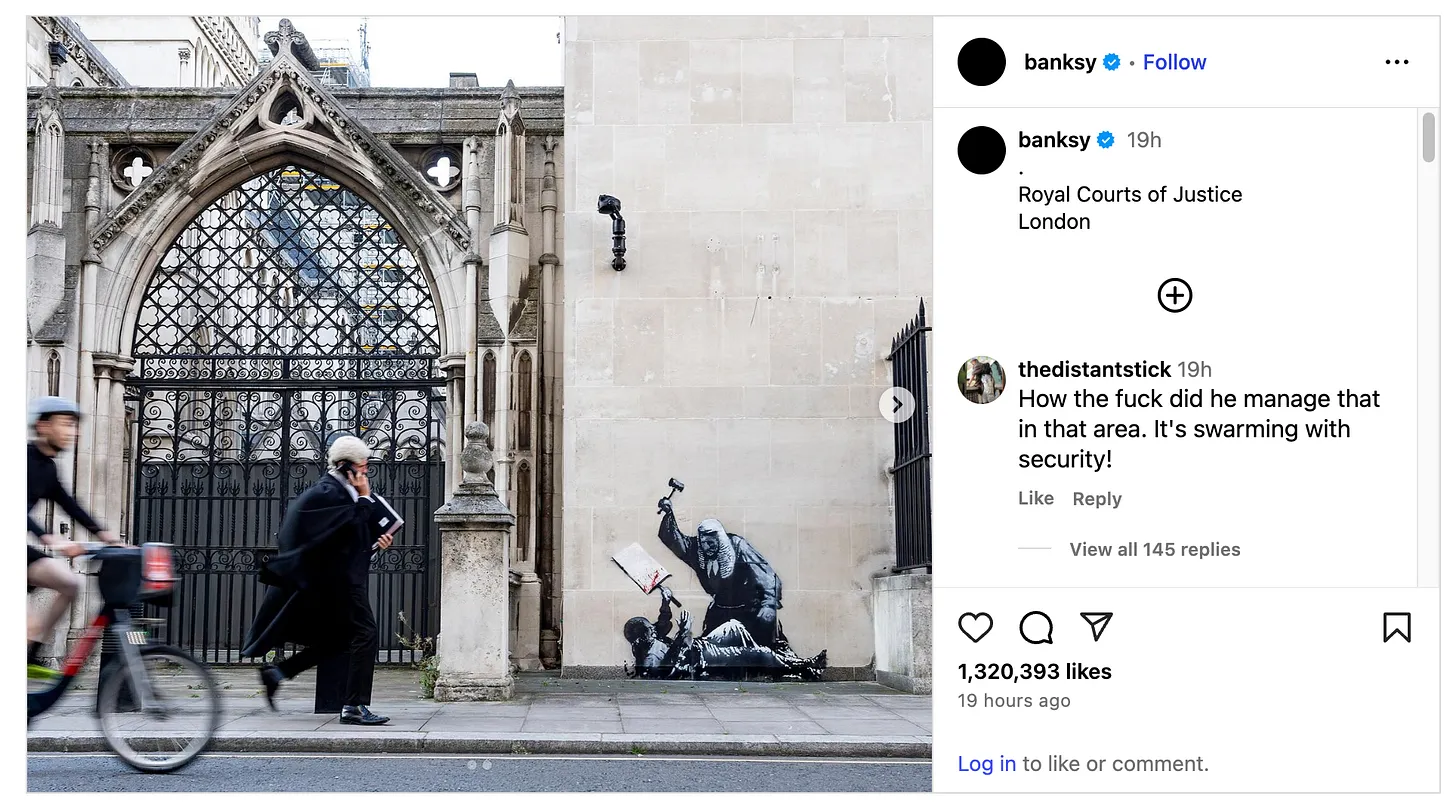
This was, of course, this mural by Banksy:

Aesthetically it is no worse than the depictions of judges and justice inside the RCJ.

But it was unauthorised and so, from a legal perspective, prima facie criminal damage.

And, as Joshua Rozenberg has spotted, the supposed barrister in the Banksy Instagram picture must be a model, given a mistake in their dress.

Furthermore, as 1001 respondents on social media pointed out in merry unison, the judge is using a gavel, and judges in our jurisdiction do not use gavels.

*

Indeed, much of the response to the new art had little or nothing to do with what it depicted.

As such, it maybe failed in its presumed purpose – of getting people to discuss the law of protest and protesting.

And even the depiction was perhaps wrong: judges are not to blame for the laws promoted by the executive and passed by parliament and implemented by the police and prosecuted by the Crown.

Indeed it is often the courts that are the last protection for protesters.

*

One amusing aspect of the incident is that the RCJ – to match its visual rhetoric – provides one of the most elaborate security theatres of any public building.

Security is not only done, but – oh dear gods – it is seen to be done.

And yet yards away from where the zealous performances of security take place, an artist was able to commit what the law would probably regard as criminal damage without interruption.

It was only when it came to public notice that anything was done about it.

The Guardian:

The BBC:

One news report stated that yesterday morning, “guards were trying to stop people from taking pictures. More staff then arrived with supplies to cover it up”.

*

Another amusing aspect to this is that the RCJ itself is where an intellectual property judge once wrestled with questions about the law relating to Banksy murals:

One wonders where any civil dispute or criminal appeal about this week’s mural would be heard, given a possible conflict of interest.

*

Criminal damage is wrong, and as this appears to be criminal damage then this makes this wrong.

Those embarrassed by the failure of the usual RCJ security theatre will no doubt press for an investigation and prosecution.

If there is a prosecution and a conviction then there will be no doubt that this was criminal damage.

But if there is a prosecution there may also be a defence, and an acquittal.

If so, the artist would be saved by the very court process they are depicting in the mural.

Which would be ironic, don’t you think.

***

Comments Policy

This blog enjoys a high standard of comments, many of which are better and more interesting than the posts.

Comments are welcome, but they are pre-moderated and comments will not be published if irksome, or if they risk derailing the discussion.

More on the comments policy is here.

What to know about court orders, injunctions, and super-injunctions

21st July 2025

A general introduction to the coercive powers of the court to order things, and what can be done with those powers

Imagine the polity of the United Kingdom as so many machines.

There is the machine of the Crown, and – from a legal perspective – what comes out are various legal instruments enforceable and/or recognised at law: proclamations, decrees, royal charters, royal warrants, privy council regulations, and so on.

Each instrument following a certain form and even ceremony, with certain ‘abracadabra’ magical wording, and the document exists at law.

And because that document is capable of making things happen, it is called an instrument.

*

There is then the machine of Parliament, and – again from a legal perspective, what comes out are Acts of Parliament.

In a technical way these are a subset of documents from the Crown machine, as an Act of Parliament is not enforceable and/or recognised at law unless it has Royal Assent. It is in this way just another legal instrument signed by the Crown.

But Acts of Parliament can have general, even universal effect, and so are in a category of their own.

Note that other things done by Parliament – such as passing motions and resolutions – do not normally have effect outside of the Palace of Westminster (if at all).

And so when one talks of the sovereignty (or more correctly the supremacy) of Parliament, one usually means the sovereignty (or supremacy) of Parliamentary legislation.

*

And then there is the judiciary machine.

To an onlooker (and indeed many lawyers) the outputs of the judiciary machine are the judgments and sentencing remarks. And indeed the reports of judgments and remarks are central to understanding laws and legal systems around the world.

But.

The main outputs of the judiciary machine are not judgments or sentencing remarks: they are at one or two steps removed.

The main outputs of the judiciary machine are Orders.

(There are other judicial outputs such as writs and summons and warrants.)

It is the Orders that have legal effect, that are enforceable and/or recognised at law.

Judgments and sentencing remarks are all very interesting and informative, but it is the Order that is the thing.

A judgment should explain why the court made one Order instead of another, why a case was disposed of in one way rather than another.

As such, judgments can be integral to understand what has gone with a case, but it is still the resultant Order that is the thing.

Orders are thereby for courts, what Acts are for Parliament, and charters and so on are for the Crown.

They are the things which come out of the judiciary machine, at least from a legal perspective.

*

Orders can take many forms, but the form of Order which comes up most often in the news is the injunction.

An injunction is – very generally – a court Order which tells a person to do a thing or not do a thing, on pain of it being punishable as a contempt of court.

The classic historical-legal theory is that an injunction is there so as to ensure a person acts in accordance with their conscience: to do or not do a thing they ought or ought not to do.

Injunctions usually are either ‘final’ or ‘interim’/’temporary’. The latter are often used by courts to ‘hold the ring’ until a legal matter can be finally disposed of by the court: to keep things in a virtual legal state of suspended animation for the time being.

The normal position is that an injunction can be imposed on a party to litigation.

Here [A] is suing [B] for say breach of contract or an intellectual property infringement, and [A] wants to stop [B] for causing any further damage until the trial.

(Sometimes it may turn out that [B] has been injuncted when [A]’s case does not succeed at trial, and in those situations [A] must make good the damage and costs caused to [B] complying with the injunction. As such injunctions can be double-edged legal weapons. In legal practice, injunctions are the sort of things you ‘don’t try at home’ and should be left to the professionals. Injunctions can cut in unexpected and painful ways.)

Sometimes a party will want a permanent, final injunction – but generally (at least in England) injunctions are a means to an end and the final remedy at court will usually be damages.

A party breaching the injunction faces punishment (and there is a legal debate whether such punishments are criminal as such) which can include imprisonment.

A person guilty of contempt will then be expected – to use a quite lovely legal word – to ‘purge’ their contempt.

*

Injunctions, however, may not only be against a party to legal case.

They can also be granted against third parties.

In England such injunctions are not at all unusual – and the courts have developed all sorts of freezing orders and search orders where third parties caught up in a situation can be obliged to comply with court orders.

Sometimes such injunctions can be made against persons unknown (for example trespassers) or even ‘contra mundum’ (against the world).

Obviously there is practical difficulty in showing a person is aware of such an order, and the normal position is that a person is not bound by an Order unless they have (or should be expected to have) notice of the Order.

That is why injunction notices are tied to fences or emailed to legal departments of newspapers, and so on.

The injunction in the recent Afghan case was applied by the government to be ‘contra mundum’ order:

As a subsequent judgment in the same case described:

If a person has notice of a contra mundum notice then they are as bound by it as any party to the litigation.

An affected third party can have protections built in to the Order – and can also apply to the court to have the Order amended or discharged. But in practical terms the third party has little choice but to comply.

*

There is a further way to super-charge an injunction, by giving it is a special super power (though this is rare for contra mundum injunctions).

A court can turn an injunction into…

…a super-injunction.

In a super-injunction it is a term of the Order that the existence of the Order itself cannot be disclosed.

In the recent Afghan data breach case, there was a super-injunction. A judge in the case described it as follows:

Originally the super-injunction in that case was not published with the raft of documents released last week.

But following a request from this blog, the Order was published.

The “super” element of the Order is at paragraphs 4(b) and (c):

A non “super” version would have 4(a) and no mention of 4(b) in the final sub-paragraph.

If you go to front page of that Order you will see the penal notice, to warn those of the dire consequences of any breach:

Such an Order is thereby not to be taken lightly, and they are not taken lightly by any responsible person.

Super-injunctions were briefly common about 2010 as a means of protecting the claimant when they were suing for the then new tort of misuse of private information, but media and political controversy meant that the courts moved away from granting them.

*

The Afghan data breach case injunction was both a contra mundum injunction *and* a super-injunction.

As such it was an exotic legal creature, the sort which are sometimes speculated about, but rarely spotted in reality.

But even if they are exceptional the components are straightforward:

(1) it was an interim injunction that

(2) was addressed to anyone who had notice of it which

(3) had as one of its terms that the injunction should not be revealed beyond those who had notice of it.

Such injunctions can exist – and some would say that they have their place in exceptional situations.

But one question is whether it was appropriately granted in this situation – and, if so, whether its terms should have been discharged or varied sooner.

And another question is whether in this situation such an injunction stymied legitimate public knowledge and political/media scrutiny of the government by parliament.

For sometimes even the judiciary machine fails to function properly.

**

Comments Policy

This blog enjoys a high standard of comments, many of which are better and more interesting than the posts.

Comments are welcome, but they are pre-moderated and comments will not be published if irksome, or if they risk derailing the discussion.

More on the comments policy is here.

Afghan super-injunction now published

17th July 2025

Court order now in public domain following request from this blog

Yesterday this blog set out that the key super-injunction court Order had not actually been published among the raft of legal materials published a couple of days ago.

It was averred that this was an odd omission.

Following my request to the UK judiciary office, the court Order (with redactions) has now been published.


**

Comments Policy

This blog enjoys a high standard of comments, many of which are better and more interesting than the posts.

Comments are welcome, but they are pre-moderated and comments will not be published if irksome, or if they risk derailing the discussion.

More on the comments policy is here.