SLAPP and English courts – some preliminary issues

21st March 2022

SLAPP – strategic litigation against public participation – is a new-ish name for an age-old problem.

Here is L. Ron Hubbard in 1955 advocating law suits against those who were using Scientology materials without authorisation:

“The purpose of the suit is to harass and discourage rather than to win. The law can be used very easily to harass, and enough harassment on somebody who is simply on the thin edge anyway, well knowing that he is not authorized, will generally be sufficient to cause his professional decease. If possible, of course, ruin him utterly”

(The Scientologist: a Manual on the Dissemination of Material, page 157)

*

SLAPP is, of course, a pejorative term (as this blog recently averred) – but, for want of a better term, is the best name we have got for a certain thing.

The problem with SLAPP being a pejorative term is that, just as one person’s terrorist can be another person’s freedom fighter, one person’s SLAPP case is another person’s legitimate attempt to defend their reputation and/or privacy rights.

Few if any claimants will say expressly that their case is a SLAPP case – not many are as brazen as L. Ron Hubbard.

And it is possible that what one side considers to be a SLAPP case will genuinely not be considered to be a SLAPP case by the other side.

That said, SLAPP as a term has two useful qualities.

First, it is not limited to any one area of law – for example defamation – and so it implicitly recognises that various areas of law can be (mis)used – not only defamation but also misuse of private information, data protection, confidentiality, intellectual property rights, and so on.

Second, it indicates that certain decisions are being made strategically – or at least, tactically (though TLASS is a less handy acronym) – about the purpose to which law is being used.

Another problem, however, with SLAPP as a term is that its American origins may mislead people into thinking all anti-SLAPP legislation is the same.

In fact, much of what constitutes anti-SLAPP reform in the United States is already part of English law, including the ready availability of costs sanctions and early opportunities for meritless cases to be struck out.

There is no single anti-SLAPP reform that fits all jurisdictions.

So as long as the strengths and weaknesses of SLAPP as a term are borne in mind, it is the best description we have got of a certain thing.

*

But – what is that thing?

Well.

One thing it usually is not about is the law or procedural rules being broken by lawyers or their clients.

In almost all SLAPP cases, the lawyers are using the laws and court procedures available to them: the issue is the ulterior purpose to which those laws and court procedures is being put.

This is why, in my view, attempts to ‘name and shame’ the lawyers involved are misconceived.

(Though, for completeness, I know and deal with many of those who are involved.)

The lawyers that have so far been publicly named are but a sub-set of the lawyers competent and willing to take on such claims.

And – frankly – you do not need parliamentary privilege to ‘name and shame’ the lawyers: all you need to do is look at the case reports to see who they are, and at their own websites to see how they promote their practices.

I happen to be a media defence lawyer (among other things) – acting for journalists, campaigners, and politicians – and I chose not to act for claimants in these sort of cases, but that is entirely a personal choice.

In my experience of seeing dozens of threatening letters (of varying quality), almost all the threats are within the scope of law and practice as it stands.

And if a threatening letter did not come from one firm, I can imagine pretty much the same sort of letter coming from a dozen other firms.

The problem is with the law and practice, and so – if you sincerely want to solve the problem – that is where the solution will be.

Although therapeutic, ‘naming and shaming’ the lawyers involved is a cul-de-sac.

*

Another thing to note is that, in England, SLAPP is not just about costs – even if the amounts involved can be eye-watering.

Yes, London claimant lawyers are expensive – too expensive.

But: American lawyers are expensive too, sometimes even more expensive than English lawyers.

Media lawyers in other jurisdictions are also high-charging and highly paid.

Yet, it is in England that certain cases are brought – and threatened.

This is because the problem with SLAPP cases in London is not just the costs, but how those costs can be easily weaponised as part of of a legal threat.

London litigation is often not a game of thrones, but a game of costs.

The dynamics of many cases will come down to costs, and how costs consequences can be inflicted and deflected.

And how this happens comes down to the structure and practice of the relevant law.

*

But perhaps the biggest difficulty about discussing SLAPP in England is that the discussion can sometimes seem abstract.

SLAPP is a bad thing, and nice people are against bad things.

Let’s boo at SLAPP!

But the challenge is to make any SLAPP reform work practically – to make a difference in actual cases.

There are a number of ways law and practice can be misused, and so any reform needs to be set against actual cases to see if the reform would make any practical difference.

One thing I recall from the campaign which led to the Defamation Act 2013 is that the key case for mobilising support – the misconceived and illiberal claim brought by the British Chiropractic Association against science writer Simon Singh – turned out not to be directly relevant to the legislation that was then passed.

Little in that Act would stop another such case being brought again – and indeed it was the court’s own decision in that case, and not any legislation, that has stopped further similar claims.

There can be a practical disconnect between cases that attract public concerns and the reforms then promoted for dealing with such concerns.

That is why this blog is going to look over the next few days at a ‘data-set’ of SLAPP cases, to see what the actual problems are and to see what, if any, solutions can be put in place to stop similar cases being threatened and brought.

*

In the meantime, I would suggest anyone interested in SLAPP, and what practical reforms can be implemented to prevent such cases, look at the following:-

– the transcript of the oral evidence at the foreign affairs select committee on the use of strategic lawsuits against public participation (or watch it here);

the excellent and comprehensive work by Susan Coughtrie and the Foreign Policy Centre on SLAPPS – including this policy paper;

– this House of Commons library briefing on SLAPP; and

– the UK government’s recent call for evidence on SLAPP.

**

Thank you for reading – these free-to-read law and policy posts take time and opportunity cost to put together, as do the comments to moderate.

So for more posts like this – both for the benefit of you and for the benefit of others – please do support through the Paypal box above, or become a Patreon subscriber.

***

Comments Policy

This blog enjoys a high standard of comments, many of which are better and more interesting than the posts.

Comments are welcome, but they are pre-moderated and comments will not be published if irksome.

For more on this blog’s Comments Policy see this page.
The Ministry of Justice needs leadership – but we are served scorecards

25th October 2021

Another weekend gone, and another proposed ministry of justice policy reported in the Sunday press.

The last one, if you recall, came from an interview given by the new justice secretary and Lord Chancellor (and deputy prime minister) Dominic Raab to the political editor of the Sunday Telegraph.

There he spoke of a ‘mechanism’ for ministers to ‘correct’ judgments which they happened to disagree with.

And not just any judgments, of course, but those where the courts had found that the state had interfered with fundamental rights and freedoms.

One would have thought that, if the effect of such judgments needed to be overturned, this would be a matter for parliament.

But no: ministers should be able to do this, it would seem, at a whim.

As this blog averred, the fact that such a thing was his ministerial priority when the criminal justice system is in crisis was enough to make any sensible person weep.

*

We now have another proposal, given to another political editor at another Sunday paper (though this was not an on-the-record interview but from a ‘source’, so it may have come from special advisors as opposed to from the justice secretary directly).

Scorecards.

This new proposal is as follows:

– Raab ‘wants people to be able to look up their local court online and check how quickly cases are dealt with’;

– the new national register ‘will give scores on the speed cases go through the system, and on the ‘quality’ of justice served, measured by the percentage of guilty pleas before cases come to court, as well as the number of cases rearranged because of problems with the prosecution’;

– the register will also score ‘victim engagement’, described as ‘how many crime victims give up and drop out of the process’

– the justice secretary has said ‘he wants ‘granular data’ on how courts are performing across the justice system’;

– the scorecards will be ‘introduced by the end of this year and data will be updated twice a year to monitor progress’; and

– it ‘is understood the Justice Secretary is keen on introducing scorecards on a regional level, so that in future members of the public would be able to look at the performance of local courts’.

*

One response to this proposal is to point out (which the ministry of justice ‘source’ either did not know or kept hidden) that much of this data is already published.

That statement of the should-be obvious fell to the main opposition spokesperson on justice:

*

And Lammy is right in another respect: the intention between this policy seems not for data to be published, but for court users to be misdirected.

The notion appears to be that court users will use the scorecards to put pressure on courts to perform better, and for courts to feel under pressure to show court users that they are performing better.

Court users will thereby be (mis-)directed into thinking that poor court performance is a matter for the individual courts.

But.

The problem about the court system is not micro, but macro.

The system is structurally under-resourced, and it needs leadership.

*

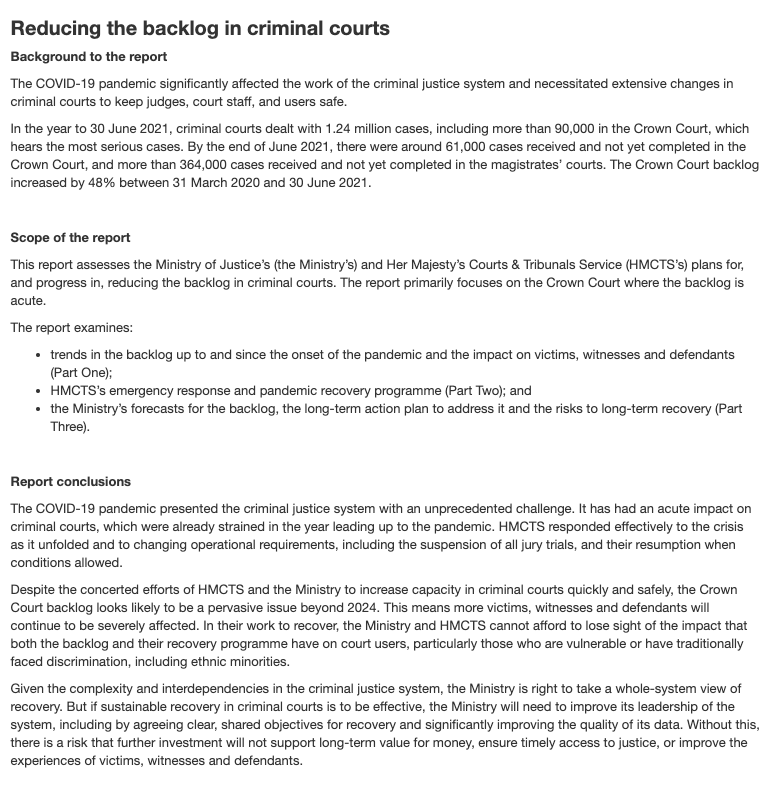
Here, let us turn our attention from the Sunday press to the National Audit Office:

The NAO published a major report just before the weekend.

The NAO did not propose scorecards.

Instead the NAO said: “if sustainable recovery in criminal courts is to be effective, the Ministry will need to improve its leadership of the system”.

Leadership.

Yes, the NAO used the ‘L’ word: Leadership.

But instead of leadership and solid policy, we get another weekend-special gimmick.

And not only just a gimmick – but one which appears to have the intention of misdirecting court users.

*

As this blog has previously averred: it does not have to be like this.

The justice secretary is a senior cabinet minister with the title ‘deputy prime minister’, as well as an experienced lawyer.

As such he is better placed than most recent justice secretaries to obtain better funding from the treasury, and to win the prize of serious reform.

But yet another weekend goes by where we are served trivial trinkets, instead of such a prize.

It is still enough to make any sensible person weep.

******

This blog needs your help to continue – each free-to-read post takes time and opportunity cost.

This law and policy blog provides a daily post commenting on and contextualising topical law and policy matters.

If you value this free-to-read and independent legal and policy commentary – for the you and for the benefit of others – please do support through the Paypal box above, or become a Patreon subscriber.

*****

You can also have each post sent by email by filling in the subscription box above (on an internet browser) or on a pulldown list (on mobile).

******

Comments Policy

This blog enjoys a high standard of comments, many of which are better and more interesting than the posts.

Comments are welcome, but they are pre-moderated.

Comments will not be published if irksome.

Lord Chancellor, there is already a mechanism for the law to be changed: it is called Parliament

18th October 2021

Usually when something daft about policy is reported in the Sunday papers, you can sort-of work out the chain of miscommunication.

For example: minister to ‘special adviser’ to time-poor reporter on a background (and thereby to be re-worded) basis.

There is little wonder that the final report is often, well, inexact.

But.

In yesterday’s Telegraph, there was a report based on an on-the-record interview with Dominic Raab, the new lord chancellor and justice secretary.

And as an on-the-record interview, the usual disclaimers do not apply.

This would be what the minister actually said (or a close approximation).

News reporters can be guilty of many sins, but they rarely make up direct statements, and still less quotations.

And the lord chancellor and justice secretary is reported to have said something very striking indeed:

‘Asked about his plans to reform the Human Rights Act, Mr Raab revealed that he is devising a “mechanism” to allow the Government to introduce ad hoc legislation to “correct” court judgments that ministers believe are “incorrect”.’

The scare-quotes are lovely – but they do indicate these are the words that Raab actually used, as opposed to the rest which may be paraphrased.

Just read that statement again.

And think about it.

*

First: it is not for ministers to change the law on the basis of what they think are ‘correct’ or ‘incorrect’ court judgments.

This is about as basic a breach of the separation of powers as one can imagine.

Just as judges should not make policy decisions instead of ministers, ministers should not make judicial decisions instead of judges.

If a minister disagrees with a judgment then that is one thing – but it is not for the minister to gainsay the judge on the correctness of the law.

*

But that is not even the strangest thing about the statement.

Raab wants to devise ‘mechanism’ for ministers to make these ‘corrections’ – and not parliament.

But it should be parliament, operating under the doctrine of parliamentary supremacy, that should make or unmake any law in these circumstances – and by the means of primary legislation.

What Raab is proposing is a separate ‘mechanism’ where (a) laws can be made or unmade by ministerial decision and (b) that decision will be based on a minister subjectively thinking that a judicial determination is ‘incorrect’.

And note: this is not just for any old laws.

Oh no.

This is for those laws where a court – usually a senior and experienced judge or panel of judges – has found that there has been a breach of fundamental rights.

If any legal ‘corrections’ should not be done in a fast-track way, without parliamentary involvement and on the basis of mere ministerial opinion, then it should not be where a court has found there to be breaches of fundamental rights.

*

In essence, what the lord chancellor and justice secretary is actually proposing is that a minister can by executive fiat reverse a judgment on the basis of a subjective opinion about ‘correctness’ when a court has found there to be a breach of a fundamental right.

Think about that.

And who is proposing this?

The very cabinet minister who has a constitutional role, recognised in statute, of protecting the rule of law.

Maybe the minister was misquoted or misunderstood, but there has not been any correction or clarification of the Sunday press report.

So presumably Raab is therefore happy with how he has been reported.

But.

There is already a mechanism where the other elements of the state can respond to such (perceived) judicial over-reaches.

It is called parliament.

And it is for parliament to decide how to respond – and to do by primary legislation.

And not ministers.

***

Or in the words of the the government’s former chief lawyer:


****

Please help this daily law and policy blog continue.

If you value this free-to-read and independent legal and policy commentary – for the you and for the benefit of others – please do support through the Paypal box above, or become a Patreon subscriber.

Each post takes time, effort, and opportunity cost.

Suggested donation of £1 upwards for each useful post, or of £5 upwards on a monthly profile.

This law and policy blog provides a daily post commenting on and contextualising topical law and policy matters.

*****

You can also have each post sent by email by filling in the subscription box above (on an internet browser) or on a pulldown list (on mobile).

******

Comments Policy

This blog enjoys a high standard of comments, many of which are better and more interesting than the posts.

Comments are welcome, but they are pre-moderated.

Comments will not be published if irksome.

When the justice system is in crisis, Dominic Raab should not be using finite ministerial time and scarce departmental resources to attack the Human Rights Act

17th October 2021

Sunday again, and another Sunday press piece about how the new justice secretary and lord chancellor Dominic Raab will do something-or-other against the Human Rights Act.

The criminal justice system in England and Wales is in crisis.

The ‘crisis’ word is not used easily: but we do have a serious situation the outcome of which is not certain.

Trials are now not taking place for years after the alleged offences; there are not enough courts or enough lawyers for hearings to take place; victims, witnesses and defendants (some of whom will, of course, be innocent) have the stress of delays and uncertainty as an everyday factor in their lives.

One would think sorting out this predicament would be the priority – perhaps the absolute priority – for the incoming justice secretary and lord chancellor.

On the face of it he is in the strong position.

He is deputy prime minister, and so he has a strong position in cabinet and is well-placed to take on the treasury for more funding.

He is a qualified lawyer with actual experience of practice, and so has the potential insight of knowing how law works in practice rather than just as a thing in the news.

He could – as this blog averred recently – become one of the great modern lord chancellors.

*

The ministry of justice is not a big department in Whitehall terms, and it is has little purchase on the parliamentary timetable.

A bill to ‘overhaul’ the Human Rights Act will be instead of ministry of justice legislation on more practical (and pressing) concerns.

Civil servants and ministers working on Human Rights Act ‘overhaul’ are necessarily doing that instead of something more useful.

Resources being used for Human Rights Act ‘overhaul’ are also necessarily diverted from something more useful.

And not since the days of Mackay, Irvine, Falconer and Clarke have we had a lord chancellor in such a strong political position within cabinet and with the prime minister.

Think of the good that this deputy prime minister could do for the justice system as a whole.

Think of it.

And now remember that this lord chancellor’s priority is contriving a fight with ‘Europe’ in respect of a symbolic assault on the Human Rights Act.

The sheer triviality of these relative priorities is enough to make sensible people weep.

*****

Please help this daily law and policy blog continue.

If you value this free-to-read and independent legal and policy commentary – for the you and for the benefit of others – please do support through the Paypal box above, or become a Patreon subscriber.

Each post takes time, effort, and opportunity cost.

Suggested donation of £1 upwards for each useful post, or of £5 upwards on a monthly profile.

This law and policy blog provides a daily post commenting on and contextualising topical law and policy matters.

*****

You can also have each post sent by email by filling in the subscription box above (on an internet browser) or on a pulldown list (on mobile).

*****

Comments Policy

This blog enjoys a high standard of comments, many of which are better and more interesting than the posts.

Comments are welcome, but they are pre-moderated.

Comments will not be published if irksome.