
13th November 2021
Over at the Financial Times, there is an interesting and informative piece about the hereditary peers in the house of lords.
And the point of the article is compelling: they make no sense.
The hereditary peers, as with the bishops of the established church of just one(!) of the four home nations, have no place in the legislature.
The only possible plausible argument for their presence is that, at least, there are members of that chamber that do not own their place to patronage.
But that is not much of an argument.
The biggest problem about the house of lords is not so much that of personnel but of function.
And unless we work out the proper function of the upper chamber then there can be no consensus on how to replace the hereditary peers and English Anglican bishops and on how to reform the house more generally.
What is the house of lords for?
*
Some may aver that the chamber should have a representative function – perhaps of the home nations or the regions.
(This like the old notion that the house of lords was there to represent the agricultural/landed interests and church interests so as to balance the interests of those represented in the commons.)
Or its membership at least based on being elected by some different configuration than the house of commons.
Like the senate in the United States having two senators per state as opposed to the variable number of representatives per state in the other house of congress.
But this view raises the potential problem of rival mandates, with both houses claiming the legitimacy of the electorate.
In the United States that problem is avoided in part because of tradition, but also because the two houses have some different functions and are elected on separate cycles.
Such a balance would not be easy, at a stroke, to transplant into the United kingdom.
*
Far more important than any representative function is, in my view, to retain and improve the revising and scrutiny role.
Here the house of lords, despite its lack of democratic legitimacy, serves the public interest in legislation often being better than it otherwise would be.
Placing the house of lords on some sort of democratic basis would risk losing this valuable role.
But other than through the patronage of the prime minister and others, how should members of this upper house be appointed?
On one hand they need to have the experience, ability and independence to say ‘no’ to a government so as to force reconsideration (though not to veto completely).
On the other hand, they need to have some legitimacy in a democratic society, and so whoever appoints them must have some direct relationship with the electorate.
Indeed, it may even be that there cannot be any reform of the house of lords until there is prior reform of the over-mighty house of commons.
And that in turn may need electoral reform and so on in an almost innate political regression.
Where would you start?
*
So, back to the immediate question: how do we solve the problem of the house of lords?
There is no obvious solution – at least not one that does not risk losing what is valuable about a revising and scrutinising upper chamber.
And an unchecked house of commons is not an attractive prospect.
Like the crown, the constitutional significance of the house of lords may be not so much what powers it does have, but what powers it prevents others from having.
Getting rid of the hereditary peers and the bishops – although welcome – leaves the more general issue of what the house of lords is for unsolved.
Perhaps there is no practical and immediate solution.
And that is why in 2021 – 110 years after the temporary retention of peers in the 1911 Parliament Act – we still have this odd system.
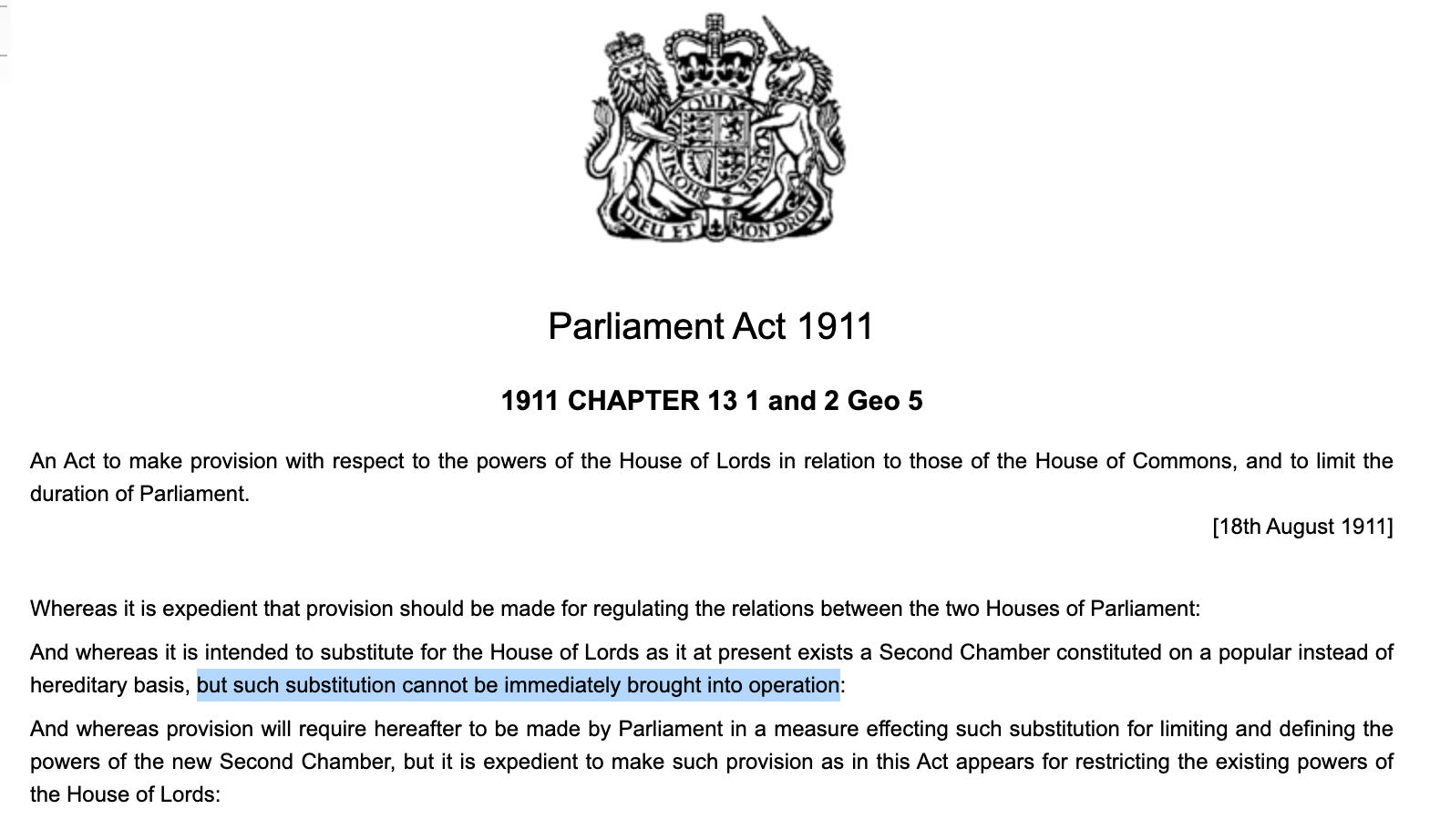
(Emphasis added.)
Perhaps in another 110 years we will have a solution.
Or perhaps not.
******
This daily law and policy blog needs your help to continue – for the benefit of you and other readers
Each free-to-read post takes time and opportunity cost.
This law and policy blog provides a daily post commenting on and contextualising topical law and policy matters.
If you value this free-to-read and independent legal and policy commentary – both for the you and for the benefit of others – please do support through the Paypal box above, or become a Patreon subscriber.
*****
You can also have each post sent by email by filling in the subscription box above (on an internet browser) or on a pulldown list (on mobile).
******
Comments Policy
This blog enjoys a high standard of comments, many of which are better and more interesting than the posts.
Comments are welcome, but they are pre-moderated.
Comments will not be published if irksome.


 The other report is not from a judge nor even from a practising lawyer, but from an endearingly obsessive non-practising barrister called
