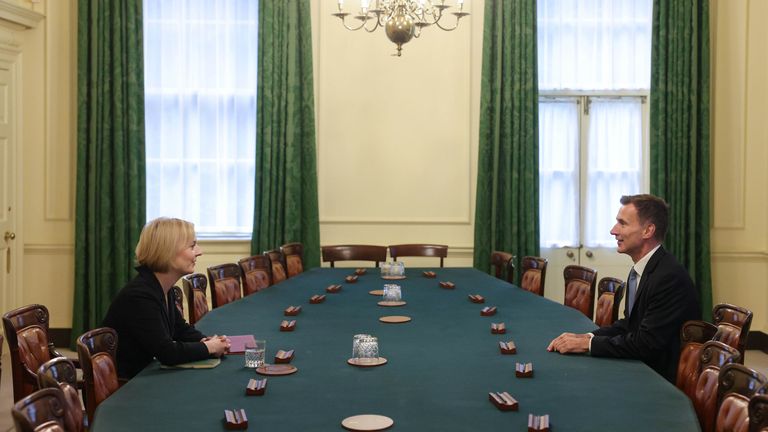
A modest proposal for helping the Prime Minister “keep on top of government” and “to push priorities”

3rd July 2023

Over on Twitter, the estimable Dr Cath Haddon is live-tweeting a talk from a former cabinet minister to the Institute of Government:

Here is an idea for a Prime Minister to have something to help him or her keep on top of what is going on in government and to push priorities.

The Prime Minister should form a committee of, say, about twenty-two individuals, each responsible for a specific government department or public function.

Those on this committee should report directly to the Prime Minister.

And the Prime Minister should be able to appoint and replace members of this committee as he or she chooses.

This committee should meet at least a couple of times a week – and this meeting should be at Downing Street chaired by the Prime Minister.

There can also be sub-committees dealing with matters where more than one government department is concerned – and these sub-committees can also be chaired by the Prime Minister or their designate.

So as to ensure that priorities are pushed – and as politics should be the language of priorities as one politician once said – these appointees should be politicians not officials.

And appointing members of parliament to this committee would also mean that the Prime Minister would have a useful direct line to what is said about the departments in parliament.

Meetings of this committee should also be attended by the head of the civil service, so that he or she can be part of the discussions and to provide advice and practical insight.

The deliberations should be confidential so that discussions can be frank and not leaked.

And there should be collective responsibility for those on the committee, so that there is a single overall direction to the course of the government.

Those on this committee should also be paid a substantial amount in addition to their parliamentary salary so as to recognise the additional work and to attract the brightest and best.

Such a model would, at a stroke, keep a Prime Minister on top of what is going on in government and for priorities to be pushed across government.

And this is the important thing…

…if a Prime Minister cannot effectively use such a committee to keep on top of what is going on in government and to push priorities, then no “Prime Minister’s Department” is going to be of any greater help.

*

The only thing left is what to call this committee.

**

Pic source.

***

Comments Policy

This blog enjoys a high standard of comments, many of which are better and more interesting than the posts.

Comments are welcome, but they are pre-moderated and comments will not be published if irksome, or if they risk derailing the discussion.

More on the comments policy is here.

Why the United Kingdom government cannot leave the ECHR without either breaching or re-negotiating the Good Friday Agreement

1st July 2023

*

The overlooked obstacle to the United Kingdom withdrawing from the ECHR

*

From time to time the demand comes from a government minister, or from one of their political and media supporters, for the United Kingdom to leave the European Convention of Human Rights.

This short blogpost sets out the most obvious obstacle for the government in doing this.

The obstacle – if that is the correct word – is the Good Friday Agreement.

*

That thirty-six page document – which is not as read as widely as it should be – contains a number of express provisions in respect of the ECHR:

“The British Government will complete incorporation into Northern Ireland law of the European Convention on Human Rights (ECHR), with direct access to the courts, and remedies for breach of the Convention, including power for the courts to overrule Assembly legislation on grounds of inconsistency.

[…]

“There will be safeguards to ensure that all sections of the community can participate and work together successfully in the operation of these institutions and that all sections of the community are protected, including:  […]

“(b) the European Convention on Human Rights (ECHR) and any Bill of Rights for Northern Ireland supplementing it, which neither the Assembly nor public bodies can infringe, together with a Human Rights Commission

[…]

“The Assembly will have authority to pass primary legislation for Northern Ireland in devolved areas, subject to: (a) the ECHR […]”

And so on.

*

The ECHR is not just mentioned in passing in a recital.

Instead the ECHR is integral to the Good Friday Agreement.

Rights under the ECHR that can be relied upon in Northern Ireland are a fundamental part of the agreement.

It was important to Ireland – and to the nationalist community – that there were rights beyond the reach of Westminster and Whitehall (and Stormont) that could be enforced directly against the state of the United Kingdom, including against the police and security services.

*

When this obstacle is pointed out, sometimes the response is “Aha! Why not just have the ECHR applicable in Northern Ireland?”

Of course, there is nothing in the Good Friday Agreement which expressly requires rights under the ECHR to be directly enforceable elsewhere in the United Kingdom.

But.

Article 1 of the ECHR provides:

It may thereby not be open to the United Kingdom to be a party to the ECHR and pick-and-choose who within its jurisdiction can have the benefit of the rights.

This would be in addition to the political issues about having a further legal “border down the Irish Sea”, which presumably would not be welcome to unionists.

*

Perhaps the government of the United Kingdom could seek to renegotiate the Good Friday Agreement?

This would mean Ireland agreeing that those – especially nationalists – in Northern Ireland should have their existing legal rights against the United Kingdom state removed.

It would also mean Ireland agreeing that it would not be able to take the United Kingdom to court in Strasbourg.

And it would also mean – in practice – the United States and the nationalist community agreeing that legal rights and protections are removed.

This is not at all realistic.

*

And the difficulty cannot be resolved by simply copying and pasting the Convention rights into a domestic statute for Northern Ireland.

For unless the rights are as constructed and interpreted by the Strasbourg court, and unless a disappointed party can petition the Strasbourg court directly, they are not “convention rights” – even if identically worded.

(This is partly why even Dominic Raab’s “Bill of Rights” that was to repeal the Human Rights Act had the convention rights in a schedule and a duty on public authorities to comply with those rights.)

*

Part of the difficulty of Brexit was because some did not know or did not care about the particular situation of Northern Ireland. Some also pretended it was not an issue, but as we now know it needed special care and attention – and it still has not been fully resolved.

Similarly those who believe just leaving the ECHR would be easy may again be overlooking the Irish and Northern Irish dimensions.

And unless the Good Friday Agreement is re-negotiated, the United Kingdom leaving the ECHR would place the United Kingdom in breach in Good Friday Agreement.

Well, at least as long as Northern Ireland remains part of the United Kingdom.

And that would be another story.

*

This post is partly drawn from this earlier blogpost.

***

Comments Policy

This blog enjoys a high standard of comments, many of which are better and more interesting than the posts.

Comments are welcome, but they are pre-moderated and comments will not be published if irksome, or if they risk derailing the discussion.

More on the comments policy is here.

Is it, at last, time to say “good bye” to Thoburn and the idea of “constitutional statutes”?

 9th February 2023

Oh dear old Thoburn, what shall be done with you?

Thoburn, the mainstay of thousands of constitutional law essays and hundreds of learned articles, does yesterday’s Supreme Court decision mean you are now no more?

*

Thoburn is the 2002 “metric martyrs” case which introduced into the then quiet, sedate world of constitutional law the exciting concept of “constitutional statutes”.

Until then all Acts of Parliament were regarded as being equal, none of them any more entrenched – enshrined – than any other.

But in Thoburn the judge said, in effect, that there was a class of super-duper statutes known as “constitutional statutes” and these statutes had super-duper qualities not available to more mundane everyday statutes.

Incredible, if true.

And so Thoburn became the recent constitutional law case any student or informed pundit had to have an opinion about.

But yesterday’s Supreme Court decision on the Northern Irish Protocol may mean the dictum in Thoburn are no longer to be taken seriously.

What will law students and pundits do?

*

To understand what happened with the Thoburn case we have to go back to the Victorian doctrine of the supremacy of parliament.

This doctrine holds that no statute passed by the Crown-in-Parliament can be gainsaid by any court.

But in two case in the early 1930s about the Acquisition of Land (Assessment of Compensation) Act 1919 and the Housing Act 1925, the courts were presented with a situation where two statutes contradicted each other.

How should the courts deal with this situation?

The clever idea the courts came up with was “implied repeal” – and so the fiction adopted was that parliament in passing the later legislation knew about the earlier legislation, and so the (presumed) intent of parliament was to repeal the earlier legislation.

But as this repeal was not explicit in the later legislation, it would have to be an implicit repeal.

And this is how the interwar courts managed to disapply a piece of primary legislation, notwithstanding the heady doctrine of the supremacy of parliament.

(Of course, if no Act of parliament can actually be gainsaid by a court, then the courts should have just refused to choose between the two contradictory statutes and return the matter to Parliament to sort out – but the fig-leaf of the “intent” of parliament meant the courts could sort out the legislative mess parliament had created.)

And the legal rule from these case was that the later statute trumps – that is, implicitly repeals – the earlier statute when the two contradict.

*

But in 2002 the court was faced with another seemingly awkward situation.

It was submitted in that case that the Weights and Measures Act 1985 somehow implicitly repealed the earlier European Communities Act 1973.

On the merits of the case, the court found that this was not the position.

But in a dictum – which was not about the point on which the case turned – Lord Justice Laws (and please none of the usual jokes about nominative determinism) went on a judicial frolic and speculated about implied repeal.

Could a later Act of Parliament really implicitly repeal the European Communities Act 1973, which – in turn – was the (then) basis for the laws of the European Union having effect in the United Kingdom?

On the basis of the 1930s cases then this would have to be the position, as the later statute trumps the earlier statute.

But.

As we now know, repeal of the European Communities Act 1973 would be a very complicated and far-reaching thing.

And so Lord Justice Laws posited a new category of statutes which would be immune from any implied repeal.

If there were any contradictions with an earlier “constitutional statute” then it would be the later statute that would be repealed, not the earlier one.

His dictum was as follows (which I have broke out into one-sentence paragraphs):

We should recognise a hierarchy of Acts of Parliament: as it were “ordinary” statutes and “constitutional” statutes.

The two categories must be distinguished on a principled basis. In my opinion a constitutional statute is one which (a) conditions the legal relationship between citizen and State in some general, overarching manner, or (b) enlarges or diminishes the scope of what we would now regard as fundamental constitutional rights.

(a) and (b) are of necessity closely related: it is difficult to think of an instance of (a) that is not also an instance of (b).

The special status of constitutional statutes follows the special status of constitutional rights.

Examples are the [sic] Magna Carta, the Bill of Rights 1689, the Act of Union, the Reform Acts which distributed and enlarged the franchise, the HRA, the Scotland Act 1998 and the Government of Wales Act 1998.

The ECA clearly belongs in this family. It incorporated the whole corpus of substantive Community rights and obligations, and gave overriding domestic effect to the judicial and administrative machinery of Community law.

It may be there has never been a statute having such profound effects on so many dimensions of our daily lives.

The ECA is, by force of the common law, a constitutional statute.

*

This was exhilarating, provocative stuff.

And it was utter flapdoodle.

There was no basis for positing such “constitutional statutes” – either then or now.

They were invented just to get the courts out of the potentially tricky situation which the judges’ contrived solution to the problems in the 1930s had got themselves into.

The notion of “implied repeal” was now a reversible switch – and it was to be the judges who decided (and not parliament) whether it would be the earlier or the later legislation that would be “implicitly repealed” by the simple expedient of the judge perhaps dubbing one or the other of the Acts of Parliament a “constitutional statute”.

It was all rather daft, but you will see why it was like catnip to those with an interest in constitutional law.

*

Anyway, the Laws dictum was relied on by the applicants in the recent Allister litigation on the legality of the Northern Irish Protocol, which eventually reached the Supreme Court.

The Supreme Court decision in that case is fascinating and it warrants a post by itself, especially on respect of the developing jurisprudence of the court on devolution.

But the Supreme Court was unimpressed by the Thoburn point.

The court described the submission (again broken up into one-sentence paragraphs):

On the hearing of this appeal, the appellants submitted that the Acts of Union were constitutional statutes so that the rights in the trade limb of article VI of His Majesty’s subjects of Northern Ireland being on the same footing in respect of trade as His Majesty’s subjects of Great Britain, could not be subject to repeal or to subjugation, modification, or suspension absent express or specific words in a later statute.

In support of that submission, the appellants relied on a line of authorities starting with Thoburn v Sunderland City Council [2002] EWHC 195 (Admin)[2003] QB 151 for the proposition that whilst ordinary statutes may be impliedly repealed constitutional statutes may not.

At para 63 of Thoburn, Laws LJ suggested that the repeal of a constitutional statute or the abrogation of a fundamental right could only be effected by a later statute by:

“express words in the later statute, or by words so specific that the inference of an actual determination to effect the result contended for was irresistible.”

The appellants submitted that the Acts of Union are constitutional Acts and that the rights to equal footing as to trade were fundamental rights so that there was no scope for implied repeal and by analogy there was no scope for implied subjugation, modification, or suspension.

*

You will see that the Thoburn point has now been expanded beyond implied repeal and that “constitutional statutes” have various other super-duper legal protections.

The court held (again broken up into one-sentence paragraphs, and with my two comments interposed):

The debate as to whether article VI created fundamental rights in relation to trade, whether the Acts of Union are statutes of a constitutional character, whether the 2018 and 2020 Acts are also statutes of a constitutional character, and as to the correct interpretative approach when considering such statutes or any fundamental rights, is academic.

“Academic.”

Even if it is engaged in this case, the interpretative presumption that Parliament does not intend to violate fundamental rights cannot override the clearly expressed will of Parliament.

“Even if”

*

Allister is not about implied repeal, so strictly speaking the Laws dictum in Thoburn may be said to not be applicable.

But the notion of “constitutional statutes” is plainly not taken seriously by this unanimous Supreme Court in an important devolution case engaging what Laws would have called many “constitutional statutes” , with a panel consisting of justices from Northern Ireland, Scotland, and Wales, as well as the court’s leading public law justice, Lord Sales.

For the Supreme Court, the content of the Acts of Union have no special entrenched legal status, and they can be amended, and so on, just as any other Act of Parliament.

The question of what would happen with a direct contradiction, as in the early 1930s has been sidestepped.

But the expedient of “constitutional statutes” as suggested by Laws in Thoburn seems to have been put back in its judicial box.

Or has it?

No doubt there will now be thousands more constitutional law essays, and hundreds more learned articles, to tell us whether the dictum in Thoburn is no more.

****

Comments Policy

This blog enjoys a high standard of comments, many of which are better and more interesting than the posts.

Comments are welcome, but they are pre-moderated and comments will not be published if irksome, or if they risk derailing the discussion.

New Substack Essay: The 1610 case of Dr Bonham, and the question of whether parliament is really sovereign


22nd January 2023

The new essay at my Substack is up.

The essay is on the 1610 case of Dr Bonham, and the question of whether parliament is really sovereign:

These essays on legal history or law/lore are for paid subscribers, and they are additional to my weekday free-to-read topical commentary here on the law and policy blog.

Previous essays in this series are:

Malone (1979) – perhaps the most significant constitutional case of the last 50 years

Wednesbury (1948) – the origin of the modern principle of legal unreasonableness

*

These essays are cross-posted on Patreon for my Patreon supporters.

Anyone who made a Paypal donation to this blog in 2022, as well as Patreon supporters, can be given a one-year free complimentary subscription – just leave a message marked “PRIVATE” below.

It is important that nobody pays ‘twice’ for my content.

****

Comments Policy

This blog enjoys a high standard of comments, many of which are better and more interesting than the posts.

Comments are welcome, but they are pre-moderated and comments will not be published if irksome, or if they risk derailing the discussion.

ESSAY “A decision so unreasonable that no reasonable authority could have come to it”

15th January 2023

This is my essay this week at Substack.

The Wednesbury case of 1948 provides one of the most famous and influential judgments in English legal history.

Because of the case, the phrase “Wednesbury unreasonableness” has become well-known legal shorthand for decisions and rules made by public bodies that are so unreasonable that no reasonable public body could have made them.

Nearly two-and-a-half thousand cases on the BAILII public database use the phrase “Wednesbury unreasonable”.

Indeed, the one thing that many people outside the West Midlands know about Wednesbury is that it associated with this extreme legal standard.

But in the judgment, the town’s corporation was found not to be acting unreasonably – at least in the legal sense.

And the case was not even decided on the basis of reasonableness, but on the basis of normal statutory construction.

So how did the little town of Wednesbury get such legal infamy?

*

To read the rest, you can go over to my Substack and subscribe.

Every week I will write an essay on an aspect of legal history, or on the relationship between law and lore/popular culture, for those kind enough to subscribe to my Substack.  The essay will be posted on Friday/Saturday/Sunday.  I will even sometime use multi-sentence paragraphs, like this one.

Last week’s essay was on the Malone case of 1979, which I reckon to be the most significant constitutional case of the last fifty years.

The weekly essay is also cross-posted on my Patreon page for Patreon supporters.

For those of you who have kindly donated through Paypal in 2022, please leave a comment marked “Private” below, and I can give you a complementary one year subscription to Substack.

It is important that nobody pays “twice” for my content.

New Essay at Substack: Perhaps the most significant UK constitutional case of the last fifty years

6th January 2023

Over at my new law and lore Substack, I have published an essay for paying subscribers on how the Malone case of 1979-1985 exposed the lie of our supposedly liberal constitution and changed the way we were governed.

The essay starts as follows:

Consider this simple, attractive proposition: in the United Kingdom, you are free to do as you will, unless there is a law against it.

What could be wrong with such a nice proposition: it is almost a perfect articulation of principled liberalism.

But.

This proposition can have a hidden and ugly implication.

For it also can mean that the State can do as it wishes, to you and other people, unless there is a law against it.

And the case which exposed this unpleasant truth – and helped put an end to it, so that the State was required to have a legal basis for interfering with our lives – is the 1979-85 case of Malone.

This is the story of that case, and of its effects.

You can read the rest of the essay with a paid subscription here.

*

This essay is also being posted on Patreon for those who subscribe to this blog using that medium.

For those who subscribe and donate through either Patreon or PayPal, please leave a “PRIVATE” comment below confirming you want me to add your email address to the Substack system so you can have a one-year complementary subscription to the law and lore Substack.

It is important that nobody pays “twice” for my content.

The one big problem with House of Lords reform

22nd November 2022

As today is a palindrome day – 22/11/22 – here is another palindrome: 111.

One hundred and eleven.

That is, the number of years since this statute was passed:

And if you read the preamble above, you will see that Act was only intended to be temporary, until there was a second chamber constituted on a “popular” basis.

But one hundred and eleven years later, the House of Lords is still there.

For reform is easy to announce, but hard to accomplish.

And in the House of Lords there are still ninety-one hereditary peers – and even twenty-six bishops from the Church of England (which, remember, is the established church in only one of the four constituent nations of the United Kingdom).

There are also several hundred life peers, each of whom is the beneficiary of some sort of patronage, or closed selection process, and none of whom are elected or in any meaningful way politically accountable.

*

Of course, the House of Lords should be reformed or replaced.

Of course.

But how?

And here is a big problem about the House of Lords in our constitutional arrangements.

We need to first understand what a second chamber is for.

*

Any reform of, or replacement for, the House of Lords has to be carried by the government of the day with the support of the House of Commons.

And neither the government of the day nor the House of Commons will usually want to strengthen the power of a second chamber.

This means that any reform or replacement is likely to strengthen both the government or the House of Commons, or both.

You may be think that would be a good thing, and perhaps it is, but as it stands the House of Lords provides a check and and a balance to any government that commands the House of Commons.

*

The House of Lords cannot veto any legislation.

And the House of Lords will not (by convention) delay any legislation for which there is a mandate at a general election.

But for legislation which has been forced through the House of Commons with little or no scrutiny, the House of Lords currently provides an essential function, despite its lack of democratic legitimacy.

How can this function be maintained – even enhanced – with reform or replacement?

*

This problem is why any fundamental reform of, or replacement for, the House of Lords really needs to be complemented by fundamental reform of the House of Commons.

For, as it stands, the House of Lords currently saves the House of Commons – and government ministers – from themselves.

Repeatedly, routinely, almost daily.

*

Replacing life peers with elected politicians seeking re-election will removed the independence and expertise that provides the merit of the House of Lords.

Using some other basis of election – by regions or otherwise – may create a chamber with an equal claim to democratic legitimacy, thereby creating logjams, rather than revision.

As with the Crown, one useful feature of the House of Lords is not so much the power it has, but the power it prevents others in the polity from having.

So any serious discussion about reform or replacement should be preceded by anxious consideration of function and purpose: what is the House of Lords or new other chamber to do?

What is it actually for?

And then we should work backwards from that so as to see how it should be comprised.

By putting the question of composition before the question of function and purpose, one is perhaps putting the state coach before the horses.

*

It is to be welcomed that the Leader of the Opposition, who has a real chance of being Prime Minister after the next general election, is openly discussing doing something with the House of Lords.

The first term of a left-of-centre government is usually the only time we will ever get a programme of constitutional reform – for example in 1945-50 or 1997-2001.

There are certainly a number of smaller reforms which could be made, including excluding the bishops and remaining hereditary peers, and reducing the scope of patronage by existing and exiting prime ministers.

All easy, quick wins.

But anything more significant requires there to be a balancing exercise, between the new chamber and the House of Commons and the executive.

And that balancing exercise should not be rushed.

Though, of course, we should not have to wait another one hundred and eleven years.

***

Please subscribe to this blog – each post will then be delivered to you by email.

(This may be useful if and when Twitter is no more)

***

Please also sponsor this blog, if you can.

Posts like this take time and opportunity cost, and so for more posts like this – both for the benefit of you and for the benefit of others – please support through the Paypal box (above), or become a Patreon subscriber.

***

Comments Policy

This blog enjoys a high standard of comments, many of which are better and more interesting than the posts.

Comments are welcome, but they are pre-moderated and comments will not be published if irksome.

Hierarchies vs networks in the age of Musk and Mastodon

9th November 2022

Regular readers of this blog will know that central to my thinking about law, government and politics is the so-called Dunbar’s Number.

This number – which is about 125-150 for members of our species – is the number of individuals with which one can have meaningful relationships with at one time.

The implication of this number (in my view) for law, government and politics is that with any community or society larger in size than this number there will tend to be a limit on what can be done without shared rules and recognised commands and notions of status.

It is very difficult to be sustainably dominant merely on a face-to-face basis with large numbers of people.

One way of scaling upwards (and downwards) is by having hierarchies.

And with hierarchies we get the conceptual paraphernalia of lordship and kingship (and ladyship and queenship), with lower levels and higher levels.

But another way of scaling is more horizontal: networks and shared protocols.

Here certain signifiers and agreed rules and lore will mean that groups of people can interact.

What has made me think about this is the current contest between commercial social media platforms (like Facebook and Twitter) and the protocol-based Mastodon, of which I have become a great fan.

(And where I somehow now have 18,000 followers in just a few days.)

The commercial platforms are sometimes called “proprietary” because the software is owned by the corporation.

But they can also be regarded as “proprietary” by how they treat their users.

The new owner of Twitter, in particular, seems to see the users of Twitter as a standing asset to be exploited, by charging users for this or that.

The assumption seems to be that the users will stay and pay.

And the way the Twitter acquisition was structured and financed suggests that there has to be a high level of return very quickly.

Perhaps some users will stay and pay: but many will not.

And some will move to forms of social media where there is not one big corporation in charge, imposing its own standards (and whims), but lots of smaller platforms joined by optional or negotiated protocols.

If so, this will be nothing that new in human history.

Human activity often moves between from hierarchies and networks, and between cathedrals and bazaars.

Networks, of course, bring their own problems – especially when selflessness and self-restraint begin to fall away.

And corporations will tend to have better access to resources to finance and maintain the development of platforms.

But Elon Musk and others will not be the first to discover that the ways and means by which individuals will interact cannot easily controlled by those asserting and expecting dominance.

***

Comments Policy

This blog enjoys a high standard of comments, many of which are better and more interesting than the posts.

Comments are welcome, but they are pre-moderated and comments will not be published if irksome.

The comments policy is here.

So this is what happens when we do not have a functioning Prime Ministership

20th October 2022

I have been a constitutional geek since about 1987 – from the time of the conflicts about the “community charge” legislation and then Maastricht up to the Brexit showdowns in parliament and the Supreme Court.

But I have never seen political chaos like yesterday – which is carrying on into today.

On the face of it, it could seem nothing much happened: there was a parliamentary vote which the government won.

There was yet another cabinet resignation in a year packed with ministerial resignations, and a Downing Street aide was suspended.

All pretty normal in these not-normal political times.

But.

The details from yesterday were extraordinary: a confidence vote which was not a confidence vote; the opposition party almost taking control of the parliamentary timetable; a three-line whip for the governing party to vote against a manifesto commitment; a large backbench rebellion; a former minister not asking a question in parliament in return for a suspension of that aide; a reported standing row between the departing Home Secretary and the Prime Minister; reports of physical violence in the voting lobbies; a Prime Minister wandering almost-lost through the same lobby unable to properly register her vote; the Chief Whip and Deputy Chief Whip resigning and un-resigning, and then reportedly threatening to un-un-resign unless a statement was put out by Downing Street in the middle of the night (at 1.33am); and so on.

Even Wikipedia could not keep up:

*

Well.

All the drama from yesterday points to one thing.

There has been an absolute collapse of Prime Ministerial power.

The details from yesterday (and today) are effects, not causes.

They are the effects of there being an implosion in Downing Street, of there being a gap where a functioning Prime Ministership should be.

One way of reckoning the significance of a thing is to imagine what would happen if that thing did not exist.

But now we no longer have to imagine what would happen if we ceased to have a functioning Prime Ministership.

We can now see.

*

This is not – yet – a constitutional crisis.

It is certainly a political crisis – indeed, it is an exemplar of a political crisis.

And it certainly is a constitutional drama.

But not all political crisis tip into constitutional crises.

This is not a constitutional crisis – but unless Parliament and the Cabinet sort it it out, it well could do

The essence of politics is conflict – and it is the failure to resolve those conflicts that can trigger a crisis.

Parliament and the Cabinet now need to act – swiftly – to restore a functioning Prime Ministership.

Until and unless a functioning Prime Ministership is restored there will be an accumulation of more unfortunate and dramatic political details.

And there will be worse: because once a Prime Ministership fails, the government itself will tend to fail; and unless Parliament can check and balance that failure, then Parliament itself could be seen to fail.

*

Brace, brace – as this blog often says.

But alas that warning is too late for the Prime Ministership of Elizabeth Truss.

That has already crashed.

***

Thank you for reading – and please now help this blog continue providing free-to-read and independent commentary on constitutional matters and other law and policy topics.

Posts like this take time and opportunity cost, and so for more posts like this – both for the benefit of you and for the benefit of others – please support through the Paypal box above, or become a Patreon subscriber.

***

Comments Policy

This blog enjoys a high standard of comments, many of which are better and more interesting than the posts.

Comments are welcome, but they are pre-moderated and comments will not be published if irksome.

The comments policy is here.

A Prime Minister in Name Only

17th October 2022

For a good part of the history of Prime Ministers, the title of “Prime Minister” was informal.

Until the late nineteenth century it was not used in official documents and it was only in the twentieth century that, here and there, it began to leave a trace on the statute book.

It was a title that was used just to describe the most dominant minister of the day, the one who controlled the cabinet and had the confidence of parliament – usually the First Lord of the Treasury but sometimes not.

And if today one asked an alien looking down from space who was the Prime Minister of the United Kingdom, that alien would assume it was Jeremy Hunt.

*

Billy the Fish and the Green Baize Vampire

*

One of the features of our uncodified constitutional arrangements is that the power of the Prime Minister varies depending on individuals, events and politics.

The last three Prime Ministers before Truss all lost office between general elections and, as this blog has often pointed out, every Prime Minister since 1974 has either gained or left office between general elections (or, most recently, both).

But loss of office is not exactly the same as loss of power – our constitution is so flexible that not even loss of office is a requirement for losing power.

And what we have at the moment is power moving away from the nominal Prime Minister towards another figure in the Cabinet.

An allusion, in a playful way, to the distinction made by the greatest of  our constitutional commentators, Walter Bagehot, between the efficient and the dignified (or, here, undignified) elements of the constitution.

*

Many assume there will have to be a general election in the current circumstances – and there certainly should be.

But if the cabinet and the government majority in parliament can accept the current arrangements then there is no way forward to an early general election.

And in the meantime, and like the personal tax rate reduction, any influence whatsoever of Truss over policy is “delayed indefinitely”.

For it is Hunt who has control over policy and has the confidence of parliament – and of the markets.

We now have a Prime Minister in name only.

***

(Apologies to Billy the Fish and Billy the Kid and the Green Baize Vampire.)

***

Comments Policy

This blog enjoys a high standard of comments, many of which are better and more interesting than the posts.

Comments are welcome, but they are pre-moderated and comments will not be published if irksome.

The comments policy is here.